
"War and Peace" by Leo Tolstoy
A Reading Experience (Pt.1)

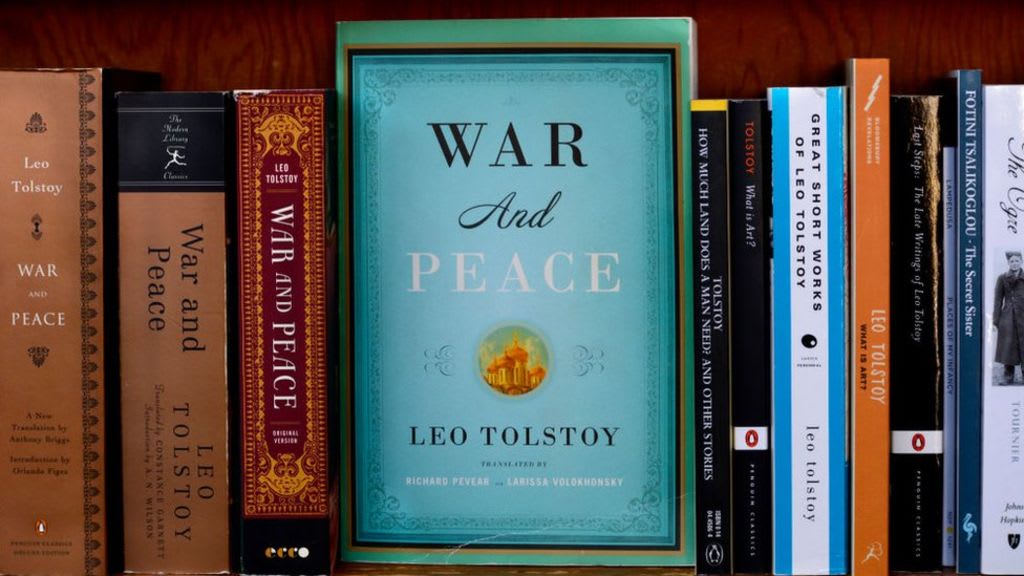
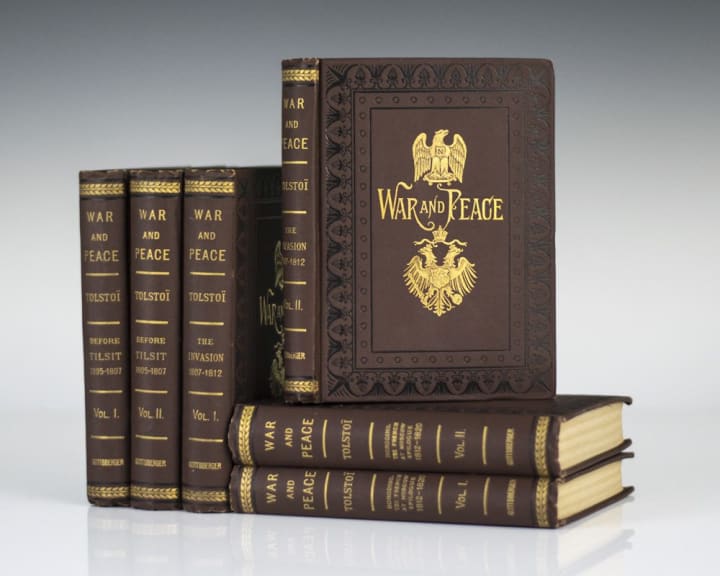
I first read “War and Peace” by Leo Tolstoy when I was fourteen years’ old. It took me a while because on hand, I would have a notebook in order to write down how characters were related to each other, words I would look up in the dictionary and concepts I didn’t really understand upon first reading - prompting me to read the book again. The way in which I discovered the book was through the school library. The school library had the book in volumes, but only volume 1-3 was available and so, I had to seek out a full version of the book myself. I had read the blurb to the first three volumes and was convinced that this, though a long read, was going to change my life forever. By the age of fifteen, I was re-reading the book in order to get a better grasp of the characters and concepts and I had noticed that this book had changed my entire opinion on how war impacts human beings. Back then, I understood bits and pieces about PTSD of course, but when it came to people who weren’t soldiers, but just regular people - I never knew that they too, could be that far done by war. It was like staring into the soul of a group of people who were constantly nervous that one day, they would have to pack up and leave everything behind. They would have to run away from the approaching army in order to spare their own lives. It is quite emotional really.
I noticed quite quickly that my favourite character in the book was Princess Maria, the sister of Prince Andrei. She is a religious and quiet woman whom I identified with quite a bit. Her language is firm but fair, her mannerisms are timid and somewhat overly emotional. She is nearly always a melancholy almost romantic character. I loved her because of the way she loved other people. When her brother returns home for the first time from war, she greets him and takes care of him. Even though her father is a bit of a brute and a hypocrite, she still cares for him though he shouts and screams at her. Maria has to endure so much and gets so little in return. Be that as it may, she still continues with her piety, her lifestyle of emotive melancholy and her attempts to soldier on through her life are not done in vain. The one thing though that makes Princess Maria so great is that she is one of the most robust characters in the book - even though a lot of the characters see her as emotionally weak and fragile. She is one of those characters that does not give in to any kind of pressure or any kind of push or shove against her. She will do as she is going to do, which always seems to work out for the best in comparison of what others want for her.
Princess Maria’s only fault I would say is her attitude towards her father. I find that she is far too compassionate towards him in comparison to the way he treats her. I think Maria would’ve been better off leaving him for a better life elsewhere. But, again, nobody knows what is best for Princess Maria like herself. She stays behind and cares for her father even though he is absolutely terrible towards her and outright insults her almost all of the time. I believe that in the book, Princess Maria represents the backbone of Russian Society. That they will not give in to Napoleon and his demands. But, be that as it may, they will also not sink to his level. She represents that there is a rigid, though calm and respected spine to Russia that people have yet to see flower and open up. It will do so when the time is right.
When I read the book for the second time, I noticed that the theme of death was quite interesting because it didn’t just deal with the deaths on the battlefield, but actually even more so, dealt with the deaths and sufferings back home. The book begins with the death of a father, which starts off an almighty row about birthright in the Bezukhov family. Pierre finally gets his inheritance and becomes the new count after his father’s death. The book also finishes with the death of a father in which the Count Rostov dies and then peace emits over the families and Pierre finally gets what he wants out of life, a proper marriage and a connection to his real friends - Natasha, Maria, Nikolai etc.
The death of the fathers at the beginning and the end mark the ‘war’ and the ‘peace’ outlines of the novel. When the first one dies, there is a certain ‘war’ between the families. The families fight about money, about marriage and who the correct person to marry their children off to really is. It turns out that the parents are not correct at all and by the time the second father dies, ‘peace’ is permitted by each one that is left finding what they really want out of their life and their marriage. So in terms of death, the deaths of the fathers are the most interesting things about the novel because it marks that now that the head of the family is gone, the pedestal is free but only to the men who are sure of their own lives. They must figure it out over the course of the book - Pierre especially. This theme really does change the way you read the book because at first, it seems like only a theme that really applies to the war. But when you take a closer look at the way the book is structured, you’ll find that it is structured around the deaths of characters. For example: only when Natasha loses everything can she see and have what she truly wants - Pierre. Natasha loses her father, her secret lover and her to-be-husband all the space of about a volume or so and this proves very difficult for her to deal with. Now that Pierre has returned and witnessed his own share of absolute anarchy - they have a common ground and have found peace within each other. They go from being great friends to marrying as a couple.
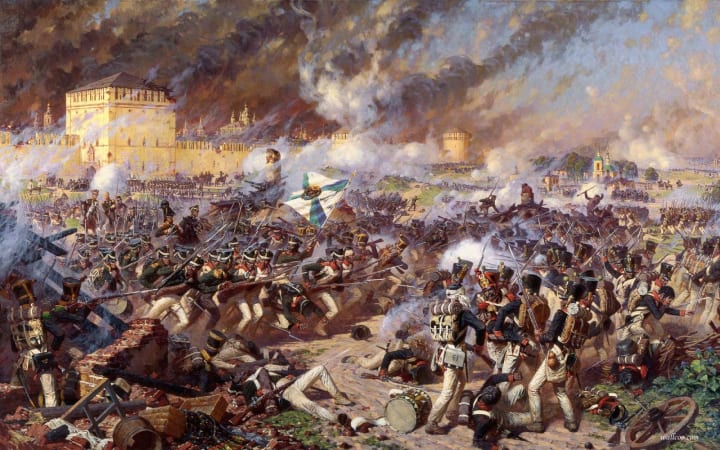
You have probably noticed that “War and Peace” by Leo Tolstoy is a book that means a lot to me. It’s a book all about how humans love each other and the lengths that humans will go to for the love of other humans. When someone says that they love “War and Peace”, people always think it is pretentious and snobby. In reality, if you take your own time with the book, it’s not actually very difficult to read. It’s just long. This book is special to me because it is one of those books where you can breathe in all the high society Russian atmosphere. You can breathe in the winter in 19th Century St. Petersburg, you can smell the gunfire from the battlefront, you can here the screams of the soldiers being blown apart and feel the hugs of the characters that fortunately, make it home. But you can also feel the intense grief over those that do not. This book made me fall in love with literature about human emotional tragedies, human connection and the requirement for love, companionship and hope. Authors like Javiar Marias, Margaret Mitchell, Colleen McCullough, Isabel Allende, Victor Hugo, James Baldwin and many more are only some of the authors I feel in love with due to my love for novels about human interaction, human emotion and the extremities of humans experiencing tragedy, loss, grief and still managing to find glimmers of hope in their lives. It is truly a beautiful thing. I may not re-read “War and Peace” that much and have only done so on a handful of occasions, every time it does happen I like to look out for which characters find hope at times of grief. It is these characters that go on to find strength in times of tragedy. These characters prove to be the strongest when consoling others as well - it shows their will to survive and their emotional maturity. Mostly though, this is Princess Maria.
In conclusion, I would like to recommend you read “War and Peace” by Leo Tolstoy and I don’t care whether it takes you three days or three years - I think that you should not have to miss out on one brilliantly written and meticulously planned novel. The intensity of emotion in this book is among the likes we have never seen elsewhere. And it is still read widely by people today even though there are many people who shrug it off, or some lie about having read it. The reason many people read it today is because of the emotional portrayals in the book. Not only does it teach us how to find hope in times of deep grief, but it also teaches us that no matter whether the world is shattering around us - there is still something to look forward to. There is still something good to come out of life even though the lives of others are breaking down and new worlds are opening up before us. In my next re-read of this book, I will hopefully learn more about the characters who I find are the most tragic: Anatole, Helene, in some aspects Prince Andrei and finally, the doomed Petya. So what are you waiting for? Start this brilliant novel now and we can meet each other someday at the end when we have both experienced a range of over 1000 emotions in the space of only one book.
“The whole world is divided for me into two parts: one is she, and there is all happiness, hope, light; the other is where she is not, and there is dejection and darkness...”
"War and Peace" by Leo Tolstoy
About the Creator
Annie Kapur
I am:
🙋🏽♀️ Annie
📚 Avid Reader
📝 Reviewer and Commentator
🎓 Post-Grad Millennial (M.A)
***
I have:
📖 280K+ reads on Vocal
🫶🏼 Love for reading & research
🦋/X @AnnieWithBooks
***
🏡 UK
Keep reading
More stories from Annie Kapur and writers in Geeks and other communities.
On This Day: 1st Academy Awards Ceremony
On this day in May, 1929 at the Hollywood Roosevelt Hotel, LA, California - the very first Oscars Ceremony was underway. A private dinner held by the then president of AMPAS, Douglas Fairbanks and ticket costs were $5 (which is around $74-75 in today's money considering inflation). Around 270 people took their seats to watch and the ceremony itself lasted just 15 minutes. The ceremony was neither broadcast on radio of TV with the idea of the radio broadcast coming in by the following year's awards show. There were 12 awards and the winners were announced some months before the event of the dinner itself. There were only 36 banquet tables required on the night.
By Annie Kapur6 years ago in Geeks
Silver Screen Magic with Mae West
American actress and singer Mae West became a popular film actress during the Great Depression. She started entertaining in vaudeville, then performed on Broadway, and finally went to Hollywood. She signed up with Paramount Pictures and made her debut in the 1932 film “Night After Night.” She also starred in musicals, comedies, and crime dramas. The American Film Institute named her one of the best classic Hollywood actresses.
By Rasma Raisters3 days ago in Geeks




Comments
There are no comments for this story
Be the first to respond and start the conversation.