
Visual Filmmaking in 'Materna'
How a sequence of visuals undermines the story and underlines the failures in David Gutnik's 'Materna.'

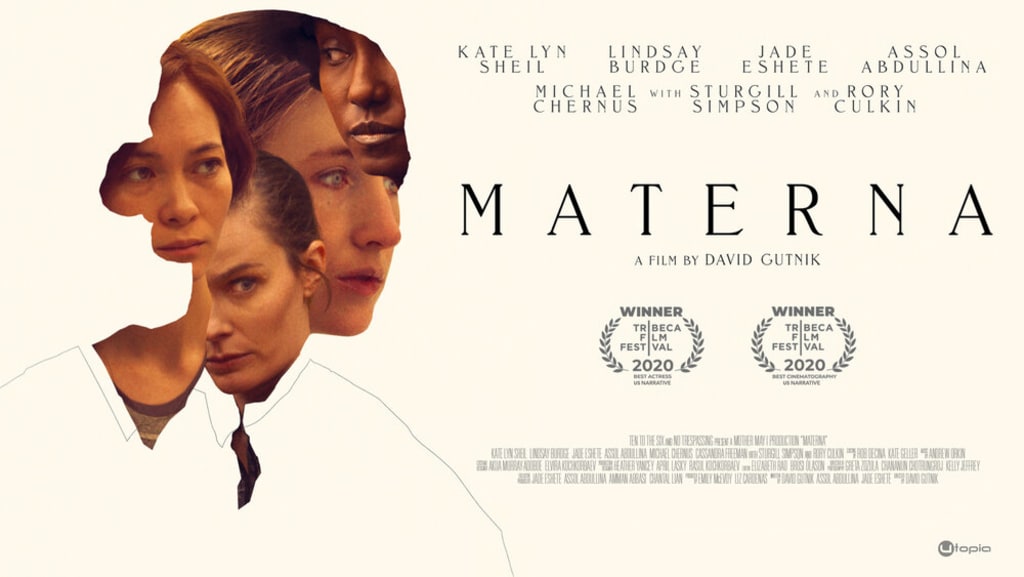
Visual film-making is tricky, it’s very easy to move an audience to the wrong conclusion by giving bad visual information. In this article I am going to explore the troubled visual film-making in the movie Materna from director David Gutnik and how the visual choices in play in the film’s opening story lead to puzzling conclusions that affect the rest of the film. The choices made during a sequence starring the brilliant Kate Lyn Sheil aren’t bad but as they exist in the story, and are stitched together in editing, they can lead to a conclusion that doesn’t fit with the rest of the movie.
To introduce Materna allow me a moment to set the plot. Four women are among a group of people who are aboard a New York City Subway car when a male passenger, played by Sturgill Simpson becomes belligerent and appears headed toward some sort of violent eruption. Each of these four women, strangers to each other, have something in common, they are each struggling in relation to their mother or motherhood for themselves. Their individual stories, leading up to them arriving on this subway car, are told in Materna as separate short film flashbacks.
I’ve written a full length review of Materna, which you can find on my Vocal profile page, linked here, don’t forget to subscribe and consider leaving a tip. The review delves into why Materna fails overall as a whole movie. But we are not here to talk about the whole movie. Rather, we will focus on the first of the four stories told in Materna, that of Jean, played by Kate Lyn Sheil. We are going to discuss visual signifiers and the unintended consequences of scene selection.
This will contain spoilers so if you want to watch Materna unimpeded by spoilers, go watch it and come back.
We join Jean in her apartment in New York City. The scene is alienating in that she is dressed in a full body motion capture suit and VR headset. We have no idea even that her name is Jean and we don’t know what it is she is about to do. This kind of alienation isn’t a bad thing, it’s intriguing. We know this is one of the ladies from the Subway car but we don’t know who she is or what she’s about to show us.
In short order we are told by Jean, as she takes notes aloud, that there is a glitch in her system and she is going to explore it. In this exploration we watch as Jean enacts sex in virtual reality. We watch her kissing the air, we watch her body react to the haptics in the suit. Haptic is the name for how virtual reality simulates touch and when Jean tells us that she is having a haptic response we can sense contextually what she means as she moans slightly and her body clearly reacts to the feeling of being touched sensually.
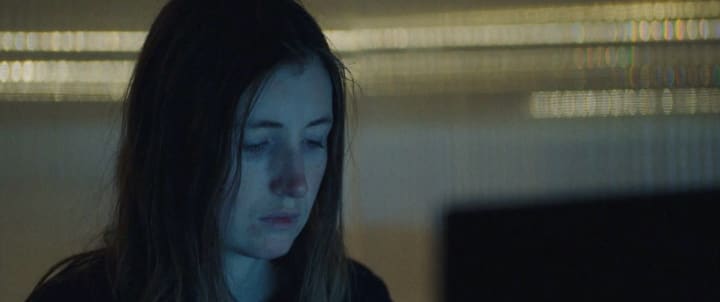
We see Jean touch herself briefly before she returns to touching her unseen V.R partner. We watch as she drops to all fours and appears to be taken from behind. Then, suddenly her body stiffens and she appears to stop moving. You might assume she is experiencing an orgasm but she’s also completely stiff for a moment, something she will take note of after rewatching the footage of this encounter. Then, she collapses to the ground, before tearing off the headset in a moment of terror.
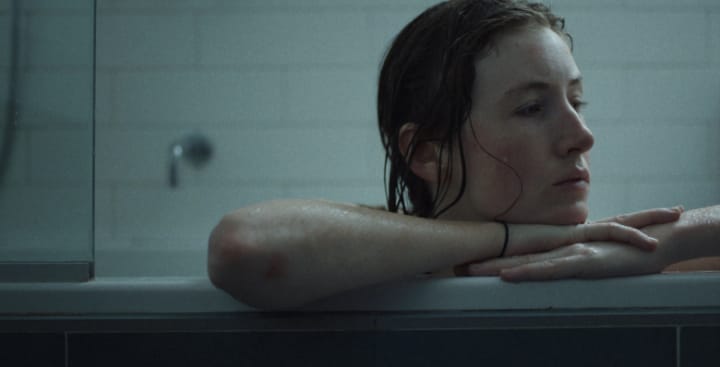
This is an undoubtedly strange way to introduce a character within a movie about maternal strife. Jean’s mother is heard to call Jean as she bathes following her V.R encounter. Their relationship is adversarial, Jean’s mother is pushy and insistent upon Jean dating and planning to have children. Jean eventually simply hangs up on her. Then the scene shifts to Jean in bed and a montage unfolds showing us Jean’s unyielding routine, breakfast, tai chi, work, lunch, reading, a bath, dinner and to bed. Jean doesn’t leave her apartment as seemingly days pass.
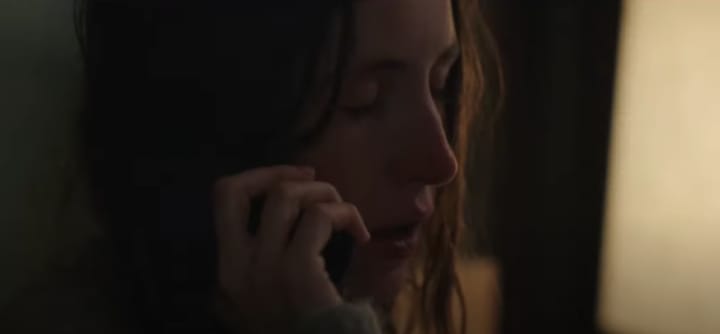
Then, Jean falls ill. We see Jean vomiting violently one day and then the next. This is a signifier, a very well worn signifier for women in movies. Generally speaking, vomiting more than one day in a movie is indicative of pregnancy. It’s never stated out loud that Jean is pregnant but this scene is followed by a pregnancy test, a private, at-home ultrasound, and Jean ordering pills off of the internet. Again, without words, aside from another strained and awkward call from her mother, all of what we infer about what is happening is in visual cues.
Jane takes the pill and takes another the following day. Stomach cramps ensue, deathly painful ones. Jane climbs into the bathtub and we know what is occurring based solely on her agonized face, she’s going through contractions. The pills however, tell us that this isn’t giving birth, it’s an abortion. This is also indicated by the lack of crying from the baby and the time table indicated by the small amount of time that passes between learning of her pregnancy and going through these painful contractions.
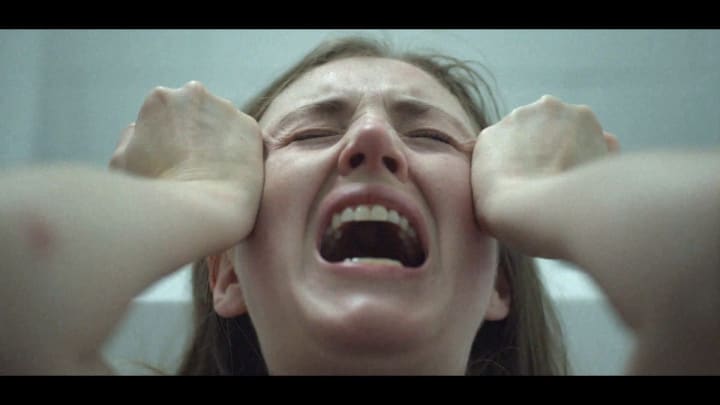
On the surface, there would appear to be very strong visual film making language on display. Wordlessly the movie communicates a great deal of information in images that are striking yet familiar. Indeed, director David Gutnik is very talented, he has a great eye and a strong sense for crafting an aesthetic that draws you in and underlines the intended tension of the story being told. This is clear in the lighting, set design and cinematography. That said, there is an elephant in the room and it’s implied via the structure and editing of this sequence.
In a strictly visual sense, you must wonder, how did Jean become pregnant if her only sex is via virtual reality? The purely visual indication is that Jean has somehow, miraculously, has been impregnated via virtual reality. Accordingly, she is aborting this virtual reality baby. This is entirely illogical and flies completely in the face of the grounded stories told in the rest of the movie. It’s also not what is really happening. I believe, and I have no other evidence than my belief, that Jean was impregnated before the story began.

However, the film language of Materna, the visual film-making, sends the wrong message. The editing and choice of scene and setting along with the lack of contextual dialogue, leaves no visual alternative to the idea that Jean’s pregnancy is some sort of technological miracle, a virgin birth via virtual reality. This is bad film language. Unless the director intends for us to believe Jean has been impregnated by V.R, this is sloppy and poorly conceived. It upends the grounded reality of the entire movie.
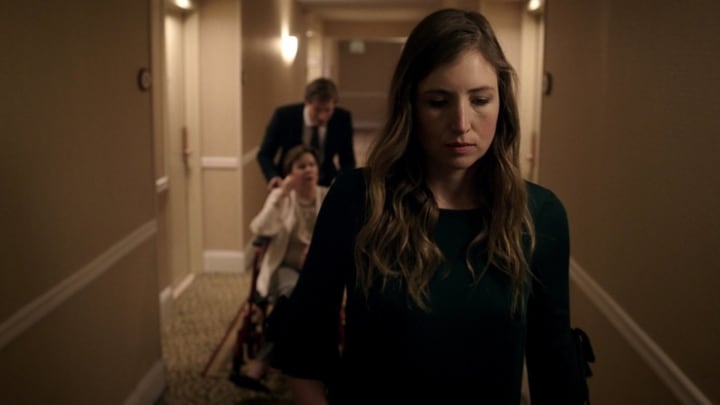
Let me remind you that Materna is a movie based on a series of stories about mothers, motherhood and maternal strife. The subway scene is grounded in the reality of a violent man inflicting his traumatic past on a group of strangers he feels slighted by because they don’t want his attention. This is a terrifying example of the way men can inflict themselves on people, but specifically on women. This framing device marries the four stories as much as the underlying stories of maternal concerns.
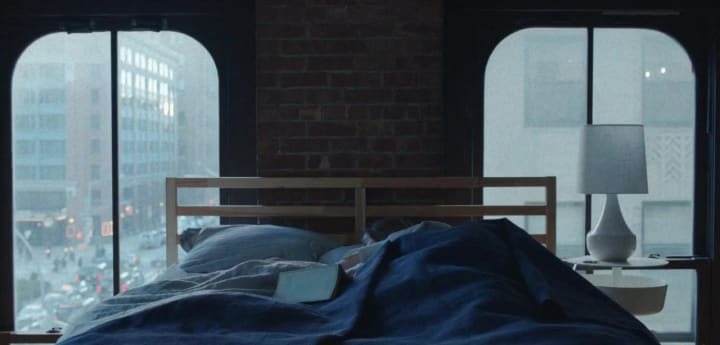
Thus, when a series of scenes imply that a woman has been impregnated via virtual reality, it creates a problem for the grounded reality of the rest of the movie. In a strictly surface level fashion, whether intentional or not, Director David Gutnik leaves open the possibility that we’ve seen a woman become pregnant via virtual reality sex and that is in deep defiance of logic and everything else we know and will come to know about the rest of Materna.
If intentional, this implication overwhelms everything else in the movie and Jean’s story can’t possibly end with her simply leaving her apartment. That’s not the journey or revelation that satisfies this very outlandish plot. Introducing this creates expectations that the rest of Materna is not built to satisfy. This isn’t a sci-fi movie, there aren’t any hints of the supernatural in any other part of Materna. Including this outsized element is deeply at odds with the movie being made and leaving it unaddressed is maddening.
Now, do I think that is actually what this series of scenes intended? Not really, no. Perhaps I am merely rationalizing but I don’t think that the intention was to create a V.R pregnancy angle. At the very end of Materna, Jean appears to murder the man on the subway who is now carrying a gun and threatening to execute other passengers. Jean is seen to pull a large knife from her pocket and the film cuts just as she is about to plunge the knife into the man’s jugular.
This knife is established during Jean’s story, she has taught herself to throw knives. It comes completely out of nowhere in the subway scene however though, if you read deeply enough, an indication as to why it suddenly appears becomes clear and it speaks to the idea of how Jean became pregnant. Dialogue with Jean’s mother hints that Jean has recently become home-bound, she recently stopped leaving her apartment, within the last couple months perhaps. This information combined with the sudden pregnancy leads me to infer that Jean was sexually assaulted and now fears leaving her apartment.

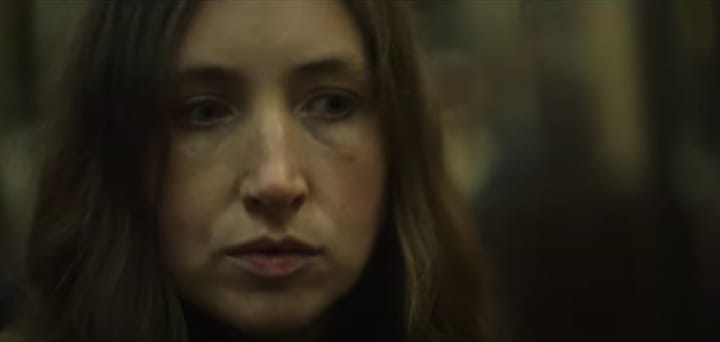
Again, I am having to lift this fully into the subtext as the movie offers no explanation, visual or otherwise. On the subway, we can see the pain and fear on Jean’s face as the man forcefully tries to make conversation with her. We know that the simulated sex of the V.R contains a terrifying glitch that sends her into a panic, perhaps it’s a form of immersion therapy to help her deal with the trauma of the sexual assault. Finally, the pregnancy itself, and the subsequent abortion are not in any context supernatural in nature.
Nothing in Kate Lyn Sheil’s performance reflects the horror and confusion of the idea that she has been impregnated by a virtual reality partner or is preparing to give birth to some virtual reality abomination. It’s all very real in Sheil’s performance. What we do see however, are the haunted eyes and manner of someone who has suffered a traumatic experience and one she has chosen to keep to herself.
The concealment of trauma is a secondary theme throughout Materna. Another character in Materna, Mona, is hiding the fact that she and her mother are estranged due to religion and she doesn’t want to use the trauma of her lost connection to her mother as an acting motivation but she can’t access the emotion needed for a role because she refuses to draw on this experience. A mother and grandmother in the final of the four stories are trying to hide the fact that a member of their family committed suicide and the shame they feel over it.
That’s the biggest problem of the whole of Materna however, there are many secondary themes that run throughout the four stories in the movie but they don’t cohere, they never feel like a whole. The failure of Materna is that there are four individually compelling stories that could make for their own movie but they are truncated into this one movie. That’s underlined specifically by Jean’s story and the clumsy, awkward, and bizarre choice to leave hanging whether or not she’s suffered a miraculous., spontaneous, virtual reality pregnancy.
The visual language employed in this and other parts of Materna isn’t bad, but it is a little clumsy, to say the least. This combines with an overall lack of cohesion between the four stories told and you have a movie that is admirable in so many ways and still manages to fail. It fails because so many good ideas are left unexplored as the movie jams four feature length ideas into a just over 100 minute runtime.
I would have really liked to watch a movie where Kate Lyn Sheil explores the bizarre notion of being spontaneously pregnant via V.R sex. There is a rich amount of text and subtext to be mined from that idea. Her story is unsatisfying in this short film form because it’s far too intriguing and too little explored. If this isn’t about V.R pregnancy and it is really about a woman who suffered a sexual trauma and is on track for form of revenge, then this sequence, as intriguing and involving as it is, is clumsy, shoddily put together and and fails in a different way.
About the Creator
Sean Patrick
Hello, my name is Sean Patrick He/Him, and I am a film critic and podcast host for the I Hate Critics Movie Review Podcast I am a voting member of the Critics Choice Association, the group behind the annual Critics Choice Awards.
Keep reading
More stories from Sean Patrick and writers in Geeks and other communities.
Classic Horror Movie Review: 'House' 1977
House or Hausu has its origins in a strange place. According to legend, the film was dreamed up after executives at Toho, the company famed for creating Godzilla, had seen Jaws become a worldwide phenomenon and they wanted their own horror phenomenon. The executives tapped well known commercial director Nobuhiko Obayashi to develop the concept and after failing to find anyone inside the company to direct House, and after Obayashi used his commercial instincts to create a small cult around the movie before it had been made, Toho allowed Obayashi to bring his bizarre vision to life.
By Sean PatrickExclusive • 5 years ago
Silver Screen Magic with Mae West
American actress and singer Mae West became a popular film actress during the Great Depression. She started entertaining in vaudeville, then performed on Broadway, and finally went to Hollywood. She signed up with Paramount Pictures and made her debut in the 1932 film “Night After Night.” She also starred in musicals, comedies, and crime dramas. The American Film Institute named her one of the best classic Hollywood actresses.
By Rasma Raisters8 days ago in Geeks
25 Years Ago The World Welcome Hobbits & Lord of The Rings into Theaters
Twenty-five years ago, a gamble reshaped cinema—and few people realized it in the moment. Where it all started! In December 2001, audiences stepped into Middle-earth with The Lord of the Rings: The Fellowship of the Ring, and something quietly seismic happened. This wasn’t just another fantasy movie arriving for the holiday season. It wasn’t a niche genre experiment or a disposable blockbuster meant to fade once the credits rolled. It was the opening chapter of a cinematic undertaking so ambitious that, even now, it feels borderline impossible that it worked at all.
By Lawrence Lease4 days ago in Geeks


Comments
There are no comments for this story
Be the first to respond and start the conversation.