
UniversityGPT: In Defence of Gen-Z
An Opinion Piece



Disclaimer: Same rules apply: if you're reading this, please keep the conversation civil and do not insult the character of myself or anyone else. If you disagree with anything I see, I would love to read your take on the topic in a comment or your own article. If you are not being civil or you are spamming the comments section for interaction then you will be reported to moderators.
Thanks,
Annie.
***
WARNING:
This article goes to some dark places, including discussions about addiction, self-inflicted harm and passive/active s******l ideation. If you are struggling with your mental health, please proceed with caution and do not hesitate to contact your local service provider.
***
UniversityGPT: In Defence of Gen-Z
The Inevitability of ChatGPT in University Education for Generations Z and Alpha
Part 1: Highway to Hell - Generations Z and Alpha

It is not a surprise that ChatGPT is ruining university and, if you've read this 'Sleepless Nights' article then you'll know exactly what I'm talking about. It's been three years since ChatGPT came into our lives and therefore, the students finishing university this year will mostly have basically no skills when it comes to literacy or critical thinking. The amount of them writing essays using ChatGPT, not being able to read or articulate ideas in a meaningful way and on top of that, having no skills in the subject they themselves paid to do at university means that Gen-Z and Gen-Alpha are as the 2005-2010 prophecy foretold. And let me walk you through what that means...
I think that everyone that knows of technology before the smartphone knows the theory that one day, technology will take over the world. Everyone looked on in shock when Steve Jobs presented the iPod to his audience and then, after some years, the iPhone. I remember back when I was in school and someone had brought an iPhone with them. Needless to say, nobody would go near this person because we all thought the iPhone was possessed. I don't think that Gen-Z and Gen-Alpha appreciate that the generations before them had to figure out how this stuff was meant to be used. One day I was making mixtapes for my boombox, the next minute I had an iPod and had to plug it into something to put songs on to it. It was quite the experience.
But, technology was changing rapidly during this time, things were coming and going as far as tech-fashion was concerned. As soon as the iPhone came out, it completely changed the market. People who rebelled against it openly had blackberries instead of pagers now. People who didn't know what to do kept their Nokias until they couldn't. People who pushed for progress did a completely different thing altogether. There were new things coming out so fast, we couldn't even keep up and then, of course, was the question about whether technology would take over our ability to think.
Fun became different too. Once upon a time, fun was me playing with the Barbie Plane Set, the Barbie Wardrobe, the My Scene Dolls and more. That day, it was all physical play. The next day there were websites. Okay, that's not too bad. But then came the applications. I didn't get Facebook (not the account I have currently) until I was about 14 or 15 years' old and I thought it was only good for things I used to do on MSN: talk to my mates on messenger. Before this, I was part of random chatrooms on the black hole of the internet. It wasn't all that exciting and you physically couldn't spend a lot of time on there. Posting, reading other people's posts and mindless scrolling wasn't really a thing. It would be a while before infinite scroll was released and from then on, we knew the next generation was doomed.
We had partly proved that technology wanted to make us stupid by the way in which it was identified later on that social media applications run on the same logic for addiction as gambling does - especially with the introduction of infinite scroll. As Gen-Z came into the world, iPhone in hand, they were pretty much fighting a losing battle from the outset. But it was about to become much worse for everyone with the introduction of ChatGPT in the early 2020s.
Social media has done some damage, I think we can agree, to the mind of everyone born after around 2005-2007. To these people, there had never been life without it and now, instead of social media being a supplement for real life, real life became a supplement for social media. The online world has skewed their opinions of reality and thus, terms for these people started to weave into the discourse critiquing their intellectual (or lack thereof) value: 'TikTok Brain Rot' and 'Chronically Online' were among some of them.
The pandemic beat these two generations even further into the void with the release of the forementioned 'TikTok' application. And thus, they were plunged into the black hole of short-form content, having already been subjected to years of intellectual neglect in the form of infinite scroll and on top of this, having being scrutinised for their appearances on the nightmarish dystopian: Instagram. Already unable to get off their smartphones, the little attention they had left was shifted on to an application which has been proven to reduce the grey matter in the brain and optimise dopamine rewards quickly in a horrific addiction cycle (as seen in the YouTube short 'Nuggets'), similar to that of a cocaine junkie. What chance did they have?
From being locked in their homes with basically none of the experiences that other teenagers and young adults had, these two generations would suffer the fear of being left out like no other generation before them. They would not grow up intellectually or socially and the fault isn't even their own. In fact, they are even aware that it is happening. Take a look at this extract from the article discussing a similar issue in the New York Magazine. It is called Everyone is Cheating their Way Through College.
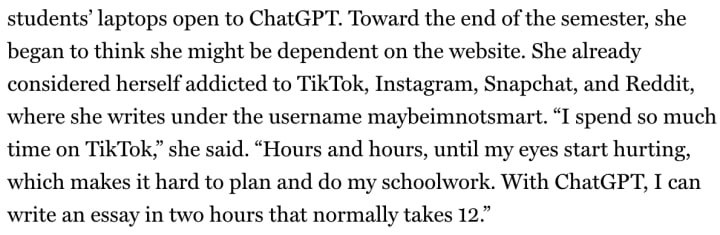
I only half-support this analysis. Whilst it presents the reality and awareness of the generation, the title of the article seems to blame them for what has happened. It would be like giving a baby meth and then blaming it when it's 18 for being addicted to meth and experiencing all the horrific side effects.
Coming out of the pandemic, we all knew something was wrong with these young people who had struggled to maintain themselves. Socially inept, detached from the real world, their minds had been taken over by the online realm and, it was entirely by design. The fears of the past had come true: Generations Z and Alpha had been experiments in a wild capitalistic game of submission, consumerism and brain-rot. But it was about to get much worse as they emerged from the pandemic and back into the real world, without the real-life experience to handle the next level of the game.
Part 2: The Path of Least Resistance in the World of Education

When you wear down someone's resistance and ability to engage, you do it aggressively - it's never a passive achievement. We cannot ignore how aggressively these applications have marketed themselves to these two generations we are discussing. Yes, we the millennials suffered too - but we still remember what life is like without these things and so, we could only crumble so far. And on top of this, millennials were the 'blogging' generation - we loved to read and write and document our findings on blogs. I mean, you're currently reading a blog by a millennial who has been blogging for over ten years on various sites, so there's your evidence.
But something changed with Gen-Z. When Gen-Z came to secondary school, education was no longer about letting the teacher actually teach. It became about *'experts' and analytics. It became about theorists and principles and sociology - all of a sudden teaching became a science. Less about teaching, more about 'delivery'. This is another 'content' word. You've heard us writers being called 'content creators' by Gen-Z, well they can't get away from the word itself.
*English Secondary School Teachers are by no means experts of their subject, but that is just my humble opinion.
'Content' reduces everything to something that simply must be ingested and got out of the way for more content. Reducing education from 'teaching' to 'delivery', reduces 'education' to 'content' as the word 'delivery' is most associated with content creation. In my few wanders around the world of education behind closed doors, the amount of times you hear the phrase 'deliver the content' rather than 'teach the subject' is dangerous at most and slightly disheartening at the least.
In this recent article from TES, it is stated that there has never been a time of less autonomy for teachers and therefore, the whole profession has been reduced to delivering content rather than teaching the subject. The author explains that in a high-stakes environment where technology, social media and now, AI have taken the place of learning anything in these children's lives (Gen-Alpha mainly), the path of least resistance through strict routine and reduction of 'mental load' through dumbing down the process is the only way to go.
It is understandable that the education sector is stretched beyond belief, but repeating Rosenshine's principles ad nauseam throughout the day to the point teachers become slaves and are reduced to content delivery rather than actually teaching harms education down the line. What happens is that you now have people you have worn down delivering content which falls upon ears deadened by the social media world we discussed in Part 1. We have returned to the robotic form of compulsory education when it was first birthed: to create two young generations of compliant workers who cannot think for themselves. First you have to wear down those who are meant to enlighten intellectual curiosity and make them believe it is best they don't do that.
The TES article seems to hit the nail on the head here:
"Centralised curriculum models may support workload reduction, mitigate against the absence of subject specialists and facilitate a common understanding of subject content and optimal sequencing.
But we have tended to conflate the ends with the means: how we arrive at a shared curriculum model matters.
When we outsource the deeply intellectual work of curriculum design - be it to external agencies or internal specialists - we deny teachers opportunities for creativity and critical thinking, for joyful immersion in the patterns and rhythms of their subjects."
There is no room for creative expansion when the only thing that matters on the groundwork is how you are implementing the shared routines your institution relies on beyond anything else. There is no room for critical thought when every two minutes there is a routine to complete which can get in the way (or more than often, interrupts) any learning. There is no room for education when you as a teacher, are penalised or receive disciplinary action for not repeating the routine for the tenth or maybe twentieth time in the lesson, reducing learning time to a mere few minutes of a an already reduced lesson time.
It is no wonder that through this 'dumbing down' of the world of education that students are also choosing the path of least resistance. Students who once (in the millennial era and before) carried their own books and textbooks to and from school, were active participants in their own equipment for the day and their learning for the evening and were also engaging endlessly in extra-curricular activity no longer exist. It has moved to students not being responsible for even taking a pen with them to school, students not receiving any homework whatsoever sometimes and extra-curricular activity not being compulsory or available due to the recruitment crisis in education.
The path of least resistance is formed out of 'good intentions' for the student. A hell-bent narrative to 'reduce mental load' or, in other words: don't make them think about what they are doing.
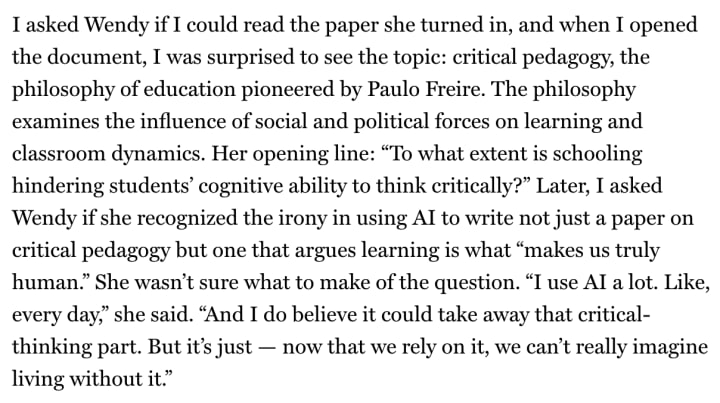
I'd like to end this section with this part of the New York Magazine article I was writing about before. I'll let this one hang in the air as we move into the next section which deals with this exact issue:
Part 3: Enter Mephistopheles

So as we can see, ChatGPT was an inevitability for these students. In secondary education they were never taught to be literate, with some having made it to the age of 18 having never read a book or done a lengthy piece of writing. In primary education, their world was virtual - a path of least resistance but for play and attention. When ChatGPT came around, we the older generations viewed the younger ones as being dishonest without being charming. But in fact, this may be the result of expectation.
During my own generation, university went from something you wanted to do, to basically another piece of compulsory education. Jobs became more difficult to get if you didn't have a bachelor's degree at least (and now even that, in 2025, means nothing). Even jobs where you couldn't really see why you would need a degree to do it, required you to have one. It became the marker for self-disciplined learning as compulsory education was knowingly going down the pan. What this resulted in was a younger generation (Z) who were incapable of thought through aggressive social media marketing, often insidious addictive qualities of smartphones and applications and on top of that, the dumbing down of their own education. Then, what resulted from this was the same generation being pressured into an environment they physically could not function in.
Enter our Mephistopheles: Sam Altman
Sam Altman, the man who is most associated with the phrase "cult of personality", at least since the reigns of Boris Johnson, Tony Blair and in the more modern times of The Daily Wire: Ben Shapiro.
Sam Altman, the man who is about to change the entire minds of people across the world in relatively the same way Oppenheimer changed the population of Japan.
Sam Altman, who has single-handedly maximised on the passive s******* ideation of these two generations with providing their academic imposter syndrome with an phoney exit plan without fixing any part of the problem. I'm sure he must be wonderful to have around.
ChatGPT seemed to solve the issues that the roads of Generations Z and Alpha were paved with:
- increased anxieties about their future
- inability to study or learn because of reduced cognitive function
- inability to concentrate due to shortened attention span
- consumerist culture because of their existential dread
- imposter syndrome for not being 'as smart' as former generations
It seemed to offer them a way to deal with it, like medicating a a meth addict with cocaine. It simply was another step in the path of least resistance that became their lives as they were designed to be. This list of five factors created a generational passive s******* ideation in Generation Z to say the least, and one that was more normalised in Generation Alpha. The path of least resistance was no longer the paving of the road, but practically all other roads had been obliterated. With screen times increasingly problematic, what better way to solve the problem by simply introducing another application that they cannot live without?
The worst part about it is that they know it's happening (imagine I am tapping that section of the New York Magazine about 'Wendy'). How else would they be expected to complete a university education without having been able to read a book, having been reduced to consumers as opposed to people with ideas, having been ground down by a sub-par state education system modified to stop them from thinking for themselves? And yet, we still call them out like this:
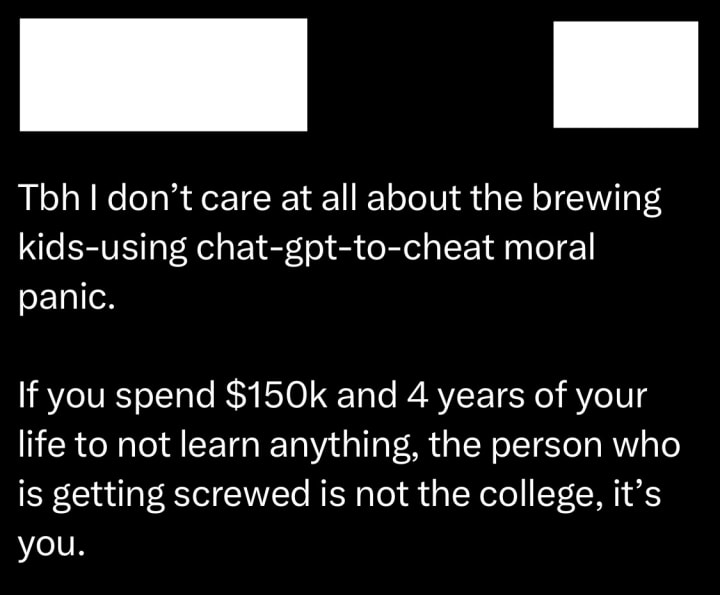
To call it a 'moral panic' is to ignore the larger issue bubbling beneath the surface. A very small minority of these students are using ChatGPT to pretend to be intelligent but rather, simply do what they believe is now expected of them. On behalf of the millennials with our university boom: I apologise for making this the only path to success. When university education is the sole factor associated with intellect and success, with a good job and a fine life when it comes to the future of the world looking as bleak and dystopian as it does: there was really only one way they could go if they could not do it at all.
Conclusion

As we can see, this has been done by design. It is not a ChatGPT moral panic, but rather an inevitability of the lives of these people who have been aggressively worn down. Some of you may say 'don't give them a smartphone then' but then, the parent of said child would be actively letting their child become a subject of possible bullying and belittlement at school - leaving them traumatised in the long run. In my opinion, we need a complete return to form. A smartphone blanket ban until the legal age of adulthood, an encouragement to think critically will follow as it has always done. But if you think that ChatGPT is a 'new' problem, you may want to read this article one more time.
About the Creator
Annie Kapur
I am:
🙋🏽♀️ Annie
📚 Avid Reader
📝 Reviewer and Commentator
🎓 Post-Grad Millennial (M.A)
***
I have:
📖 300K+ reads on Vocal
🫶🏼 Love for reading & research
🦋/X @AnnieWithBooks
***
🏡 UK
Reader insights
Outstanding
Excellent work. Looking forward to reading more!
Top insights
Easy to read and follow
Well-structured & engaging content
Expert insights and opinions
Arguments were carefully researched and presented
Eye opening
Niche topic & fresh perspectives
Keep reading
More stories from Annie Kapur and writers in Geeks and other communities.
"Nothing Can Perish...Things Merely Change Their Appearance."
Background and Context: I love writing about the 19th Century and as I've said with my essay on 'Jane Eyre' I was thinking about starting a podcast about it all so I have lots of material. I thought and thought about it and I don't think anyone wants to listen to my posh British accent talk about literature so now, I just have tons of essays and nothing to do with them. So, I've decided to release them on here. At least I know some of you will appreciate them. If you look through my posts and my profile, you can see that these are coming out intermittently. I have to say though, this one perhaps contains some of my favourite ideas and literature. Enjoy.
By Annie Kapur10 months ago in Geeks



Comments (19)
I give zeroes for bot-generated work in my classes.
❤️🌟🌹🌺🌼 💌💝 💞💓 💖🎉🌹🌺🌼🌷📖💖🌺📝🌼💌🌷🌿�📝🌼💌🌷🌿🌼 💌💝 💞💓 💖🎉🌹🌺🌼🌷📖💖🌿 Congrats Top Story ❤️🌟🌹🌺🌼 💌💝 💞💓 💖🎉🌹🌺🌼🌷📖💖🌺📝🌼💌🌷🌿�📝🌼💌🌷🌿🌼 💌💝 💞💓 💖🎉🌹🌺🌼🌷📖💖🌿
Trying to coax kids out of the house from their tech is like talking to an unmoving mountain. You are preaching to the choir, but the meat of the audience just are like robots, in one ear and out the next. The world will go to hell, because more dumb people will rise to be rulers. 'Trumping' the few smart ones, great article...
Support me I am new here please
Support me I am new here please
wow so interesting, lovely read learned something new! i subscribed..plz lmk what you think of my poem thank you!!
Try i Robot by Isaac Asimov. (NOT i Phone)
GEN-z is BEst
Heyyyy, I'm a Millenial too! "English Secondary School Teachers are by no means experts of their subject, but that is just my humble opinion." I totally agree with this. My friend is a secondary school teacher. His major is Biology and minor is Music. He was recently asked to teach English because there was no one to fill that position. But luckily, they got an actual English teacher in time. Reducing mental load of students, I feel that's bullshit. Here in Malaysia, the Minister of Education eliminated two veryyyyy essential exams for students. The bullying that would ensue if students don't have smartphone is real. I agree with the smartphone ban. Maybe until they're 18 would be okay Congratulations on your Top Story! 🎉💖🎊🎉💖🎊
The way how you see love and feel it is brilliant. I subscribed you to give my support and I welcome you to read my ones too 🥰!
What an excellent deep dive into Ai and how education and technology has impacted our society.
As someone who's Gen Z, it was refreshing to see a millennial write about the generational shift without blaming us, as it is often overlooked how much we have had to struggle while adjusting in a technology-ridden world, especially after being thrown into a pandemic during the most crucial years of development. Thank you for sharing your perspective. I loved your work. "Generations Z and Alpha had been experiments in a wild capitalistic game of submission, consumerism and brain-rot." This was my favourite part of your work, it was really well said.
Very good work, congrats 👏 I’ve also been sharing stories recently—feel free to take a look!
This topic is very interesting. I will def read more !
Good luck
Okay, okay... I'm approaching this as a GenXer with my own view of things. I have never felt sorry for Millennials or GenZ or Y or whatever is coming up the pipe, nor did I hate them. Every generation has to go through whatever the world throws at them and just deal with it. This was a very telling and important piece of work, Ms. K. Now, let's put those phones away for a moment and deal with the real world...
As someone near the cusp of boomer/Gen X, I'm having a difficult wrapping my brain around how the younger generation learn anything. We have computers at hands length that tell us anything we want to know. As for Chat GPT, I've never used it, but fail to see how anyone can retain any information when they're simply using a program to write an essay for them. I don't know, I'm one of the old ones that had to carry my books to school, so I guess I'm out of the loop.
I think it's a bit harsh and overlooks how adaptive and resilient many young people are. Yes, there are challenges with tech and education, but Gen Z and Gen Alpha aren't doomed they're just navigating a very different world than the one we grew up in. Let's give them a little more credit.
I don't think ChatGPT is the problem. I think it's the fact that some of these children have been brought up around technology and there has been no awareness about how addictive it can be. One of my children spent day and night using technology, to the point where she wasn't willing to spend any time on her school work, and I know a person who completely failed his university exam because instead of thinking it through and using what he had learned to write it, he chose to write it completely using AI because he didn't think he could write it. Technology isn't a bad thing; It allowed me to access my education in ways I couldn't when I was at school in the 80s and 90s because back then there were many struggles and difficulties, that stopped me from succeeding at school. However, I think ChatGPT is good for discussing a topic even though, as I found, it doesn't always get it right; but we need to reinforce that physical work, real teaching and human critical thinking are still important.