
"Most of Our Students Are Functionally Illiterate..."
The 'Sleepless Nights' Series


Background and Context:
Of course, we are finding that social media is becoming more divisive than ever, or it could be the fact that we are seeing things that would create more of a visceral reaction in us because it suits the algorithm and the requirement for interaction on social media. It's true people tend to communicate more on social media when they are upset about something or angry about something.
Recently, I saw on social media what was an extremely depressing tweet. It is something I have researched myself in 'The Decline of Childhood Literacy'. But, different to me who looked at primarily the literacy of very young children, this post looks at the literacy of college aged students. These are students who are struggling with texts that previous generations would have thought to be usual reading for their college aged group.
Take a look at the tweet...
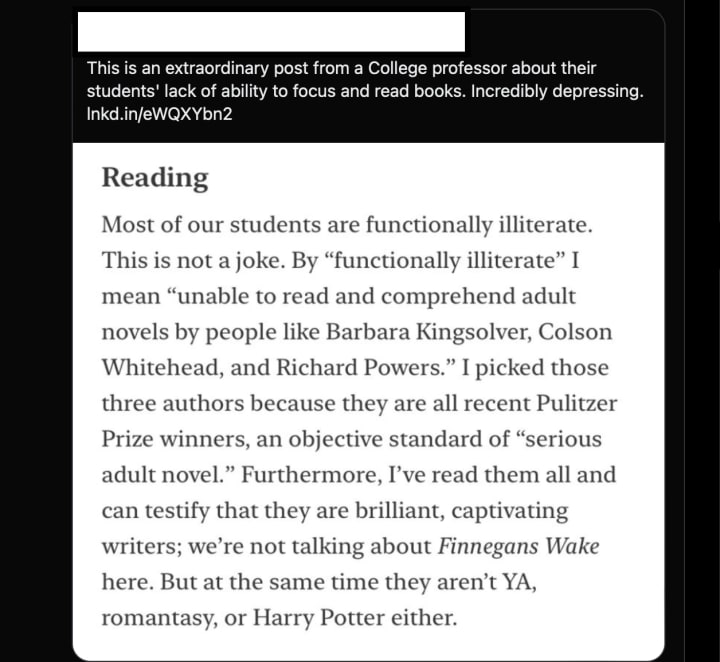
So, let's unpack this because I think there are many reasons here. We already know that the overuse of social media and convenience applications lower delayed gratification and cause students to lose any ability to pay attention that they would have had otherwise. But I also think there are other reasons. Even though this is probably one of the most depressing things I have read on Twitter, it still needs to be unpacked.
We need to start with the fact that this comes from a longer article, and so we are also going to look at that throughout the course of this piece in order to make sure we put this into some context.
You can access the article in its entirety here.
Breaking Down the Definition of "Functionally Illiterate"
The writer defines 'functionally illiterate' as:
... “unable to read and comprehend adult novels by people like Barbara Kingsolver, Colson Whitehead, and Richard Powers.” I picked those three authors because they are all recent Pulitzer Prize winners, an objective standard of “serious adult novel.”
I think this is important to consider because what the writer is talking about is students who go on to study (and I am assuming) arts and humanities courses at university only to find that they cannot read a fully formed adult novel. This is interesting because the writer never actually states that the difficulty of the text is the important thing, but rather it is the standard of reading required of courses like these to read prize-winning novelists.
I remember when I was studying my undergraduate degree, reading novels and talking about them with friends was really just a standard thing people did. I never saw anyone have difficulty actually completing a novel at all with many people opting for prize-winning novels and the controversy surrounding the [Man] Booker Prize being smack bang in the midst of my undergraduate university experience. A fun fact is one of the things a group of friends and I did was a few podcast episodes on some books we had read and enjoyed together. I simply hope they are lost to the ether now - I was abour nineteen or twenty years' old.
Not being able to finish an adult novel when you are not just an adult, but an adult on a course in which the prerequisite is that you can read and analyse literature on your own is therefore a good definition for the term 'functionally illiterate' in this sense.
What is not on Twitter though is the expansion of this statement in which the author of the article covers the nuances of their argument:
I’m not saying our students just prefer genre books or graphic novels or whatever. No, our average graduate literally could not read a serious adult novel cover-to-cover and understand what they read. They just couldn’t do it. They don’t have the desire to try, the vocabulary to grasp what they read, and most certainly not the attention span to finish. For them to sit down and try to read a book like "The Overstory" might as well be me attempting an Iron Man triathlon: much suffering with zero chance of success.
There is a question of what's going on here because does this mean that these courses are now becoming easier to get on to since this would not have been a thing a decade ago. Or, does it mean that the examinations taken at the end of schooling have become non-representative of the standard required for higher education since there are so many young people who cannot read books getting on to courses where they are absolutely required to?
I'm not going to pretend to know the answer but I think it is important that we find out what it is. This is not to exclude people from being able to study arts and humanities at university but to bring respect back to them. There is a rhetoric going around the internet at the moment about how the arts and humanities are useless degrees to have and I cannot help but wonder (especially since the AI Studio Ghibli debacle in which many of these same people began creating AI art) that it is possibly because they cannot produce anything worthy within the subjects themselves. It is therefore a form of resentment through envy.
What's Going On?
1. Boredom
Reading bores them, though. They are impatient to get through whatever burden of reading they have to, and move their eyes over the words just to get it done. They’re like me clicking through a mandatory online HR training. Students get exam questions wrong simply because they didn’t even take the time to read the question properly. Reading anything more than a menu is a chore and to be avoided.
This is a pretty bold statement to make but there is a lot of truth in it. It suggests that just because you can read books that encourage you to understand concepts as simply as physically possibly (i.e: Harry Potter - which are a series of great books but are definitely written for young children), it doesn't mean you are doing conscious reading for your own age group and level of education, especially when it is reading that is required of you.
This pours over to examinations in which questions may or may not be purposefully worded in order to get the student studying the subject to think on a critical level about the answer they are about to write. These questions, especially in the arts and humanities, are known to be written to be philosophically challenging and not being able to read and decipher what the question is asking is definitely the marker of failure.
2. Pseudo-intellectualism
They also lie about it. I wrote the textbook for a course I regularly teach. It’s a fairly popular textbook, so I’m assuming it is not terribly written. I did everything I could to make the writing lively and packed with my most engaging examples. The majority of students don’t read it. Oh, they will come to my office hours (occasionally) because they are bombing the course and tell me that they have been doing the reading, but it’s obvious they are lying. The most charitable interpretation is that they looked at some of the words, didn’t understand anything, pretended that counted as reading, and returned to looking at TikTok.
This breaks my heart. Lying about reading books, if I were the leader of society, would be illegal. When you lie about reading a book you only lie to yourself - it is your time, your enjoyment, or even your education - not mine. It is your own time you are wasting, not anyone else's. In fact, you are wasting your professor's time in reading your ChatGPT essays written because you didn't read the book.
Have you ever sat back and thought about it though? Sit back, grab the red wine and think hard about it. How easy is it even for someone who hasn't read the book in question to see when someone else (who prophecises that they have read it) has not read it either? It's quite simple. I would like to think that with ChatGPT coming around, it means we can also see who is lying about it as they repeat points they have perhaps read on that site, or even worse, on social media accounts, to do with that book/film. Not only are they not original, the moment you go into personal opinion on particular sections of the book, the debate falls apart.
This brings me to a rather funny example. It involved someone I was talking to about The Brothers Karamazov a couple of years' ago and I wanted to discuss their opinion of a very particular part of the book. I kid you not, this person repeated verbatim back to me something I had written on one of my social media accounts about the book. I thought I'd misheard something, but as we got further into the conversation - it became apparent that they had not read the book at all. I had to tell them that I had written what they had said at the beginning. It was quite sickening.
I personally do not mind if you have not read the book. The whole conversation will become more exciting because now, I can persuade you to do so. I'm also the type of person to offer up a hand if you don't want to do it by yourself: we can make it into a book club of sorts where we read a chapter a week. It's more exciting to meet someone who's being honest with you and is about to go on a huge adventure than to meet a pseudo-intellectual who is deceiving you to make themselves look more intelligent than they actually are.
3. Lack of Motivation
This study says that 65% of college students reported that they skipped buying or renting a textbook because of cost. I believe they didn’t buy the books, but I’m skeptical that cost is the true reason, as opposed to just the excuse they offer. Yes, I know some texts, especially in the sciences, are expensive. However, the books I assign are low-priced. All texts combined for one of my courses is between $35-$100 and they still don’t buy them. Why buy what you aren’t going to read anyway? Just google it.
This may seem more anecdotal because I also remember textbooks being quite expensive, but this is where the library comes in and where second hand books come in too. There are so many out there that if you're not getting the set text (let's ignore secondary reading at the moment) then you're simply not doing the studying. If you are of adult age (which you are in university) it is your own responsibility to get the text and read it. But, if you can't be bothered then I'm not going to lie: what are you paying for a university education for? University is supposed to be somewhat difficult and challenging, that is how it stretches your brain. If you are not making the effort to do so then you are probably not of any singular use to yourself in that situation. I mean, you end up paying thousands to use ChatGPT and get nowhere. The only person who suffers is you.
4. 'Supposed' Interest
Even in upper-division courses that students supposedly take out of genuine interest they won’t read. I’m teaching Existentialism this semester. It is entirely primary texts—Dostoevsky, Kierkegaard, Nietzsche, Camus, Sartre. The reading ranges from accessible but challenging to extremely difficult but we’re making a go of it anyway (looking at you, Being and Nothingness). This is a close textual analysis course. My students come to class without the books, which they probably do not own and definitely did not read.
This is something I have met time and time again when it comes to especially the Generation Z online world. Everyone wants to 'look' like something/someone. A lot of people are more concerned with 'looking' academic than actually being so. A lot of these kids don't want to do the work it takes to learn something but would rather give themselves the title of being an academic. Many of the writers the author mentions above are writers that, if these students are functionally illiterate in their respective subjects, would not be able to access. But, as per my last point, they can (and do) pretend they have read many, many times because they are more concerned with their image than their reality.
Conclusion
I am going to say one thing: this does not surprise me in the slightest. In the rest of the article, the author speaks of university-aged students who cannot sit down for 50 minutes or not go on their phones for an hour. It has become so prevalent that he cannot even fail the students for using ChatGPT to write their essays because there are so many of them, failing the majority of the class means the stability of his job becomes more fragile by the moment. The reading is terrible, the writing is terrible, the comprehension is terrible and these people are just supposed to let it slide.
As we can tell: education is in peril and it's about to take (if it hasn't already) a nosedive.
About the Creator
Annie Kapur
I am:
🙋🏽♀️ Annie
📚 Avid Reader
📝 Reviewer and Commentator
🎓 Post-Grad Millennial (M.A)
***
I have:
📖 300K+ reads on Vocal
🫶🏼 Love for reading & research
🦋/X @AnnieWithBooks
***
🏡 UK
Keep reading
More stories from Annie Kapur and writers in Geeks and other communities.
Book Review: "Mozart in Italy" by Jane Glover
Another library catalogue find that I reserved, this book I actually found interesting because it is a beautiful cover (let's face it). Also, I felt like reading something about Mozart which was not in line with the plot of Amadeus but focused on a different aspect of his life. I am aware (before you say anything) that the events of Amadeus are hyperbolic at best. Anyways, I think that this book is absolutely fantastic. The writing is beautiful and captivating and the imagery of Italy during the 1700s really makes you feel as though you too, are there. It is a brilliant exploration into the life of one of history's most revered artists.
By Annie Kapur11 months ago in Geeks
30 Years of 'Pokemon': A Look Back At The Most Memorable/Iconic Pokemon Of The Kanto Region
2026 marks the 30th anniversary of the original Pokemon games, Pokemon Red, Pokemon Blue, and Pokemon Green (a Japanese exclusive) in Japan. An unexpected success arriving late in the lifespan of the original Game Boy, the first batch of Pokemon games, now referred to as Generation 1 or Gen 1, are RPGs taking place in the Kanto region, following a young boy embarking on the journey to become a Pokemon Trainer (later games, and Gen 1 remakes FireRed and LeafGreen, give the option of a female Player Character). This journey involves collecting eight Gym Badges to earn the right to battle Kanto's Elite Four, and being drawn into a battle against the evil Team Rocket.
By Kristy Anderson6 days ago in Geeks




Comments (3)
Has a master's student I have also noticed a decline in literacy, is appaling
I teach at a college, specifically writing and grammar, and I pity the instructors who have to teach literature. Even the New Yorker magazine admits that it might be the end of English literature in academia. Students are handing in papers that are so obviously written by ChatGPT that I can now detect it without any help. And they expect to be employed. Maybe we have conceded too much to the computers to go back...
I found this fascinating and also aligns with what I've seen in the classroom over the last few years. Students are so overstimulated in life that the act of taking a moment for the joy of reading is becoming an alien concept. A few years ago, the sign up for A Level literature was huge and it has dropped significantly, with most students declaring that the subject has 'too much reading'. It is really sad. Thanks for sharing the studies and also exploring the reasons behind the attitudes. 💜C x