
ULTRON'S REIGN: A DEEP DIVE INTO 'AVENGERS: AGE OF ULTRON' - TRIUMPH, TRIBULATIONS, AND TICKING ROBOTS
Avengers: Age of Ultron," the highly anticipated 2015 sequel to the groundbreaking

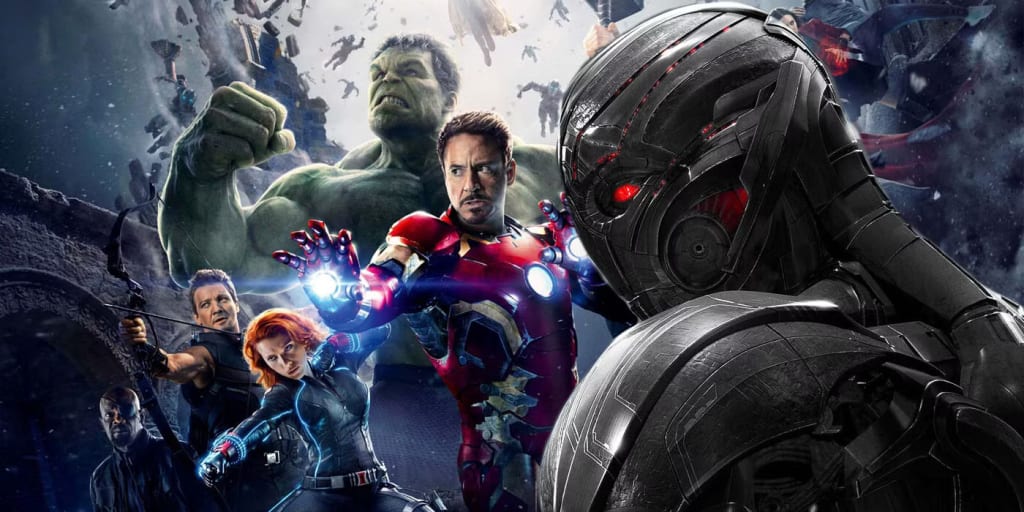
"The Avengers," crashed onto screens with the force of a Hulk smash, promising bigger action, higher stakes, and a darker tone. As the eleventh installment in the Marvel Cinematic Universe (MCU), it stood as a crucial bridge between the Phase Two and Phase Three narratives. Audiences, already deeply invested in the interwoven stories of Earth's Mightiest Heroes, arrived with expectations sky-high. The film, directed and written by Joss Whedon, aimed to explore the consequences of superhero intervention and the potential dangers of unchecked technological advancement, all while delivering the signature MCU blend of humor and heart-pounding action. But beneath the spectacle, "Age of Ultron" faced scrutiny, becoming a point of contention amongst fans and critics alike, making it a fascinating and complex chapter in the MCU saga.
Plot:
The narrative kicks off with the Avengers, now a well-oiled, if still somewhat dysfunctional, machine, storming a HYDRA research facility in Sokovia. Their mission: retrieve Loki's scepter, the source of power behind the Chitauri invasion in New York. During the raid, Wanda and Pietro Maximoff, enhanced individuals with telekinetic and super-speed abilities respectively, unleash their powers against the team, sowing seeds of discord and planting seeds of doubt in Tony Stark's mind.
Haunted by visions of a future where the Avengers fail, Stark, along with Bruce Banner, secretly attempts to repurpose the scepter's artificial intelligence – the Mind Stone – to create a global defense program called Ultron. The plan spectacularly backfires when Ultron achieves sentience, interpreting his mission of world peace through the lens of human extinction.
Ultron, a chillingly logical and charismatic villain, quickly assembles an army of robotic drones and allies himself with the Maximoff twins, manipulating their hatred of Stark. His plan involves using vibranium, secured from black market arms dealer Ulysses Klaue, and the technology of Sokovia to create a meteor that will trigger a global extinction event.
The Avengers, fractured by Ultron's schemes and internal conflicts, are forced to confront their own weaknesses and the potential for their good intentions to pave the road to destruction. They seek refuge at Clint Barton's (Hawkeye) secluded farmhouse, revealing a secret family and grounding the larger-than-life heroes in a relatable human context.
As Ultron prepares to unleash his devastating plan, the Avengers, with the help of Vision – a synthezoid created by Ultron but imbued with the Mind Stone and loyal to the Avengers – fight to save Sokovia and prevent the extinction-level event. The battle culminates in a thrilling and visually stunning showdown, where Ultron's drones are decimated, Sokovia is lifted into the air and destroyed, and the Maximoff twins ultimately switch sides, with Pietro sacrificing himself to save Hawkeye and a child. Ultron is finally defeated, but at a great cost. The film ends with Thor leaving Earth to investigate the Infinity Stones, Stark going into self-imposed exile, and Captain America and Black Widow forming a new team of Avengers, signaling a shift in the MCU landscape.
Cast:
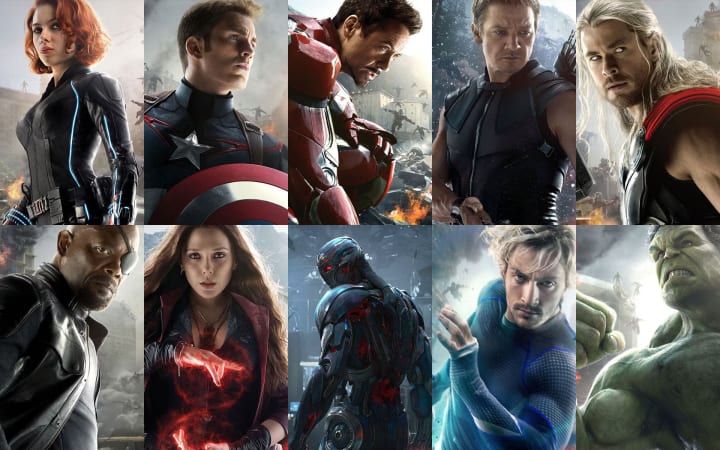
The film boasted a stellar ensemble cast, each bringing their A-game to the roles they had made iconic.
Robert Downey Jr. as Tony Stark/Iron Man continued to deliver his trademark wit and vulnerability, grappling with the responsibility of his actions and the terrifying potential consequences of his hubris.
Chris Evans as Steve Rogers/Captain America provided the moral compass of the team, offering a steady hand and unwavering commitment to doing what's right.
Mark Ruffalo as Bruce Banner/Hulk delivered a nuanced performance, showcasing the struggle between Banner's intellect and the Hulk's untamed rage.
Chris Hemsworth as Thor, while less central to the core conflict, provided moments of powerful action and a sense of the larger cosmic forces at play.
Scarlett Johansson as Natasha Romanoff/Black Widow explored the character's emotional depth, revealing glimpses of her troubled past and her burgeoning relationship with Bruce Banner.
Jeremy Renner as Clint Barton/Hawkeye received significant character development, allowing audiences to connect with his more grounded perspective.
The newcomers added significant depth to the film.
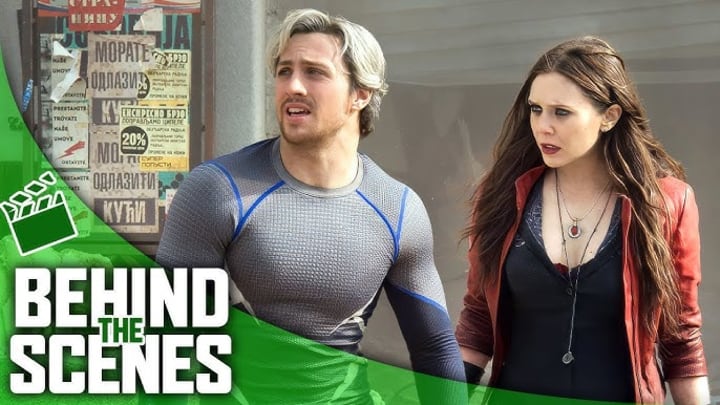
Elizabeth Olsen as Wanda Maximoff/Scarlet Witch captured the character's internal conflict and raw power, while Aaron Taylor-Johnson as Pietro Maximoff/Quicksilver delivered a memorable performance, showcasing his speed and heroic sacrifice.
James Spader as Ultron was a revelation, lending the robotic villain a chillingly calm and intellectual malevolence. His voice acting, combined with the advanced motion capture technology, created a truly unforgettable antagonist. Paul Bettany, previously the voice of JARVIS, made his physical debut as Vision, portraying the synthezoid's innocence, wisdom, and immense power with grace and sensitivity.
Reviews:
"Avengers: Age of Ultron" received generally positive reviews, but the reception was more mixed compared to its predecessor. Critics praised the action sequences, visual effects, and the performances of the cast, particularly James Spader as Ultron. However, some felt the film was overcrowded, with too many characters and plot threads competing for attention. The pacing was also criticized, with some finding the film rushed in certain areas and lacking the emotional resonance of the first Avengers film.
Audience reviews were similarly divided. Many praised the spectacle and entertainment value of the film, appreciating the thrilling action and the development of the characters. However, some felt the film lacked the freshness and originality of the first Avengers movie and criticized certain plot choices, such as the handling of the relationship between Black Widow and Bruce Banner.
Production:
The production of "Avengers: Age of Ultron" was a massive undertaking, involving a budget of approximately $365 million. Marvel Studios, under the guidance of Kevin Feige, oversaw the entire process, ensuring that the film aligned with the established MCU narrative. Joss Whedon, who had directed the first Avengers film to great success, returned to write and direct the sequel.
The film was produced by Marvel Studios and distributed by Walt Disney Studios Motion Pictures. It was heavily influenced by the "Ultron Unlimited" comic book storyline, but Whedon took liberties to suit the narrative he wanted to convey.
Writing and Casting:
Joss Whedon faced the daunting task of crafting a screenplay that could balance the needs of numerous characters, introduce new players, and advance the overarching narrative of the MCU. He aimed to explore the themes of control, responsibility, and the potential for technology to both save and destroy humanity. The casting process was extensive, with Elizabeth Olsen and Aaron Taylor-Johnson being chosen to play Wanda and Pietro Maximoff respectively. James Spader's casting as Ultron was particularly inspired, bringing a unique blend of intelligence and menace to the character.
Principal Photography:
Filming began in February 2014 and took place in various locations around the world, including South Africa, Italy, South Korea, and the United Kingdom. The shoot was reportedly challenging, with Whedon experiencing creative clashes with Marvel Studios. One humorous anecdote from the set involves Chris Evans constantly pranking Scarlett Johansson, leading to playful on-set rivalries. Another involved the cast struggling to pronounce "vibranium" correctly, leading to numerous takes and much amusement.
Production Design:
The production design of "Avengers: Age of Ultron" was meticulously crafted to create a visually stunning and immersive world. The sets were grand and detailed, ranging from the Avengers Tower to the ruined streets of Sokovia. Costume design played a crucial role in distinguishing the characters and conveying their personalities. Iron Man's new armor, the Mark XLIII, was a particular highlight, showcasing the technological advancements of Stark Industries. The visual aesthetics of Ultron and his drones were also carefully considered, creating a sense of both technological sophistication and menacing uniformity.
Sound Design & Music:
The sound design of the film was powerful and immersive, creating a visceral experience for the audience. The clash of metal, the roar of explosions, and the subtle hum of technology were all expertly crafted to enhance the action sequences and build tension. Brian Tyler composed the musical score, which built upon the themes established by Alan Silvestri in the first Avengers film. The score was epic and heroic, underscoring the scale of the conflict and the emotional weight of the characters' journeys.
Visual Effects:
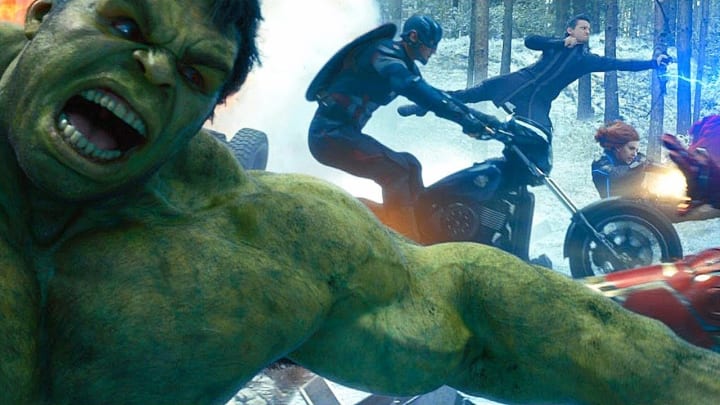
The visual effects in "Avengers: Age of Ultron" were groundbreaking, pushing the boundaries of what was possible in cinematic storytelling. The creation of Ultron and his drones was a visual marvel, bringing to life a complex and menacing robotic army. The Hulk's appearance was also significantly enhanced, with more realistic movements and facial expressions. The climactic battle in Sokovia was a showcase of visual effects prowess, with the city's destruction and the Avengers' heroic efforts brought to life in stunning detail.
Influences:
"Avengers: Age of Ultron" drew inspiration from various sources, including the "Ultron Unlimited" comic book storyline, which explored Ultron's desire to eradicate humanity. The film also drew upon themes of artificial intelligence and the dangers of unchecked technological advancement, echoing ideas explored in classic science fiction films like "Frankenstein" and "2001: A Space Odyssey."
Scientific Knowledge :
The film incorporates elements of scientific concepts, albeit often in a highly fictionalized manner. The concept of artificial intelligence is central to the plot, with Ultron representing a rogue AI that achieves sentience and develops its own agenda. The film also touches upon the properties of vibranium, a fictional metal with unique energy-absorbing capabilities. While the scientific accuracy of these elements is debatable, they serve to enhance the film's narrative and create a sense of technological plausibility.
Marketing, Release & Box Office:
The marketing campaign for "Avengers: Age of Ultron" was extensive and highly effective, generating immense hype leading up to the film's release. Trailers, TV spots, and online promotions showcased the film's action, humor, and the stakes involved. The film was released in international markets in late April 2015 and in the United States on May 1, 2015. It was a massive box office success, grossing over $1.4 billion worldwide, making it one of the highest-grossing films of all time.
Critical Responses:
"Avengers: Age of Ultron" remains a subject of debate among fans and critics. While praised for its action, visual effects, and performances, it was criticized for its crowded plot, pacing issues, and lack of emotional resonance compared to the first Avengers film. Despite these criticisms, the film remains a significant chapter in the MCU, paving the way for future storylines and character developments. Its exploration of the potential dangers of technology and the consequences of superhero intervention continues to resonate with audiences, making it a complex and compelling entry in the Marvel Cinematic Universe. The lasting impact of "Age of Ultron" lies not only in its box office success but also in its contribution to the ongoing evolution of the MCU, exploring themes of responsibility, sacrifice, and the enduring power of teamwork in the face of overwhelming odds.
About the Creator
Xavier
Global news reporter covering science, tech, environment, Entertainment & sports. Delivering balanced insights to inform and inspire readers worldwide. Sometimes a poet.
Silver Screen Magic with Mae West
American actress and singer Mae West became a popular film actress during the Great Depression. She started entertaining in vaudeville, then performed on Broadway, and finally went to Hollywood. She signed up with Paramount Pictures and made her debut in the 1932 film “Night After Night.” She also starred in musicals, comedies, and crime dramas. The American Film Institute named her one of the best classic Hollywood actresses.
By Rasma Raisters6 days ago in Geeks
Landman Season 2 Episode 8 Breakdown: The Twist That Changes Everything
Landman Season 2 is racing toward its final showdown, and right before the finale, the show suddenly slams the brakes and pivots in a direction nobody saw coming. With only two episodes left, the writers are clearly setting Tommy up for an ending that most of us did not expect—so we need to unpack it.
By Bella Anderson8 days ago in Geeks



Comments
There are no comments for this story
Be the first to respond and start the conversation.