
Time for Bob Iger to Resign from Disney Following YouTube TV ESPN Power Move
A $4-million-a-day blackout exposed the cracks inside Disney’s leadership, its boardroom, and its shrinking leverage in the streaming era.

In late October, Disney made a move it thought would force Google’s hand. In the middle of a contract dispute with YouTube TV, Disney pulled its entire suite of channels from the platform: ESPN, ABC, FX, National Geographic, Disney Channel — gone in an instant. Millions of subscribers woke up to a blank screen.
For Disney, this was supposed to be leverage.
For YouTube TV, it was an inconvenience.
For the industry, it was a preview of something bigger:
the balance of power in media has shifted, and Disney isn’t the heavyweight it used to be.
What followed was a negotiation that quietly cost Disney around $4 million a day — a burn rate that balloons into well over $1.2 billion a year. And by the time the dust settled, it was clear who walked away with the upper hand.
This wasn’t just a carriage dispute.
It was a mirror held up to Disney’s leadership, its board, its strategy, and its increasingly fragile place in the modern media ecosystem.
Today, Disney looks less like a titan and more like a legacy giant struggling to adjust to the rules of a game it used to dominate.
When Disney Pulled the Plug — and Nothing Happened
The blackout began on October 30th. Disney pulled the nuclear option, assuming YouTube TV would rush to restore its channels. This was the model that worked for decades with cable companies: pull your channels, create a public panic, force the distributor to pay up.
But this wasn’t Comcast or Charter.
This was YouTube TV — backed by Google, insulated by diversified revenue streams, and supported by a subscriber base already used to disruptions in the streaming era.
YouTube TV didn’t cave.
It didn’t budge.
And crucially, it didn’t lose its audience.
Consumers shrugged and said, “Well, I guess I’ll watch something else.”
For Disney, that reaction was devastating.
The Deal: A Win for YouTube TV, A Warning Shot for Disney
When Disney’s channels finally returned, YouTube TV announced the resolution with a tone that sounded almost celebratory. Subscribers got everything back — plus access to ESPN’s new direct-to-consumer offering — without a price increase.
From the outside, it looked like YouTube TV got the better deal while Disney quietly retreated. The company that once bullied distributors into paying more for its content now looked like it had outrun its leverage.
This wasn’t just an unfavorable negotiation.
It was Disney discovering, maybe for the first time, that tech platforms aren’t intimidated by its programming.
Disney lost the battle in public view, but the larger war is what matters most.
The Billion-Dollar Burn Rate No One Can Ignore
A $4 million-per-day loss isn’t something Wall Street just shrugs off. Disney is already under pressure:
Disney+ continues to struggle with profitability
ESPN is caught between declining cable economics and uncertain streaming growth
Theme-park attendance is softening
Creative output is inconsistent
Operating costs are ballooning
And the stock has spent a decade going nowhere
Disney should be one of the most valuable companies in the world.
Instead, it’s functioning like a company stuck in strategic limbo.
When you add a billion-dollar dispute loss to the pile, it becomes harder to pretend everything is fine.
Bob Iger Returned to Fix Disney — But the Problems Are Deeper Than His Legacy
Bob Iger’s return was supposed to be the steady hand guiding Disney through turbulence. Instead, this standoff highlighted a problem his presence can no longer hide: the company’s fundamentals are misaligned with the modern media landscape.
Consider the basics:
Disney owns the strongest catalog in entertainment
It controls a theme-park empire that prints money
It holds ESPN, one of the last remaining anchors of live TV
Its IP portfolio is unmatched: Marvel, Star Wars, Pixar, Lucasfilm, ABC, and more
Its merchandising and licensing reach is global
Yet with all that, Disney is valued around $200 billion, not the trillion-dollar tier where it should be.
That gap isn’t about brand identity.
It’s about management.
A company doesn't end up stagnant for ten years by accident.
The Board Problem Disney Doesn’t Want to Discuss
A major undercurrent of Disney’s struggles sits inside its boardroom. Not because of political controversy, but because of imbalance.
Political donations and corporate disclosures suggest the board leans around 75% to 80% in one direction. The problem isn’t the direction — it’s the lack of diversity in perspective.
When a board tilts that far ideologically, you get:
Groupthink
Weak dissent
Misreading cultural signals
Overconfidence in narrow strategies
A blind spot to middle-America consumer behavior
And decisions that alienate customers without meaning to
Disney sells to everyone.
Its executive thinking does not reflect everyone.
That’s not culture-war rhetoric — that’s business reality.
Theme parks depend on families.
Merchandising depends on mainstream consumers.
Streaming depends on broad interest, not niche ideals.
A board that doesn’t match the customer base risks misunderstanding the customer base.
And over the last five years, Disney has repeatedly run into exactly that problem.
The Flywheel Disney Should Control — But Doesn’t
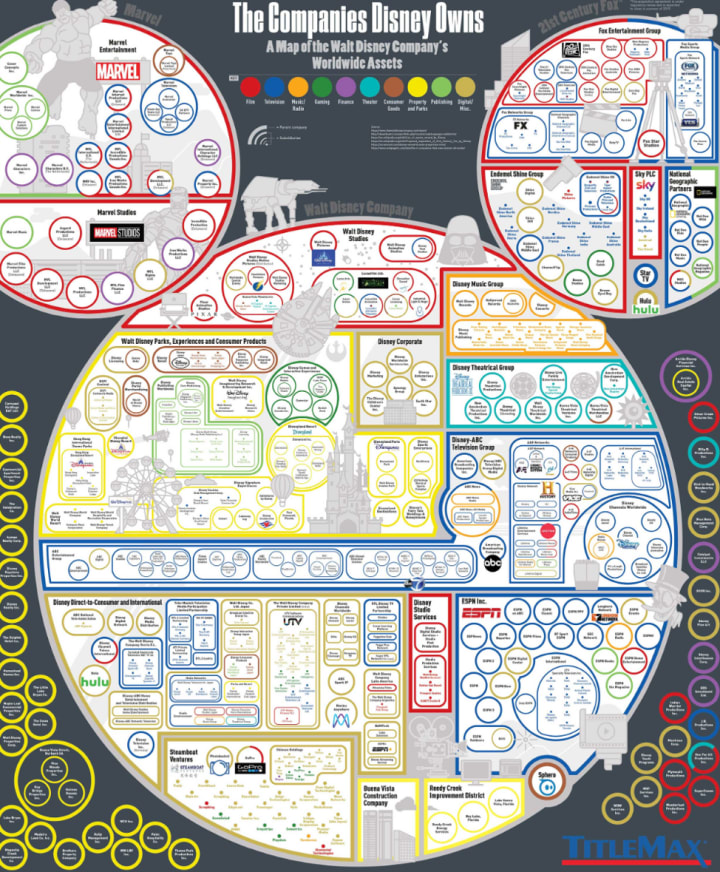
Take a step back and look at the Disney “flywheel,” the visual map of its interconnected businesses — parks, movies, merchandise, streaming, networks, sports, cruises, licensing, and more.
It’s a machine that should compound value.
Instead, it’s misfiring.
A company with that kind of ecosystem shouldn’t be stagnating in valuation. It shouldn’t be getting outmaneuvered in carriage disputes. It shouldn’t be spending billions just to maintain the status quo.
When your flywheel has Star Wars, Marvel, ESPN, Pixar, ABC, NatGeo, and theme parks feeding each other, you should be unstoppable.
But Disney is stuck trying to remind the world of the magic it used to create effortlessly.
The Dispute Wasn’t the Cause — It Was the Symptom
The most important takeaway from the YouTube TV fight isn’t who “won.” It’s what the fight signaled:
Disney can no longer throw its weight around and expect the world to fall in line.
Tech companies hold more leverage.
Consumers have more alternatives.
The public is less loyal to brands.
And the old cable-era playbook is collapsing.
YouTube TV wasn’t intimidated.
Google doesn’t fear losing Disney.
And subscribers barely blinked.
That’s the real story.
Where Disney Goes From Here
Disney’s future hinges on acknowledging what this dispute made unavoidable:
The board needs ideological and managerial restructuring
Leadership must adapt to a world where tech platforms dominate distribution
ESPN’s future must be stabilized with a real streaming roadmap
Disney+ must become profitable or be rethought entirely
The company must reconnect with mainstream families
The flywheel needs direction, not just nostalgia
Because right now, Disney is operating like a company still coasting on its past — while the world around it moves at Google speed.
The $4 million-a-day standoff wasn’t a fluke.
It was a forecast.
If Disney doesn’t change course, the next negotiation won’t just cost them money. It’ll cost them relevance.
About the Creator
Lawrence Lease
Alaska born and bred, Washington DC is my home. I'm also a freelance writer. Love politics and history.
Keep reading
More stories from Lawrence Lease and writers in Geeks and other communities.
WWE Need To Show RUTHLESS AGGRESSION To Make Its Next John Cena
John Cena didn’t tiptoe onto WWE’s main roster — he kicked the damn door down. In 2002, he stepped up to Kurt Angle, dropped the now-legendary “ruthless aggression” line, and punched one of WWE’s top stars right in the mouth. It was loud, bold, and exactly the kind of debut that sticks to you for life. WWE made sure you knew this kid was somebody. Those early weeks were designed to scream, “He’s the future — watch him.”
By Lawrence Lease2 months ago in Geeks
Silver Screen Magic with Mae West
American actress and singer Mae West became a popular film actress during the Great Depression. She started entertaining in vaudeville, then performed on Broadway, and finally went to Hollywood. She signed up with Paramount Pictures and made her debut in the 1932 film “Night After Night.” She also starred in musicals, comedies, and crime dramas. The American Film Institute named her one of the best classic Hollywood actresses.
By Rasma Raisters6 days ago in Geeks

Comments
There are no comments for this story
Be the first to respond and start the conversation.