
The Bridges of Madison County (1995): A Secret Masterpiece in Plain Sight
The Secret Cinema Masterpiece You Thought Was Just a Boomer Romance.

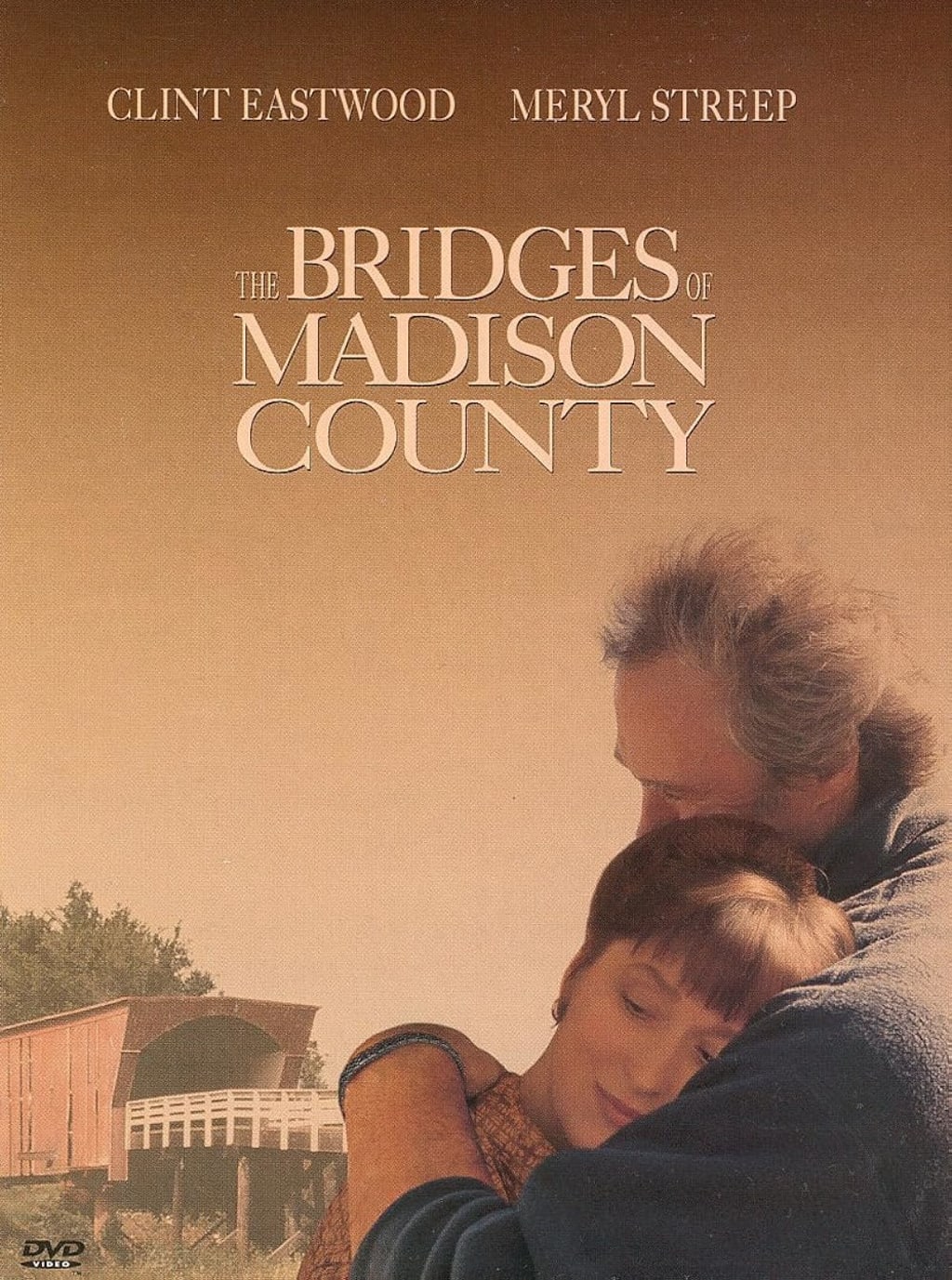
The Bridges of Madison County (1995) Review
Directed by: Clint Eastwood
Written by: Richard LaGravenese
Starring: Meryl Streep, Clint Eastwood
Release Date: June 2, 1995
“Clint Eastwood’s Masterpiece in Disguise: Unpacking the Hidden Genius of The Bridges of Madison County”
⸻
The Quietest Blockbuster
Clint Eastwood, best known as the stoic gunslinger of Unforgiven and The Man with No Name, wasn’t the obvious choice to adapt Robert James Waller’s 1992 bestselling novel The Bridges of Madison County. His reputation for gritty, bombastic films seemed ill-suited to a gentle, introspective romance. Even Eastwood himself initially didn’t see the fit.
Steven Spielberg first secured the rights and hired screenwriter Richard LaGravenese, envisioning a faithful, emotionally resonant adaptation. Spielberg even considered directing after Schindler’s List, but eventually passed. Sidney Pollack and Robert Redford were both linked to the project, with Redford as a potential lead opposite Meryl Streep. When deals couldn’t be reached, Eastwood, already loosely attached to star, stepped in as director to meet Warner Bros.’ production deadline.
The result? A quietly devastating film that stands as one of Eastwood’s most accomplished—and misunderstood—works.
⸻
Framing the Story: Perception and Reality
The film’s structure is its hidden genius. Francesca Johnson (Meryl Streep), a married Italian immigrant living in rural Iowa, leaves behind three notebooks for her adult children, Michael (Victor Slezak) and Carolyn (Annie Corley), after her death. These notebooks detail a four-day love affair in 1965 with photographer Robert Kincaid (Eastwood). Her dying wish—to have her ashes scattered at Roseman Covered Bridge rather than buried beside her husband Richard (Jim Haynie)—shatters her children’s image of her.
Michael’s anger and Carolyn’s curiosity set the tone for the story. Their reactions mirror the audience’s. We initially view Francesca’s affair as a distant, polite narrative: interactions between her and Robert seem muted, almost mundane. This isn’t accidental—it’s the filter through which Michael and Carolyn, and we as viewers, are perceiving her story.
⸻
A Deliberate Slow Burn
Eastwood and Streep’s performances, often understated, reflect this filtered perspective. Francesca’s passion is initially invisible, her flirtations buried beneath surface politeness. We don’t witness the magnetic pull between her and Robert because, in these early scenes, neither do her children. They’re grappling with the realization that their mother was more than a dutiful wife and mother; she was a woman with desires, agency, and a capacity for profound love.
Robert, too, is filtered through Francesca’s recollections and her children’s evolving understanding. Eastwood plays him not as a man of unbridled passion but as a romanticized figure—a creation of Francesca’s memory, softened by time and longing. His performance is deliberate, embodying not Robert Kincaid the man, but Robert Kincaid as Francesca imagines him.
⸻
The Power of Cinematic Precision
Many viewers—and even I, on my first watch—might find the first two acts dry, even dull. The muted colors, the lack of a sweeping score, the sparse dialogue—these choices risk alienating audiences accustomed to overt cues of romance and drama. But Eastwood is inviting us to look deeper, to experience cinema at its most granular. His refusal to spoon-feed emotion mirrors Francesca’s children’s struggle to comprehend her story.
It’s in the third act that everything coalesces. The narrative shifts: Francesca’s voice emerges in full, her longing and regret vivid and unfiltered. The score swells, the cinematography blooms with color and movement, and we finally witness the heartache and passion she lived and lost.
The film’s emotional climax—Francesca’s silent choice at the intersection, her hand on the door handle as Robert waits in the rain—is a masterclass in cinematic storytelling. The camera, mirroring Francesca’s gaze, follows Robert’s truck as it turns away, while Richard obliviously rolls up the window, symbolically closing the door on her secret. It’s subtle, devastating, and far more powerful than any grand romantic gesture.
⸻
Legacy and Revelation
The Bridges of Madison County was marketed—and often dismissed—as a conventional romance for older audiences. I, too, approached it with skepticism, ready to critique its sentimentality. But watching it for the film’s 30th anniversary, I realized how thoroughly Eastwood subverted expectations.
By withholding overt emotion until the third act, Eastwood transforms what could have been a simple melodrama into a profound meditation on memory, perception, and the compromises of a lifetime. Francesca’s children—and we—come to see her not as a paragon of maternal virtue, but as a fully realized woman, shaped by longing and loss.
⸻
Why This Film Matters
Eastwood’s film isn’t without flaws. His later efforts (The 15:17 to Paris, Trouble with the Curve) failed to replicate the intricate balance of this film. But The Bridges of Madison County remains a singular achievement—a movie that challenges us to look past surface sentimentality and embrace the subtleties of human connection.
It’s a film that rewards patience, attention, and openness to ambiguity. For those willing to meet it on its terms, it offers a deeply moving, technically brilliant meditation on love, regret, and the stories we leave behind.
⸻
A Call to Reevaluate
I once thought The Bridges of Madison County was a nostalgic relic for boomers. Now, I see it as a secret masterpiece, a testament to Eastwood’s precision and Streep’s extraordinary subtlety. This is cinema that doesn’t just tell a story—it shows us how stories are told, remembered, and transformed over time.
I offer this reappraisal not as a definitive statement, but as an invitation: watch The Bridges of Madison County again, with fresh eyes. Look beyond the quiet surface and discover the storm of emotion and craftsmanship underneath. It’s worth it.

About the Creator
Sean Patrick
Hello, my name is Sean Patrick He/Him, and I am a film critic and podcast host for the I Hate Critics Movie Review Podcast I am a voting member of the Critics Choice Association, the group behind the annual Critics Choice Awards.
Keep reading
More stories from Sean Patrick and writers in Geeks and other communities.
Silver Screen Magic with Mae West
American actress and singer Mae West became a popular film actress during the Great Depression. She started entertaining in vaudeville, then performed on Broadway, and finally went to Hollywood. She signed up with Paramount Pictures and made her debut in the 1932 film “Night After Night.” She also starred in musicals, comedies, and crime dramas. The American Film Institute named her one of the best classic Hollywood actresses.
By Rasma Raisters5 days ago in Geeks
Premier League in Singapore: How to Watch
The 2025–26 Premier League season is underway, marking the 34th edition of the competition and the 127th year of top-flight English football. Liverpool start their title defense with confidence after lifting their second Premier League trophy last season, but the return of Leeds United, Burnley, and Sunderland ensures fresh rivalries – including the long-awaited Tyne–Wear derby, back for the first time since 2015–16.
By David Cook2 days ago in Geeks




Comments
There are no comments for this story
Be the first to respond and start the conversation.