
Tess (1980): How Polanski’s Troubled Production Made a Pastoral Masterpiece
From on-set strikes and the death of Geoffrey Unsworth to Nastassja Kinski’s breakout performance and multiple Oscars, here’s how Roman Polanski’s fraught shoot produced one of the most beautiful period films of the 1980s.

Movies of the 80s recognizes that content surrounding someone like Roman Polanski can be controversial and hurtful to those who've been through similar trauma. This article is not intended to venerate Roman Polanski the man but rather, to discuss a movie that is a great work of art despite the character of its creator.
A Pastoral Film Born From Chaos
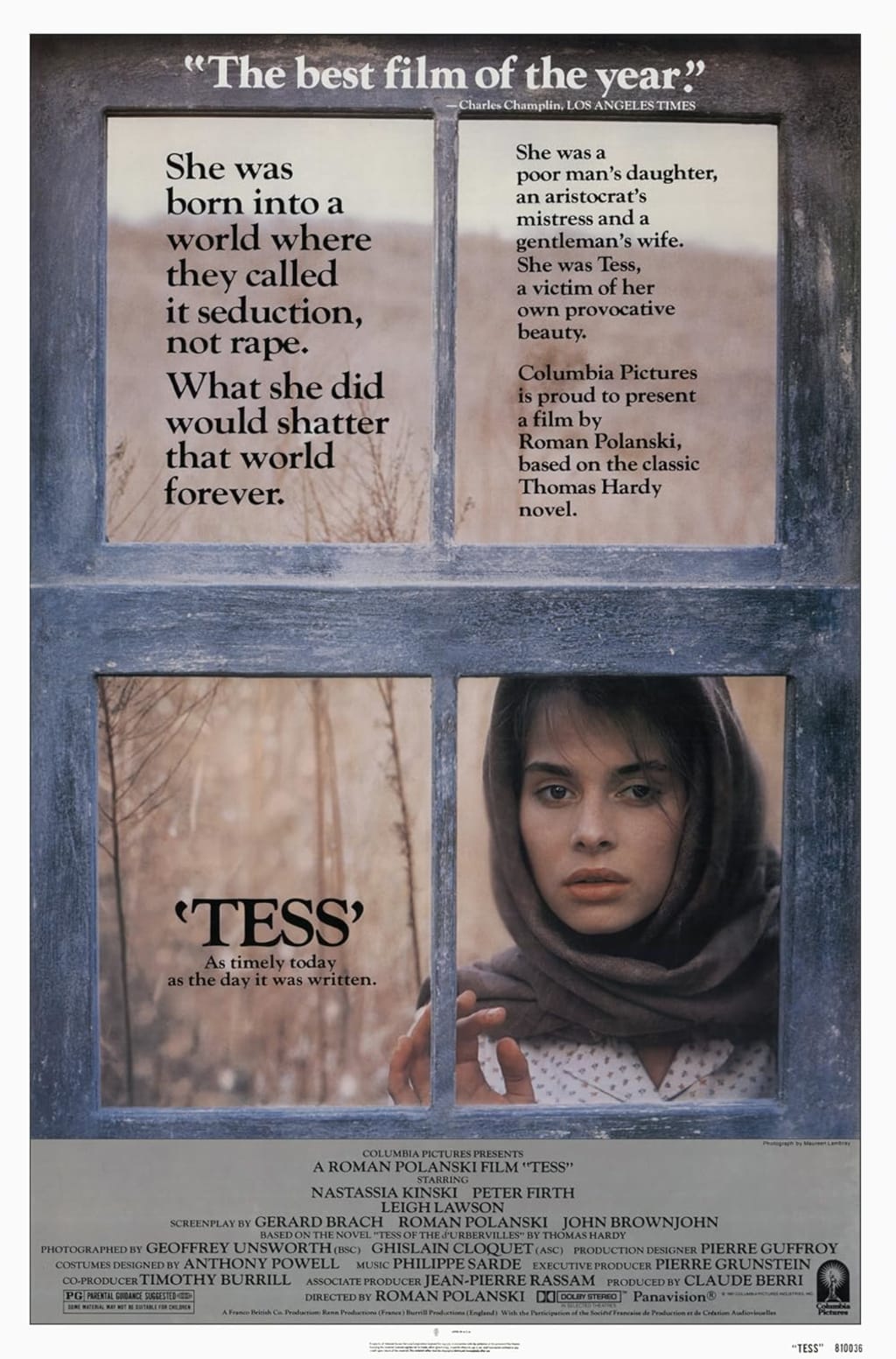
Roman Polanski’s Tess might be the most paradoxical film of the early 1980s. Adapted from Thomas Hardy’s Tess of the d’Urbervilles, the movie glows with pastoral beauty and painterly restraint. Yet behind the camera was a production riddled with strikes, tragedy, and the looming shadow of Polanski’s exile. Out of that storm came a three-hour film that critics praised as one of the decade’s most luminous literary adaptations.
⸻
Strikes, Seasons, and a Death on Set
Polanski’s ambition was to shoot Hardy’s rural England in a natural rhythm, following the seasons across the French countryside. Production moved between Normandy and Brittany, but the pastoral vision came at a cost: frequent strikes by French technicians slowed progress and stretched an already lengthy schedule.
Then came a blow that reshaped the film. Geoffrey Unsworth, one of Britain’s great cinematographers, suffered a fatal heart attack during the shoot. He had already filmed many of the sweeping exterior sequences, suffused with weathered light and epic scale. French cinematographer Ghislain Cloquet stepped in to complete the interiors. Together, their work was honored posthumously with the Academy Award for Best Cinematography — a bittersweet recognition that memorialized Unsworth’s final images.
⸻
Nastassja Kinski’s Breakthrough and Controversy
The film would not exist without Nastassja Kinski. As Tess, she is both vulnerable and radiant, embodying Hardy’s heroine as a figure shaped and destroyed by fate. Her performance launched her to international stardom. But her off-screen relationship with Polanski has long complicated how the film is remembered.
Reports from the era described a close, sometimes romantic attachment between director and star, a dynamic that has been reassessed in the decades since. Kinski herself has offered shifting perspectives on their connection. For some viewers, this history casts a shadow over the film. For others, her performance remains a testament to her talent, regardless of the circumstances.
⸻
Critical Reception: From Ebert to the Academy
When Tess premiered in 1979 in France and later reached U.S. audiences in 1980, critics were struck by its painterly elegance. Roger Ebert praised it as a “wonderful film” about doomed sexuality and inevitability, noting that Polanski resisted sensationalism in favor of a slow, tragic drift toward fate.
The Academy responded in kind. Tess earned six Oscar nominations, including Best Picture and Best Director. It ultimately won three — for cinematography, art direction, and costume design — cementing its reputation as a work of extraordinary craft. While it lost Best Picture to Robert Redford’s Ordinary People, its technical triumphs guaranteed its place in film history.
⸻
Legacy: Beauty in Tension
Seen today, Tess is inseparable from the contradictions of its creation. The luminous landscapes and period textures exist because of an arduous shoot that dragged cast and crew across the French countryside. The Oscar-winning cinematography is forever tied to the death of Geoffrey Unsworth. The breakthrough performance of Nastassja Kinski cannot be discussed without addressing her relationship with Polanski.
And yet, the film endures. For many, Tess is one of the most visually stunning adaptations ever put to screen, a film where tragedy behind the camera seems to mirror the inexorable tragedy of Hardy’s novel. It stands as proof that beauty can emerge from chaos — and that sometimes, the messiness of production history becomes part of a movie’s very soul.

Subscribe to Movies of the 80s on YouTube for more on Tess, and many, MANY, more Movies of the 80s.
About the Creator
Movies of the 80s
We love the 1980s. Everything on this page is all about movies of the 1980s. Starting in 1980 and working our way the decade, we are preserving the stories and movies of the greatest decade, the 80s. https://www.youtube.com/@Moviesofthe80s
Keep reading
More stories from Movies of the 80s and writers in Geeks and other communities.
Clyde’s Revenge: The Wild Story Behind Any Which Way You Can
When Clint Eastwood released Every Which Way But Loose in 1978, audiences weren’t quite sure what to expect. The world’s most famous tough guy, known for his squints and six-shooters, was suddenly playing a laid-back trucker with a mischievous orangutan sidekick. It sounded absurd—but the film became a massive box office hit. Two years later, Eastwood returned with Any Which Way You Can (1980), a sequel that doubled down on the oddball comedy, the bare-knuckle brawling, and most importantly, Clyde the orangutan.
By Movies of the 80s4 months ago in Geeks
Silver Screen Magic with Mae West
American actress and singer Mae West became a popular film actress during the Great Depression. She started entertaining in vaudeville, then performed on Broadway, and finally went to Hollywood. She signed up with Paramount Pictures and made her debut in the 1932 film “Night After Night.” She also starred in musicals, comedies, and crime dramas. The American Film Institute named her one of the best classic Hollywood actresses.
By Rasma Raisters4 days ago in Geeks



Comments
There are no comments for this story
Be the first to respond and start the conversation.