
Terrifying Nature
The Sublime in Mary Shelley's "Frankenstein" (1818)

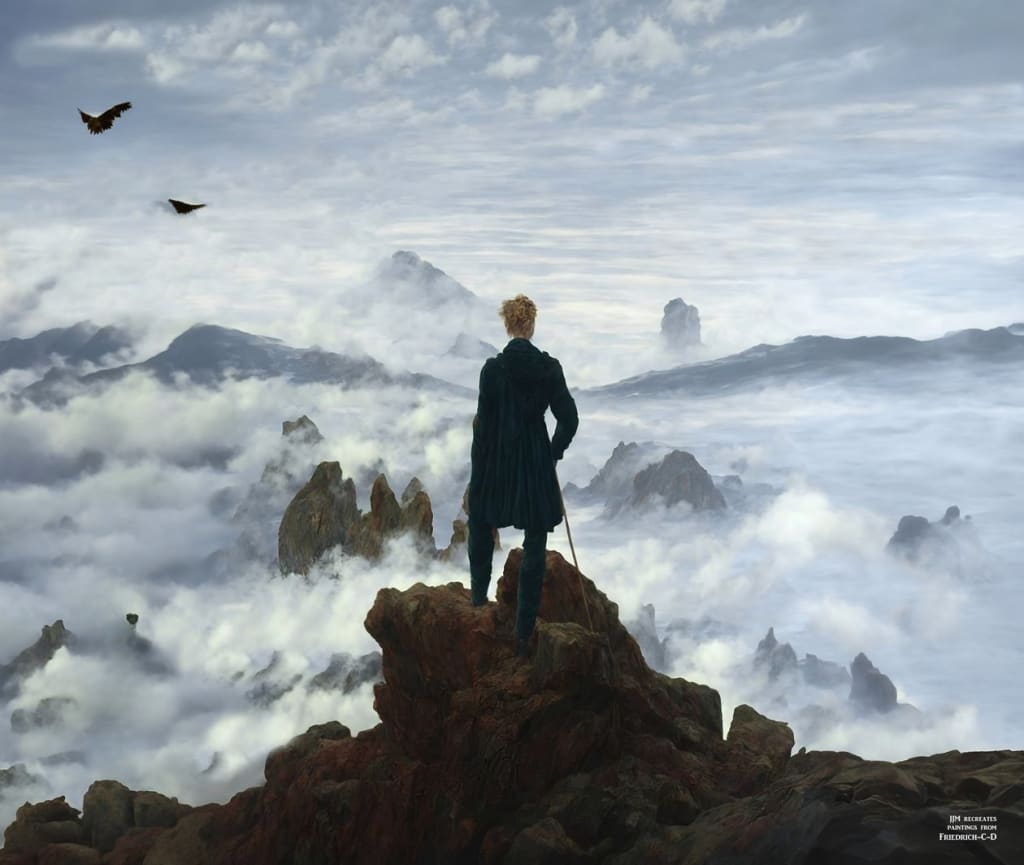
The concept of the sublime, rooted in eighteenth-century aesthetic philosophy, refers to an experience that provokes both awe and terror in the face of something vast, overwhelming, or transcendent. Edmund Burke, in A Philosophical Enquiry into the Origin of Our Ideas of the Sublime and Beautiful (1757), distinguishes the sublime from the merely beautiful by its capacity to evoke astonishment through vastness, obscurity, and power. For Burke, the sublime is “productive of the strongest emotion which the mind is capable of feeling” (Burke, 1998, p. 36), often emerging in natural phenomena such as: storms, mountains, and oceans. Immanuel Kant similarly viewed the sublime as a confrontation with nature’s might that simultaneously humbles and elevates the perceiver by revealing the limits of human comprehension and control.
In Frankenstein (1818), Mary Shelley draws heavily on these notions of the sublime to depict nature as both beautiful and terrifying, and crucially, as a force indifferent to human suffering or ambition. Set against a backdrop of the Romantic movement’s reverence for nature, Shelley’s novel complicates this ideal by portraying nature not only as a source of inspiration and solace, but also as a mirror to the psychological disarray of its characters. Through sublime landscapes: jagged Alpine peaks, wild storms, and icy Arctic expanses – Shelley evokes emotional extremes that mirror the turmoil within Victor Frankenstein and his Creature. These vast and unyielding environments are more than just atmospheric; they become central to the novel’s exploration of humanity’s place in the natural world, and of the costs of transgressing natural boundaries.
Shelley thus uses the sublime to interrogate Enlightenment ideals of reason and mastery over nature. As Anne K. Mellor argues, Frankenstein reveals the dangers of attempting to dominate the natural world through science, highlighting “the destructive consequences of scientific hubris” (Mellor, 1988, p. 38). Also, the Creature’s responses to natural sublimity reflect a yearning for belonging and transcendence, even as he is constantly cast out and marginalised. The sublime, then, becomes not only a motif of aesthetic power but also an ethical and philosophical force that underscores the fragility and isolation of human experience. In Frankenstein, Shelley harnesses the sublime to reflect inner turmoil, the limits of human ambition, and the vast, indifferent forces of nature that ultimately shape human destiny.
Lightning Strikes a Tree

One of the earliest and most symbolic moments of the sublime in Frankenstein occurs during Victor Frankenstein’s youth, when he witnesses a lightning storm that obliterates an oak tree near his home. He describes the scene in dramatic and almost reverential terms:
“As I stood at the door, on a sudden I beheld a stream of fire issue from an old and beautiful oak... and so soon as the dazzling light vanished, the oak had disappeared, and nothing remained but a blasted stump.”
The language here is steeped in the vocabulary of the sublime: “stream of fire,” “dazzling light,” “blasted stump” suggesting an overwhelming natural force that is both awe-inspiring and terrifying.
This moment is pivotal, marking Victor’s first encounter with the immense and destructive power of nature. The sublime quality of the scene lies not only in the scale and suddenness of the event, but in its emotional and philosophical resonance. Lightning becomes a symbol of divine power or Promethean fire, setting Victor on a path toward the dangerous pursuit of forbidden knowledge. As Gigante notes, this storm “reanimates nature’s fearful symmetry,” reminding the young Victor of the thin boundary between beauty and terror (Gigante, 2007, p. 565). The sublime thus acts as a seductive force, tempting him with its grandeur while also foreshadowing his downfall.
Also, the destruction of the “old and beautiful oak” is often read as symbolic of Victor’s loss of innocence and the beginning of his alienation from the natural order. The scene also prefigures his fascination with galvanism and electricity which are key elements in his later experiments. As Esther Schor suggests, Shelley uses natural phenomena like lightning not only to externalise inner states of wonder and fear, but also to question the Enlightenment's optimistic faith in scientific progress: “the sublime moment annihilates the self while offering it a glimpse of a power it may never fully comprehend or control” (Schor, 2003, p. 195).
Through this episode, Shelley establishes a recurring motif: the sublime in nature is a source of revelation and inspiration, but it is also a warning. Nature’s grandeur cannot be harnessed without consequence, and those who attempt to do so, like Victor, are often undone by their ambitions.
Mont Blanc & the Alps
Following the traumatic murder of his younger brother William, Victor Frankenstein turns to the natural world for solace. Travelling into the Swiss Alps, he immerses himself in landscapes of towering mountains and glacial valleys, describing them with reverence:
“These sublime and magnificent scenes afforded me the greatest consolation that I was capable of receiving.”
Shelley’s use of the sublime here draws upon the Romantic belief in nature as a source of emotional and spiritual renewal, echoing Wordsworth's ideas of the natural world as a moral and restorative force.
Mont Blanc, with its immensity and seeming permanence, offers Victor a temporary reprieve from grief and guilt. The vastness of the Alps dwarfs human concerns, reminding Victor of the insignificance of individual suffering within the grand scale of nature. As Paul Cantor notes, “Shelley contrasts the permanence of nature with the transience and destructiveness of human ambition” (Cantor, 1984, p. 40). The sublime landscape does not erase Victor’s pain, but it momentarily reorients him, evoking both awe and humility.
Yet Shelley undercuts this solace with dramatic irony: it is within this very sublime setting that Victor encounters the Creature, the embodiment of his scientific overreach and emotional denial. The reappearance of horror in the midst of natural grandeur suggests that the sublime cannot offer lasting refuge. As Saree Makdisi argues, “the sublime in Frankenstein is never purely restorative; it is always shadowed by a return of the repressed” (Makdisi, 2010, p. 858). Beauty and terror, awe and dread, are shown to be inseparable components of the sublime.
The mountains also serve as a formative environment for the Creature, who has spent time observing nature and learning from it. It is in the wilderness that he gains consciousness of himself and the world. His dialogue with Victor on Montanvert reveals a complex being shaped, in part, by the same natural sublime that consoles his creator. Nature, then, is not simply a backdrop, but an active force in the development of both men; highlighting the ambiguity of the sublime as both nurturing and indifferent.
The Creature's Experience of Nature

The Creature’s first conscious encounters with the natural world are steeped in the sublime, as he begins to interpret the rhythms of the environment with a blend of wonder, fear, and melancholy. Reflecting on his earliest experiences, he recalls:
“Autumn passed thus. I saw, with surprise and grief, the leaves decay and fall…”
The juxtaposition of “surprise and grief” reveals the ambivalence of his emotional response; the natural cycle of decay is beautiful, yet it also unsettles him, introducing an awareness of transience and loss.
Nature, for the Creature, is not simply a physical space but an emotional and philosophical landscape. It becomes his first teacher, presenting lessons in light, warmth, cold, and hunger, as well as in beauty and solitude. His initial impressions of sunlight, birdsong, moonlight, and weather are full of sensory richness, evoking a childlike awe that aligns with the Romantic ideal of nature as a formative influence. As Marilyn Butler notes, “Shelley allows nature to instruct the Creature morally and emotionally, in contrast to the corrupting forces of society” (Butler, 1993, p. 21). Yet while nature awakens his sensibilities, it also deepens his isolation. He is overwhelmed not only by the grandeur of the world but by his exclusion from it.
The Creature’s developing consciousness is therefore marked by the sublime in an intense awareness of vastness, beauty, and his own insignificance. The autumnal decay of the leaves stirs in him not only aesthetic appreciation but also existential grief. As David Marshall observes, Shelley uses the sublime not just to glorify nature, but to illustrate the limits of human (or creaturely) belonging: “the sublime is always paired with a painful knowledge of one’s detachment from what is beheld” (Marshall, 1995, p. 104). The Creature, unloved and unacknowledged, is left to navigate a world whose beauty constantly reminds him of his aloneness.
This moment of reflection captures the tragic complexity of Shelley’s portrayal of the sublime: for the Creature, nature offers brief comfort but ultimately sharpens his awareness of exclusion and difference. His perception of seasonal change mirrors the emotional arc of his own life: starting in innocence and ending in sorrow. The sublime, far from being redemptive, is tinged with alienation.
The Arctic Wasteland

The novel’s framing narrative, set in the Arctic, opens and closes the text with imagery of vast, frozen desolation. In one of his letters, Walton describes the landscape:
“We were compassed round by a very thick fog... the immense and rugged mountains of ice... afforded a scene of singular beauty.”
This setting epitomises the Romantic sublime marked by enormity, danger, and a kind of terrible beauty that evokes awe as well as dread. The Arctic is both breathtaking and hostile, a physical space that mirrors the psychological and moral extremities explored throughout the novel.
The frozen wasteland forms a symbolic borderland between the known and the unknowable, the human and the inhuman. For Walton, Victor, and the Creature, it becomes the site of confrontation and collapse; each drawn by a restless pursuit of knowledge, purpose, or revenge. As George Levine notes, “the Arctic represents the ultimate test of Romantic aspiration, a space where ambition meets the final resistance of nature” (Levine, 1973, p. 9). Victor's scientific ambition has brought him to this point of annihilation, and in Walton, Shelley presents a potential repetition of the same error, one she ultimately avoids through his decision to turn back.
Shelley’s Arctic is a sublime space not of inspiration, but of existential exposure. The landscape is indifferent to human presence. Its “rugged mountains of ice” offer no refuge or moral order; instead, they stand as eternal monuments to the futility of human striving. The sublime here is less restorative than ruinous. As Kari Lokke argues, “Shelley’s use of the polar sublime undermines the Romantic idealisation of heroic endeavour, exposing instead the moral emptiness at the heart of such quests” (Lokke, 1988, p. 253).
Therefore, the setting performs a dual function: it is both literal and symbolic, reflecting the extreme isolation and alienation that define each of the three central male figures. It also reinforces one of the novel’s core messages: that nature, in its immense power and indifference, exposes the limits of human ambition. The Arctic’s sublime vastness, its beauty inseparable from danger, serves as a final reckoning for all who sought to master or transcend natural boundaries.
Nature as Uncaring

Throughout Frankenstein, nature is a recurring presence that reflects and contrasts with the emotional states of Victor and the Creature. At times, it appears nurturing, even maternal, as in the early reflection:
“The very winds whispered in soothing accents, and maternal Nature bade me weep no more.”
Here, Shelley draws on Romantic conventions, presenting nature as a gentle, restorative force. The wind seems to personify nature as a caring presence, offering solace in moments of grief. This aligns with the Romantic notion that communion with the natural world can bring emotional healing and moral clarity.
However, this view becomes increasingly unstable as the novel progresses. In a later moment of despair, Victor bitterly observes:
“The cup of life was poisoned forever, and although the sun shone upon me... I saw around me nothing but a dense and frightful darkness.”
Here, the natural world continues as it always has: sunlight still bathes the earth, but Victor perceives only metaphorical darkness. His internal desolation overpowers the physical beauty of the world. Shelley suggests that nature, while immense and beautiful, is ultimately indifferent to human suffering.
This shift from consolation to alienation marks a critique of the Romantic idealisation of nature as innately benevolent. As Anne K. Mellor argues, Shelley “exposes the falsity of the assumption that nature will necessarily restore and console the suffering human heart” (Mellor, 1988, p. 120). Nature, for Victor, becomes unreliable; at one moment soothing, at another, a cruel reminder of all that has been lost. The sublime, in these instances, highlights not moral or emotional transcendence, but a terrifying sense of powerlessness.
This ambivalence also underscores Shelley’s broader philosophical concerns about the limits of human understanding. Nature cannot be mastered, interpreted, or trusted to follow emotional logic. As Andrew Bennett notes, Frankenstein “both inherits and destabilises the Romantic trust in nature, turning it into a backdrop against which human ambitions are mocked and revealed as tragically naïve” (Bennett, 1998, p. 143). Nature continues in its sublime grandeur, unmoved by human grief or guilt. Shelley thus uses the natural world to reveal the tragic disconnect between human emotion and the impersonal forces that govern existence.
Conclusion

In Frankenstein, Mary Shelley weaves the sublime through the fabric of the novel to explore the emotional, philosophical, and moral dimensions of human experience. The sublime, characterised by awe, fear, and a sense of overwhelming vastness, becomes more than a literary device, it is a vital thematic force. Whether in the crack of lightning that inspires Victor’s destructive ambition, the haunting majesty of Mont Blanc, the creature’s innocent wonder at the changing seasons, or the Arctic’s desolate grandeur, the sublime evokes both the terror and beauty of nature’s indifference.
Shelley draws heavily on Romantic ideals that celebrate nature’s power to elevate and console, yet she also interrogates and destabilises these ideals through Gothic horror. The sublime in Frankenstein is not always redemptive; it can be alienating, cruel, and destructive. The natural world does not offer moral guidance or resolution instead it exists beyond human control, and its beauty is often inseparable from terror.
All in all, the sublime is not merely a backdrop to the characters’ journeys: it is an active agent shaping their destinies. For Victor, it mirrors the consequences of unchecked ambition. For the Creature, it reflects both the wonder of life and the pain of isolation. Shelley’s landscapes do not simply reflect human emotion, they exceed it, reminding the reader that the natural world is a force both outside and above human mastery. In doing so, Frankenstein offers a powerful meditation on humanity’s fragile place within a vast and indifferent universe.
Works Cited:
- Bennett, A. (1998). Romantic Poets and the Culture of Posterity. Cambridge: Cambridge University Press.
- Burke, E. (1998). A Philosophical Enquiry into the Origin of Our Ideas of the Sublime and Beautiful. Oxford: Oxford University Press.
- Butler, M. (1993). Frankenstein: The 1818 Text, Oxford: Oxford University Press.
- Cantor, P.A. (1984). ‘The Nightmare of Romantic Idealism: The Problem of Frankenstein’, English Literary History, 48(3), pp. 535–561.
- Gigante, D. (2007). ‘Facing the Ugly: The Case of Frankenstein’, ELH, 74(2), pp. 565–587.
- Levine, G. (1973). The Realistic Imagination: English Fiction from Frankenstein to Lady Chatterley. Chicago: University of Chicago Press.
- Lokke, K. (1988). ‘The Last Man and the Ends of Humanism’, Studies in Romanticism, 27(2), pp. 249–258.
- Makdisi, S. (2010). ‘Frankenstein and the Ethic of Care’, Studies in Romanticism, 49(4), pp. 857–875.
- Marshall, D. (1995). The Frame of Art: Fictions of Aesthetic Experience, 1750–1815. Baltimore: Johns Hopkins University Press.
- Mellor, A.K. (1988). Mary Shelley: Her Life, Her Fiction, Her Monsters. New York: Routledge.
- Schor, E. (2003). The Cambridge Companion to Mary Shelley. Cambridge: Cambridge University Press.
- Shelley, M. (2008). Frankenstein; or, The Modern Prometheus [1818 edition]. Oxford: Oxford University Press.
About the Creator
Annie Kapur
I am:
🙋🏽♀️ Annie
📚 Avid Reader
📝 Reviewer and Commentator
🎓 Post-Grad Millennial (M.A)
***
I have:
📖 280K+ reads on Vocal
🫶🏼 Love for reading & research
🦋/X @AnnieWithBooks
***
🏡 UK
Keep reading
More stories from Annie Kapur and writers in Geeks and other communities.
Book Review: "The Men Who Made Hollywood" by Michael Freedland
You know I like reading books about film and I have mentioned over and over again in reviews and lists that if you want to know more about film then you should start reading books regarding films. Possibly one of the best is called The Big Screen by David Thomson - I mean, it is a fantastic book which goes over some historical and cultural contexts of earlier cinema eras. I've probably read over twenty or thirty books on film in my time and yet, I have never encountered the one we are about to go through. This is The Men Who Made Hollywood...
By Annie Kapur9 months ago in Geeks
Silver Screen Magic with Mae West
American actress and singer Mae West became a popular film actress during the Great Depression. She started entertaining in vaudeville, then performed on Broadway, and finally went to Hollywood. She signed up with Paramount Pictures and made her debut in the 1932 film “Night After Night.” She also starred in musicals, comedies, and crime dramas. The American Film Institute named her one of the best classic Hollywood actresses.
By Rasma Raisters7 days ago in Geeks
Kangana Ranaut Hints At Hrithik Roshan's ‘Controversial Legal Notice’ From 2016: Life Became A Living Hell
Summary of this article Kangana Ranaut has joined the ‘2026 Is The New 2016’ trend and recalled the 'miserable' phase of her life. Without naming Hrithik Roshan directly, Ranaut referred to receiving a controversial legal notice from a "colleague". She also called 2016 the best phase of her career.
By Dena Falken Esq2 days ago in Geeks



Comments (1)
Thak you for this excellent in depth analysis of the Frankenstein universe, which told me many things that I was unaware of