

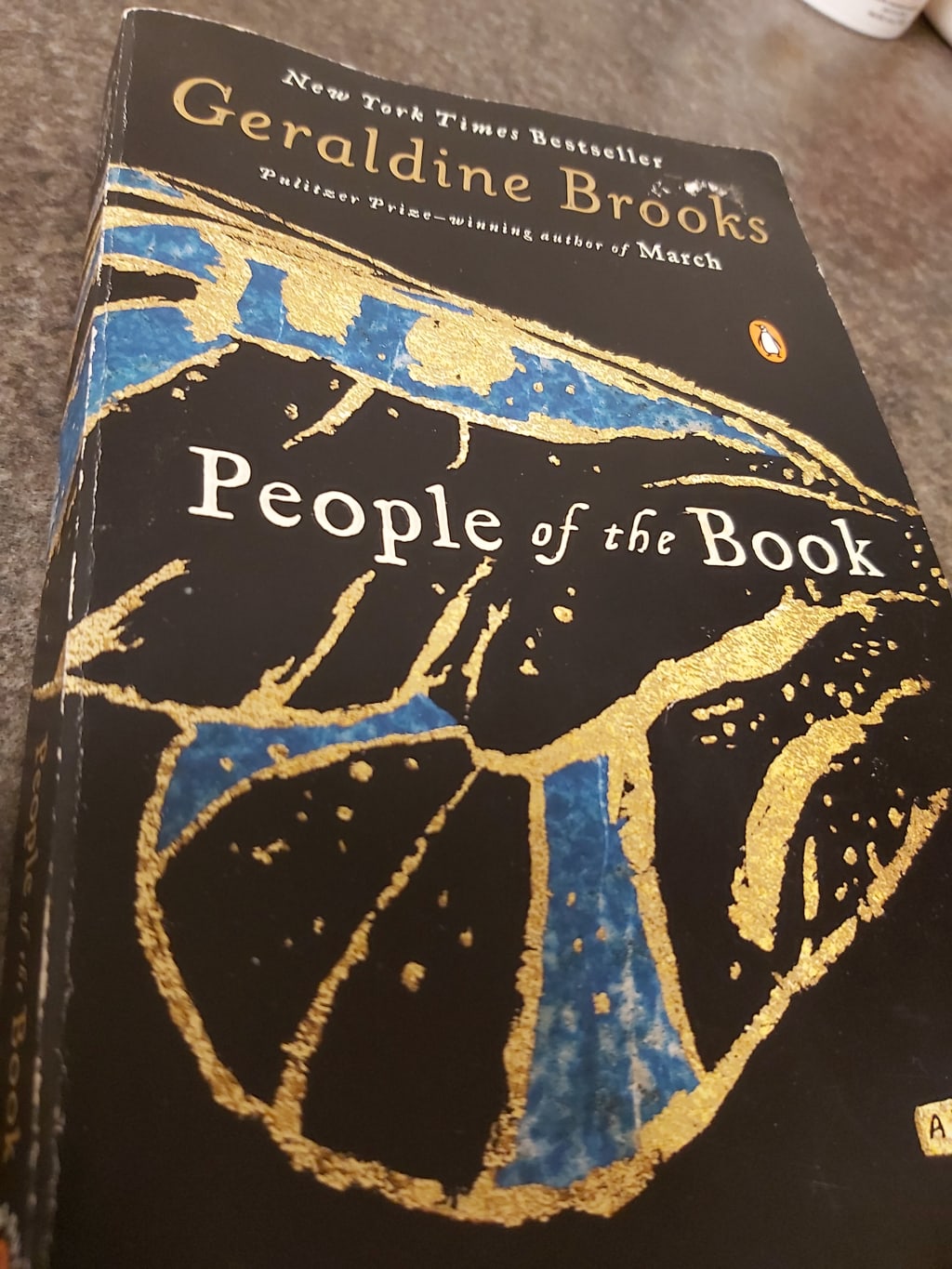
I really wanted to love People of the Book. When my mother suggested I read it, I was excited to dive into it. From the synopsis, it seemed like it could be a beautiful meld of two of my favorite things, history and books. Unfortunately, I did not enjoy this book as much as I had hoped to.
The bulk of the book followed Hanna Heath, a rare book expert and conservator, who is called to perform restoration work on the Sarajevo Haggadah, one of the oldest Jewish texts with illustrations. During her work on the Haggadah, Hanna found artifacts in the binding and on the pages. The further study of these artifacts unlocked small parts of the Haggadah's history throughout the story. Small segments of the lives of some the people who interacted with the Haggadah made up the rest of the story content.
While the writing style the author used was overall enjoyable, I found that, at times, the writing was choppy and confusing. The book was hard for me to really get into until after the first section telling of the past of the Haggadah. There was a heavy use of terminology at the beginning of the book which, even though I love history and science, made it difficult to sit down and immerse myself in the book as a fiction. As far as the plot was concerned, it was enjoyable enough, though I was a touch underwhelmed with the ending. Parts of the ending were predictable and the rest wasn't exciting enough for me to be truly thrilled with it.
The host of characters in the People of the Book were a diverse cast. Many of them I enjoyed reading about, but a few of them I did not enjoy. I did not enjoy the main character or the glimpses we saw of her relationships. Hanna was not a character I connected to. She was selfish and self absorbed, which to a degree I could tolerate in a character. She was childlike at times and she seemed to have problems with any sort of genuine emotional connection. Her unorthodox and unhealthy relationship with her mother was one of the main relationships was focused on in the book. There was a relationship that developed between Hanna and another character, but, since the relationship was not exactly fleshed out, it did not make much sense when it seemed to be an important point later, expecially coming from such an emotionally stunted character.
Most of the sections telling of the past of the Haggadah were beautifully done and gave a great insight to the Haggadah's journey. That being said, there were also sections that didn't quite seem to fit. Those sections told more of the people who came into contact with the Haggadah for only a brief moment. Even though those sections were still interesting to read, they made the immersion of the story seem a bit less enthralling. I found myself asking "What does this have to do with the book?". When I did get my answer, I'd be underwhelmed with the connection. One of the characters I found out of place didn't make sense to me at all until I found out about a real life connection to the inspiration of the story. It was only then the character's placement made sense.
The People of the Book was a work of fiction, but it contained some very good information about the object it is based around and the history of certain time periods. The Sarajevo Haggadah exists, it is approximated to be around 500 years old. While the author used no real names, some parts of the book's recent history are based on real events and real people. The author put a lot of effort into researching the time periods she wrote about. Extensive research was also put into the main character's field of work to make the story seem plausible even if it was a fictional work.
I had several problems with People of the Book, but that did not mean I hated it. I enjoyed what the story tried to do, even if it fell a little flat for me. The book contained a plethora of history facts, which I enjoyed. The story of Hanna was underwhelming for me, but I found the sections about the book's past engaging.
About the Creator
Druneia
A Canadian who has too many interests.
Silver Screen Magic with Mae West
American actress and singer Mae West became a popular film actress during the Great Depression. She started entertaining in vaudeville, then performed on Broadway, and finally went to Hollywood. She signed up with Paramount Pictures and made her debut in the 1932 film “Night After Night.” She also starred in musicals, comedies, and crime dramas. The American Film Institute named her one of the best classic Hollywood actresses.
By Rasma Raisters5 days ago in Geeks
Emma Watson, Sir Lenny Henry and Sir Elton John lead British Diversity Awards
The prizes will be handed out at a glittering ceremony in London on March 25 2026 and Harry Potter actress/activist Watson will compete with Henry and John for the top gong of Media Personality of the Year with the musician competing alongside his husband David Furnish.
By Dena Falken Esq2 days ago in Geeks



Comments
There are no comments for this story
Be the first to respond and start the conversation.