
GOTHAM'S LAST STAND: DECONSTRUCTING 'THE DARK KNIGHT RISES'
A hero can be anyone, even a man doing something as simple and reassuring as putting a coat around a young boy's shoulders to let him know that the world hadn't ended." These words, uttered by Batman in Christopher Nolan's 'Batman Begins' (2005), resonate deeply when contemplating 'The Dark Knight Rises' (2012), the epic conclusion to Nolan's groundbreaking Dark Knight Trilogy.


This wasn't just another superhero film; it was a sprawling, operatic drama tackling themes of hope, sacrifice, justice, and the human spirit's resilience in the face of overwhelming adversity. Released four years after the genre-defining 'The Dark Knight,' 'The Dark Knight Rises' faced immense pressure to deliver a satisfying conclusion to a saga that had redefined the boundaries of comic book cinema. Set eight years after Harvey Dent’s death, the film finds Gotham lulled into a false sense of security, unaware of the storm brewing beneath the surface. As a new threat emerges in the form of the merciless Bane, Bruce Wayne is forced to confront his own physical and emotional limitations and once again don the cape and cowl to save the city he loves.
Plot:
Eight years have passed since Batman seemingly vanished, taking the blame for Harvey Dent's crimes to preserve the late district attorney's reputation. Gotham is enjoying an era of peace, but Bruce Wayne has become a recluse, broken in body and spirit. The fragile peace is shattered by Bane, a masked mercenary driven by a radical ideology of equality through destruction. Bane’s plan is multifaceted: crippling Gotham's infrastructure, unleashing its criminals, and ultimately destroying the city. He steals a device capable of both producing clean energy and being weaponized as a nuclear bomb. Bane then exposes Harvey Dent's crimes, revealing the lie upon which Gotham’s fragile peace was built.
Bruce, spurred back into action by Selina Kyle (Catwoman), finds himself outmatched by Bane. In a brutal fight, Bane breaks Batman's back, leaving him imprisoned in the seemingly inescapable "Pit," a deep subterranean prison from which only one person has ever escaped. There, surrounded by despair, Bruce must confront his inner demons and rebuild himself both physically and mentally.
Meanwhile, Bane seizes control of Gotham, declaring it liberated from the corrupt elite. He arms the nuclear bomb, sets a timer, and cuts off Gotham from the outside world. A brutal reign of terror ensues, policed by Bane’s soldiers.
Bruce escapes the Pit, returns to Gotham, and rallies the remnants of the police force and the citizenry to fight back against Bane. A massive battle erupts in the streets of Gotham. Batman confronts Bane, ultimately defeating him with the help of Selina Kyle. Miranda Tate, Wayne Enterprises CEO and Bruce's love interest, is revealed to be Talia al Ghul, Ra's al Ghul's daughter, seeking revenge for her father's death. Talia activates the bomb’s trigger. Batman, with the help of Gordon, manages to carry the bomb in his Bat to the sea.
The film concludes with Batman seemingly sacrificing himself to save Gotham. However, in the aftermath, Alfred discovers that Bruce Wayne survived and is living a peaceful life with Selina Kyle in Florence. John Blake, a young, idealistic police officer, inherits the Batcave, hinting at the emergence of a new protector of Gotham. The narrative is cyclical, mirroring the journey of Bruce Wayne from broken orphan to symbol of hope, culminating in his passing the torch to a successor. The use of multiple antagonists, elaborate schemes, and large-scale battles lends the film an epic, almost operatic feel, setting it apart from more traditional superhero fare.
Cast:
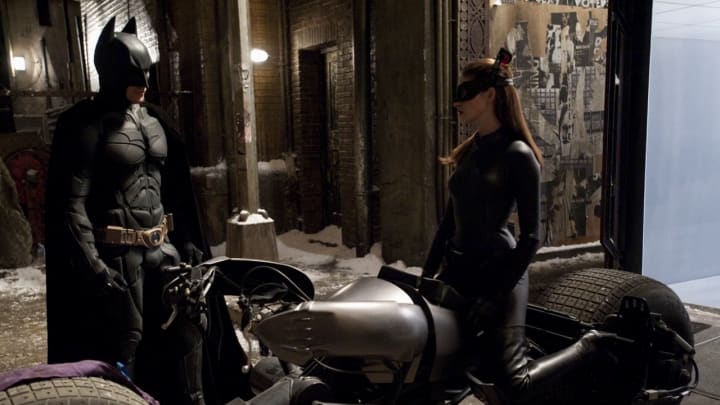
Christian Bale as Bruce Wayne/Batman: Bale delivers a nuanced performance, portraying Bruce's physical and emotional decline before his eventual resurrection. His raw intensity and vulnerability are palpable, making him a truly compelling figure.
Tom Hardy as Bane: Hardy's Bane is a physically imposing and intellectually formidable villain. Despite wearing a mask that obscures much of his face, Hardy conveys Bane's menace and charisma through his voice and physicality. His delivery, though debated for its initial clarity, became iconic.
Anne Hathaway as Selina Kyle/Catwoman: Hathaway's Catwoman is a cunning and morally ambiguous character who provides a welcome dose of wit and charm. She strikes a perfect balance between vulnerability and self-reliance.
Michael Caine as Alfred Pennyworth: Caine's Alfred provides the emotional heart of the film, acting as Bruce's surrogate father and moral compass. His scenes with Bale are particularly poignant.
Gary Oldman as James Gordon: Oldman portrays Gordon as a weary but unwavering pillar of justice in a city on the brink of collapse.
Marion Cotillard as Miranda Tate/Talia al Ghul: Cotillard's deceptive portrayal of Miranda Tate adds a shocking twist to the film.
Joseph Gordon-Levitt as John Blake/Robin: Gordon-Levitt plays Blake, a young, idealistic police officer who sees through Bruce's facade and ultimately inherits his legacy.

Reviews:
'The Dark Knight Rises' received generally positive reviews, though the reception was more mixed compared to 'The Dark Knight.' Critics praised the film's ambition, scope, and thematic depth, as well as the performances of the cast, particularly Bale, Hardy, and Hathaway. The film’s visual grandeur and practical effects were also highlighted.
However, some critics found the plot convoluted and overly long, criticizing the film's pacing and certain plot contrivances. Bane's muffled dialogue was also a common point of contention. Audience reviews were similarly divided. While many praised the film as a satisfying conclusion to the trilogy, others felt it fell short of its predecessor, citing similar issues with the plot and character development.
Production:
The development of 'The Dark Knight Rises' began shortly after the release of 'The Dark Knight' in 2008. Christopher Nolan initially hesitated to return for a third film, but he eventually agreed on the condition that he could develop a story that was both original and thematically resonant. Nolan and his brother, Jonathan Nolan, collaborated on the screenplay, drawing inspiration from various sources, including Charles Dickens' 'A Tale of Two Cities.' The film was co-financed and distributed by Warner Bros. Pictures, with a budget estimated at around $250-300 million, making it one of the most expensive films ever made at the time.
Writing and Casting:

The Nolan brothers aimed to create a story that explored the consequences of Batman's actions in 'The Dark Knight' and that brought Bruce Wayne's journey full circle. The casting process was extensive, with numerous actors considered for the roles of Bane and Catwoman. Tom Hardy, who had previously worked with Nolan on 'Inception,' was chosen for Bane, undergoing intense physical training to bulk up for the role. Anne Hathaway was selected for Catwoman after impressing Nolan with her audition, which showcased her wit, athleticism, and ability to embody the character's complexity. The deliberate casting of established actors, many of whom Nolan had worked with before, added a layer of gravitas and familiarity to the film.
Principal Photography:
Filming took place over several months in various locations around the world, including India, England, Scotland, and the United States. The production was known for its commitment to practical effects, with Nolan minimizing the use of CGI whenever possible. The large-scale battle scenes in Gotham required extensive planning and coordination, involving hundreds of extras and stunt performers.
One amusing anecdote involves the filming of the scene where Batman confronts Bane for the first time. Bale reportedly had difficulty taking Hardy seriously in his Bane costume and mask, often breaking into laughter during takes. Hardy, however, remained stoic and focused, even when Bale playfully mocked his voice. The production faced several challenges, including a tragic shooting incident in Aurora, Colorado, during a midnight screening of the film, which prompted Nolan and the cast to issue statements of condolence and support for the victims.
Production Design:
Nathan Crowley returned as production designer, creating a visually stunning and immersive world for the film. The sets were designed to be both realistic and evocative, reflecting the decay and chaos of Gotham under Bane's rule. The design of Bane's mask was a crucial element, intended to be both intimidating and functional, providing him with the pain relief he needed. Catwoman's sleek and practical costume was also carefully designed, reflecting her agility and resourcefulness.
Sound Design & Music:
Hans Zimmer returned to compose the film's score, creating a powerful and emotional soundtrack that underscored the film's themes of hope and sacrifice. Zimmer worked closely with Nolan to develop the music, incorporating elements of opera and choral music to enhance the film's epic scale. The sound design was also meticulously crafted, with particular attention paid to the sound of Bane's breathing apparatus and the roar of the Batpod. The use of silence in certain scenes was also a deliberate choice, adding to the tension and drama. The now-iconic chant of "Deshi Basara," used to signify Bane’s presence and the legend of the Pit, became a cultural phenomenon.
Visual Effects:
While Nolan prioritized practical effects, visual effects were still used extensively to enhance the film's realism and scale. The creation of Gotham's skyline, the destruction of buildings, and the flight of the Batwing all required sophisticated visual effects work. The visual effects team worked closely with Nolan to ensure that the effects seamlessly integrated with the practical elements, creating a believable and immersive world.
Influences:
'The Dark Knight Rises' draws inspiration from various cinematic, literary, and historical sources. The film's themes of social unrest and revolution are reminiscent of Charles Dickens' 'A Tale of Two Cities,' while Bane's character and ideology are inspired by various historical figures, including the French Revolutionaries. The film also draws inspiration from the Batman comic book series, particularly the storyline 'Knightfall,' in which Bane breaks Batman's back. The film also echoes themes of social inequality and the consequences of unchecked power, reflecting contemporary concerns about economic inequality and political corruption.
Scientific Knowledge :
The film incorporates several scientific and technological elements, including the fusion reactor that is capable of both providing clean energy and being weaponized as a nuclear bomb. While the science behind the reactor is not fully explained, it is presented as a plausible technology based on current research in nuclear fusion. The film also features various other gadgets and technologies, such as the Batpod, the Batwing, and advanced surveillance systems. While some of these technologies are fictional, they are grounded in real-world concepts and possibilities. The film also touches on themes of artificial intelligence and robotics, albeit in a limited capacity.
Marketing, Release & Box Office:
Warner Bros. launched a massive marketing campaign for 'The Dark Knight Rises,' utilizing a variety of media, including trailers, posters, television commercials, and online promotions. The campaign emphasized the film's epic scale and the stakes involved in Batman's final battle. The film was released in theaters worldwide on July 20, 2012, becoming a massive box office success, grossing over $1 billion worldwide. Despite the tragic shooting in Aurora, the film's box office performance was largely unaffected, demonstrating the enduring popularity of the Batman franchise and the Nolan's trilogy. The marketing also included viral campaigns that built anticipation and excitement among fans.
Critical Responses:

Overall, 'The Dark Knight Rises' was well-received by critics and audiences alike, although it was not as universally acclaimed as 'The Dark Knight.' Critics praised the film's ambition, scope, and thematic depth, as well as the performances of the cast. However, some critics found the plot convoluted and overly long, criticizing the film's pacing and certain plot contrivances. Despite these criticisms, 'The Dark Knight Rises' is widely regarded as a fitting conclusion to Nolan's Dark Knight Trilogy, a landmark achievement in superhero cinema that redefined the genre and raised the bar for future adaptations. It left a lasting impact on popular culture, cementing Nolan's legacy as one of the most innovative and influential filmmakers of his generation.
About the Creator
Xavier
Global news reporter covering science, tech, environment, Entertainment & sports. Delivering balanced insights to inform and inspire readers worldwide. Sometimes a poet.
Rereading Review: "Against Nature" by J.K Huysmans
It's been about a decade or so since I read Against Nature by JK Huysmans and so, I wanted to dive in once again. Unfortunately, my copy with some brutish annotations in which I exclaim my dislike for the main character resembling a young Morrissey in his attitudes has since been lost to time and so, I had to buy another copy. Emile Zola would probably sum up the book in the best way as it was, in fact, a charged novel against the naturalist movement - hence the title Against Nature. But then again, it is packed full of emotions that are generally against the nature of human feeling - they are against the progressive and free-willed, against the whimsical, against the want for redemption and joy. The main character's journey to discovering this is a pained one yes, one that usually drops him into the central problem of melancholic thinking and perhaps reminds us that we don't want to shovel this novel into our mouths all in one go. It is one of those books that can really weigh one's mind down.
By Annie Kapur7 days ago in Geeks
Rachel Reviews: Lakefront Wolves by Joseph Deegan
Meet Finn. He's an 18 year old kid who has potential. He's bright with great school scores and he's also an athlete, a footballer of some prowess. He has it all going for him, it would seem, and yet, he's determined to send what could be a well-planned, stable existence firmly off the rails. He drinks, he smokes, he takes drugs, he has violent tendencies and he's in danger of losing not only his mind but all that he holds dear.
By Rachel Deeming6 days ago in BookClub



Comments
There are no comments for this story
Be the first to respond and start the conversation.