
Rereading Review: "Against Nature" by J.K Huysmans
5/5 - I could not dream of giving this book anything less...

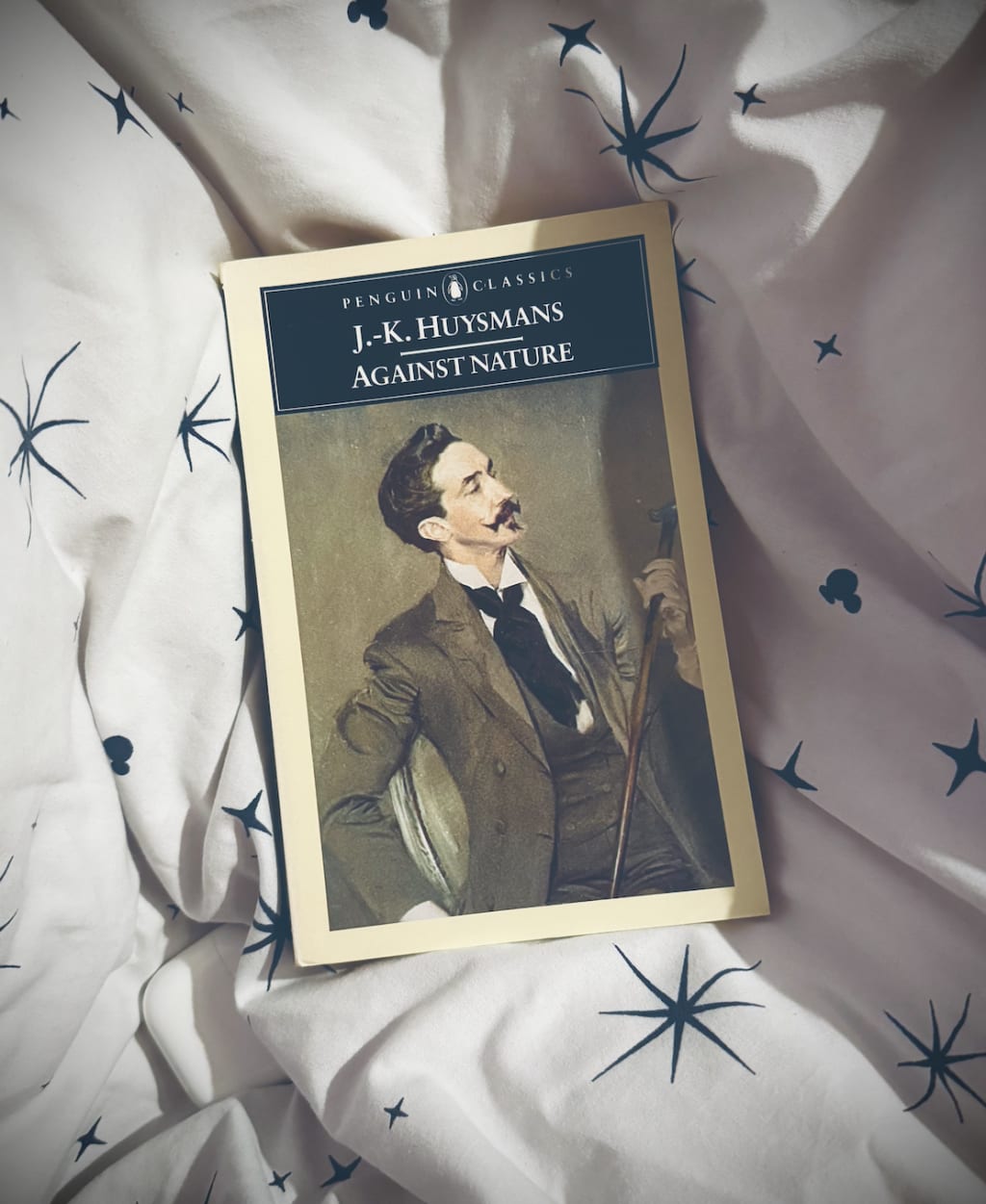
It's been about a decade or so since I read Against Nature by JK Huysmans and so, I wanted to dive in once again. Unfortunately, my copy with some brutish annotations in which I exclaim my dislike for the main character resembling a young Morrissey in his attitudes has since been lost to time and so, I had to buy another copy. Emile Zola would probably sum up the book in the best way as it was, in fact, a charged novel against the naturalist movement - hence the title Against Nature. But then again, it is packed full of emotions that are generally against the nature of human feeling - they are against the progressive and free-willed, against the whimsical, against the want for redemption and joy. The main character's journey to discovering this is a pained one yes, one that usually drops him into the central problem of melancholic thinking and perhaps reminds us that we don't want to shovel this novel into our mouths all in one go. It is one of those books that can really weigh one's mind down.
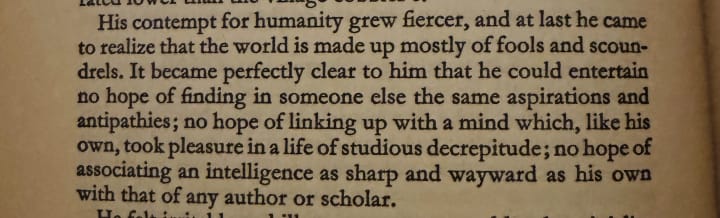
The first thing I want to focus on is the main character's apparent dislike of other people. There's a phrase I hearken back to and for the life of me, I cannot remember where I recall it from. But the phrase covers the idea that one can like humans but dislike humanity, and there are others that can like humanity but dislike humans. I would call the latter a possible misanthrope, but what the protagonist does in Against Nature is actually besides all of that. He both dislikes humans and humanity. This isn't simply a misanthrope, this is someone who holds a deep and loathing contempt for all around him and atop of that, dislikes the very concept of them. He dislikes their nature. Again, he is Against Nature. Yet another interpretation of the title. I mean, even I find the following passage quite intense and we are reading it in the 21st century:
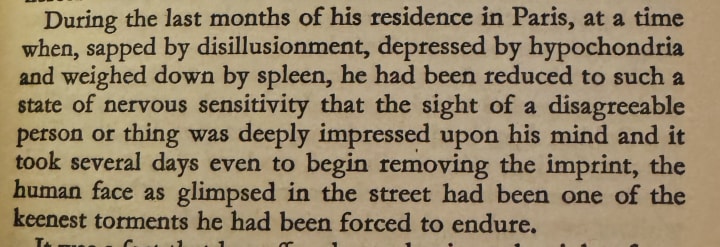
Another theme of the book I always liked to focus on is the main character's depression. As our main character is so deeply unlikeable, it is difficult for the reader to feel a shred of pain in the fact that he wants to commit s**c**e and yet, this turns the flashlight back on ourselves. Are we really that inhumane as the 'other people' that we would outcast someone who is clearly suffering depressive symptoms in which they find no joy as someone who 'has it coming if they're going to think this way'?
We can't be that stupid, can we? Are we the exact image of humanity that the protagonist has been talking about when he says he holds us all in contempt? Of course we are. The frightening thing about this book is that the emotions it can make you feel are a direct reflection of what the writer has already written and thus, it becomes a self-fulfilling prophecy. Only now are those chronically online starting to understand that there is a difference between being depressed and having depression and that, when one has depression, there are actually very few people who will hanker around you - leaving you in a well of loneliness and despair.
The fact that this is covered quite well in a book written in the 1880s is distressing as it is important. We have known this for that long:

The way in which reality is described in the text gives way to the idea that the only things about reality the main character notices are the ones that are essentially flawed. When I read this book the first time around over a decade ago, I honestly thought that there was something for me and the main character to find in common. As I revisit it, I find he is in fact more misanthropic than myself in the fact that even I can reconcile that perhaps there are aspects of humanity that are experienced with joy.
One of the aspects spoken about here is travel. As you probably know, I hate travelling and yet I can understand why certain people enjoy it. It is one of those realities which I cannot simply pass off as 'vulgar' and yet, the main character seems to do just that. In a way there's something in the snobbery which makes you either hate the main character and hope they would go away (which is exactly what the author wants you to do since you have proved his point for him), or makes you want his redemption (which is something that becomes more and more unlikely as the book goes on and yet, you might be pleasantly surprised at something).
The following passage is something strange but I hope it makes you want to read the book:

This is a brilliant book and I hope that in a decade, I come to revisit it again and come to a different conclusion. If you are interested (as I am) in fin de siècle literature (decadent novels written to the 'end of the century' - which is what the term means) then this book is the Bible to the next of its kind.
I will leave you with this passage which is one of my personal favourites from the entire text:
About the Creator
Annie Kapur
I am:
🙋🏽♀️ Annie
📚 Avid Reader
📝 Reviewer and Commentator
🎓 Post-Grad Millennial (M.A)
***
I have:
📖 300K+ reads on Vocal
🫶🏼 Love for reading & research
🦋/X @AnnieWithBooks
***
🏡 UK
Keep reading
More stories from Annie Kapur and writers in Geeks and other communities.
Frankenstein by Mary Shelley
Background and Context: If you know me then you will probably know that I think 'Frankenstein' is one of the greatest novels ever written. I would say that since I was in my teens, this has been a really been a novel that has been close to my heart. Chapter 11 is probably the most special of these in which the Creature is discovering night and fire etc. It is simply one of the best pieces of literature ever written. I've read and taught it several times for over a decade. It gets better every single time.
By Annie Kapurabout 3 hours ago in Geeks
Why Every Good Meal in Cincinnati Now Starts on Your Phone (2026)
I was standing outside a brewery at The Banks last Friday, freezing my tail off while trying to scan a QR code that just wouldn't load. Ope, there I was, staring at a spinning circle while my friends were already inside ordering a round. It’s 2026, y’all, and I reckon we should be past the "broken link" era of dining out.
By Sherry Walker4 days ago in Geeks
Belle of the Bayou
Bad move, cher. Not just the slip of her kitten heel on the rainy February cobblestones in the Fourth Ward. She got caught snooping. Detective Deleon clucked and strutted like a rooster in his rush to clear her from the scene, waving cigar smoke to and fro as he gesticulated amid the thick air of the speak easy. An experienced crime reporter, Marie knew better than to let the coppers catch her on the wrong side of the line, but curiosity had gotten the better of her.
By Maia Gadwall the metAlchemist6 days ago in Fiction


Comments
There are no comments for this story
Be the first to respond and start the conversation.