
Classic Movie Review: 1934's 'Imitation of Life' Joins the Criterion Collection
Racial and familial melodrama from 1934 provides a sociological window in time in 'Imitation of Life.'

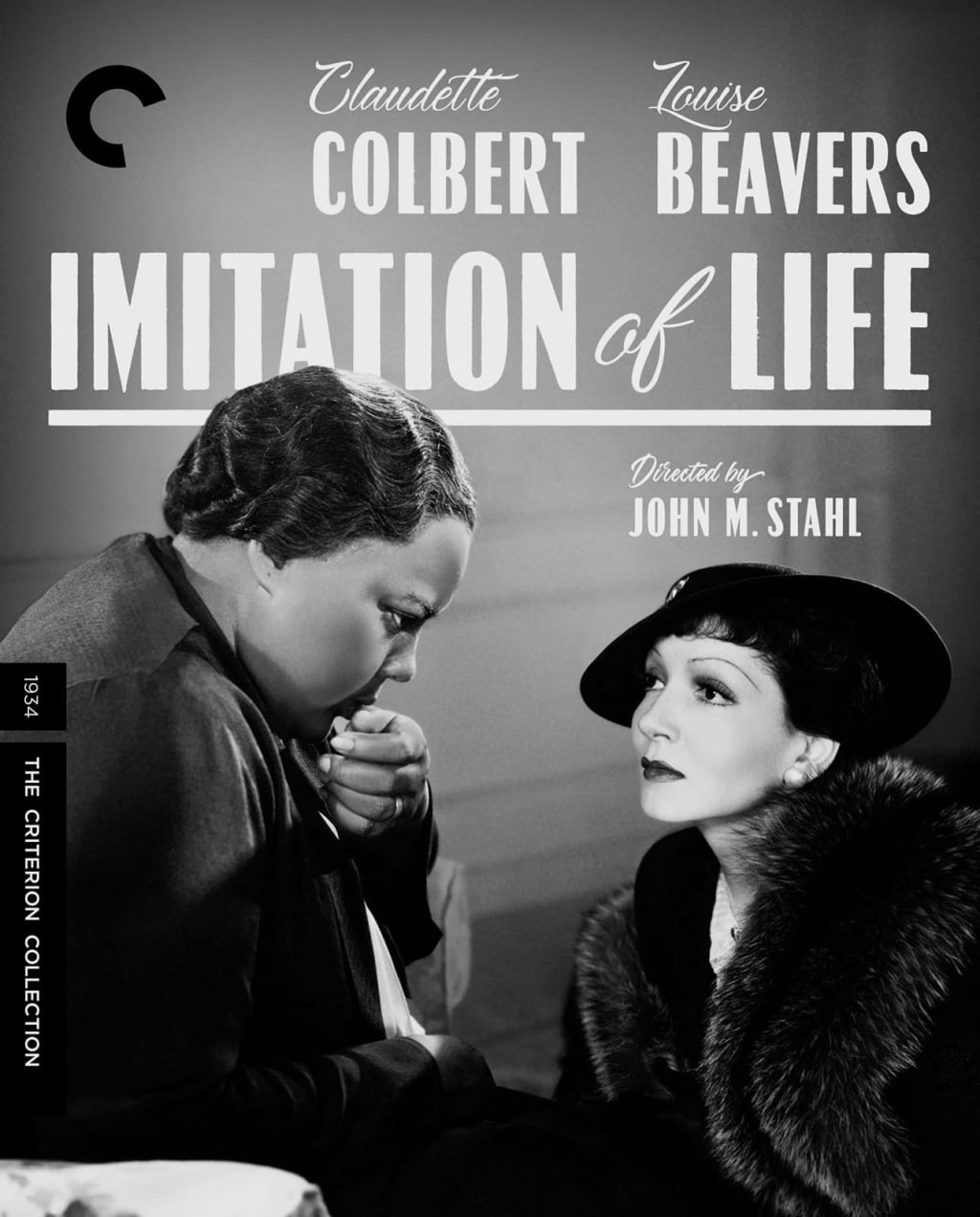
Imitation of Life (1934)
Directed by John M. Stahl
Written by William Hurlbut, Preston Sturges
Starring Claudette Colbert, Louise Beavers, Fredi Washington, Rochelle Hudson
Release Date November 26, 1934
Published January 10th, 2023
The 1934 mother-daughter drama, Imitation of Life has joined the Criterion Collection. On January 10th, 2023, Criterion released newly remastered 4K version of Imitation of Life featuring a new introduction to the film by film and cultural historian, Imogen Sara Smith, and a new interview with author Miriam J. Petty, author of "Stealing the Show: African American Performers and Audiences in 1930s Hollywood." That book is a deep dive on the careers of Imitation of Life stars Louise Beavers and Fredi Washington and their unique paths to Hollywood as black women in 1930s Hollywood.
If I may be blunt, Ms. Petty's book is perhaps more relevant and vital than the movie Imitation of Life which is little more than a minor melodrama with solid performances, muted and neutered by the racism of the time. That said, Imitation of Life is a window into that time and the way black women were portrayed in Hollywood movies. With the performances of Louise Beavers and Fredi Washington you do see black women given emotional depth and dimension that deals directly with the racial struggle of that moment. In that way, the film remains a part of film culture that should not be ignored simply for being a broad melodrama that doesn't quite rise to the level of a genuine classic.
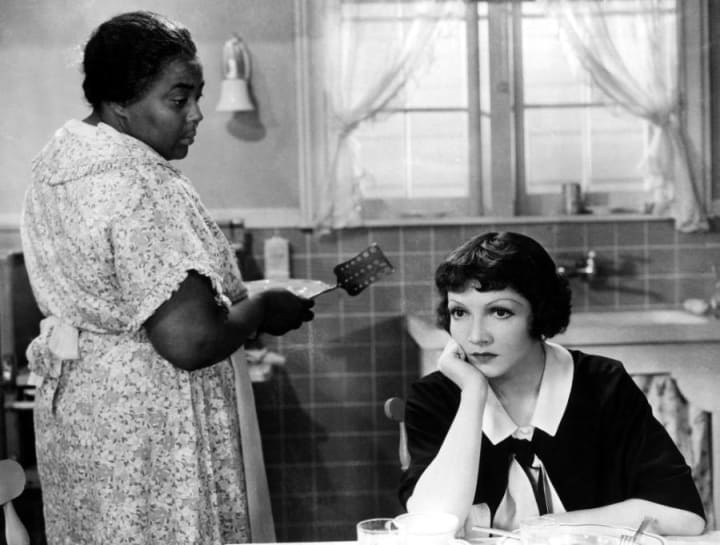
Instead of the woke, for the time, racial dynamic of Imitation of Life, what we really have is a story of mothers and daughters and the sacrifices two mothers make to give their daughters a better life than the ones they've led. Claudette Colbert stars as Bea Pullman, mother of Jessie, and recent widower. Bea is struggling to find time to raise her daughter while also keeping her husband's business alive long enough to keep a roof over her head.
Bea's life is changed forever by complete chance. While she's trying to get her daughter ready to go to the babysitter so she can get to work, Bea is visited by Delilah Johnson (Louise Beavers). Delilah is looking for work and was following up on ad in the newspaper. Since she's here, she asks Bea for work and though Bea insists she can't afford to hire Delilah, Delilah persists, saying she will work in exchange for room and board for herself and her young daughter, Peota.
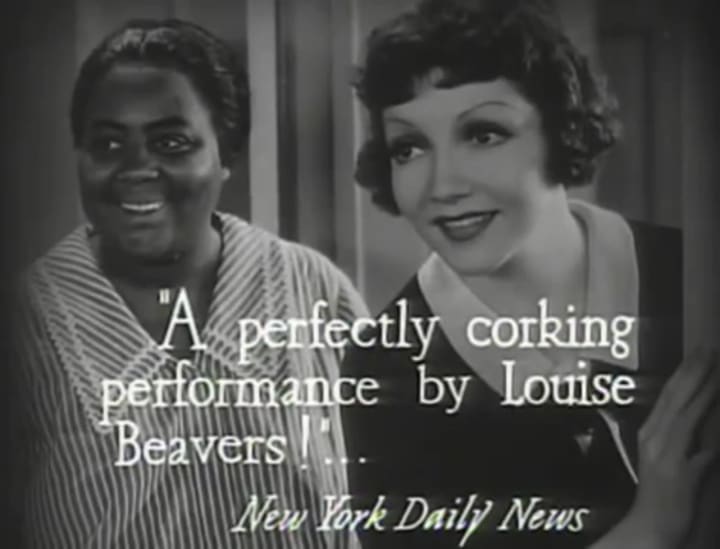
Bea relents and soon the household is humming with activity including Delilah's incredible pancakes which pair well with Bea's family syrup business. In fact, Delilah's pancakes are so good that Bea takes a huge leap and opens a restaurant. Using her charm and savvy, Bea finagles a deal for the restaurant space, furniture, and equipment and within months, 'Aunt Delilah's Pancakes' are the talk of the town. The next step takes the pancakes national and makes both Bea and Delilah wealthy, though Delilah insists on remaining Bea's cook.
At the midpoint, once Bea and Delilah are wealthy and successful, the film shifts to a story about their relationships with their daughters. Most dramatically, Peota (Fredi Washington) has begun to distance herself from her loving mother Delilah. Having discovered that she can pass herself off as white, due to her light skin color, Peota wants to use this to her advantage to be accepted into the racist white society of the time. Having seen how she has suffered the hardships of racism, Peota's desires are understandable to us but not to Delilah.
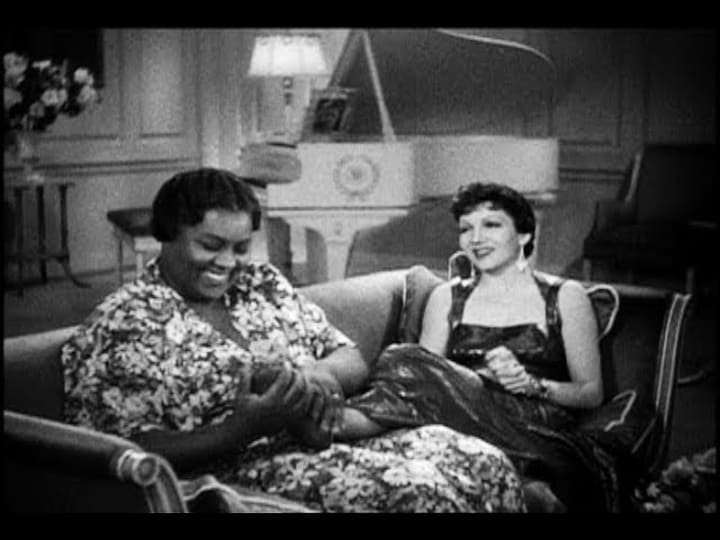
For Delilah, having been raised in a deeply racist society that seemingly bred her for service to white people, she can't understand why Peota would want more. Delilah is devastated that her daughter would sacrifice her relationship with her in an attempt to find acceptance in society. Delilah wants her daughter to have a better life than her but not if it means being apart from one another. Louise Beavers invests this with deep and agonizing emotion in an exceptional performance.
That's only part of Imitation of Life however, and the other part of the movie isn't nearly as strong. When Jessie, played as an adult by Rochelle Hudson, returns home from college she is introduced to her mother's friend, Steve (Warren William). Bea decides not to tell her daughter that she and Steve are a couple with plans to get married, she wants the two to get to know each other first. Then, when Bea goes to help Delilah to try and find Peota, she asks Steve to take Jessie out and care for her for a few days.
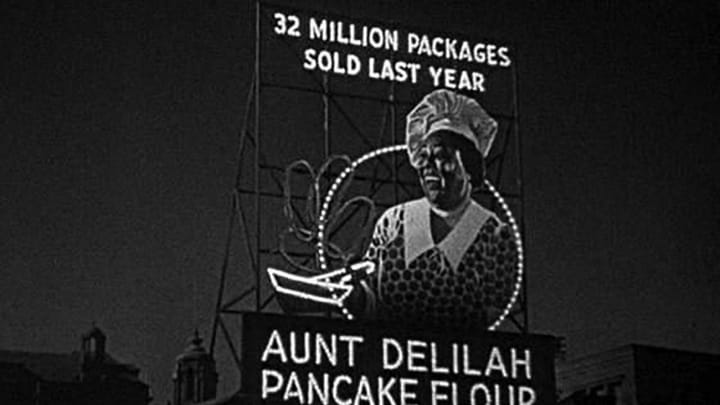
This leads to Jessie developing feelings for Steve and I will leave you to find out where that story goes. There is tension and uncomfortable levels of drama in this plot but it simply pales in comparison to our investment in the other story, that of Delilah and Peota. The love triangle of Bea, Steve, and Jessie is interesting but lacks emotional involvement beyond how much we cringe at Jessie's sad, schoolgirl crush on a much older man, and Bea's reaction to finding out about her daughter's infatuation.
Melodrama abounds in Imitation of Life, some of it good, and just as much of it broad and overwrought. Nagging at the movie is a distinct sense that we are getting less of Delilah and Peota's story because the characters are black. The movie is commendable for offering such sensitive care for black characters in a time when Hollywood was still depicting horrific racism with little care for the harm it caused. That said, you can sense where the makers of Imitation of Life know not to push to far in giving this story more weight out of fear of angering the racist policymakers of the day.
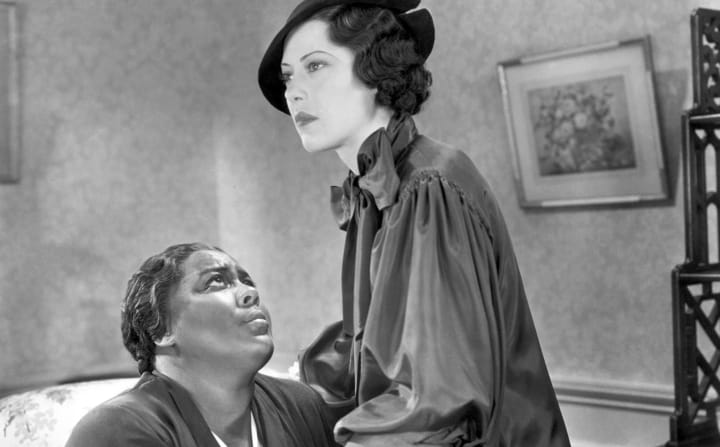
Another fair criticism of Imitation of Life is how everything leading up to Bea and Delilah's business becoming wildly successful comes so easily. Two single mothers, one white and one black manage to open a business with no money and suffer from no discrimination on their way to becoming millionaires in 1934. That's a little hard to believe. I'm not saying that racism and sexism has to be part of every story like this and I recognize that the film is not about those hardships but rather about the mother-daughter dynamics, but, in the rush to get to the mother-daughter story, it's a bit simplistic and a little to hard to believe it could have been so easy.
If I may digress on the title, Imitation of Life. What does that mean? It sounds poetic and meaningful but, I am honestly unsure exactly what the title is referring to. I do have a theory however, I think it relates to being a mother. The idea of motherhood for many and especially for the mothers in Imitation of Life, is living a life that is not for themselves. Both Bea and Delilah live lives dedicated to their daughters. They live an imitation of real life, in that they sacrifice their wants and desires to assure that their daughters will be able to live real lives, lives free from the troubles that their mothers faced.
Imitation of Life is memorable for being as progressive as it was in a time when such notions were nearly forbidden. Louise Beavers and Fredi Washington deliver powerhouse emotional performances and the human dimensions that they bring to these characters was uncommon in 1934. That makes the film worthy of being remembered and reflected upon. The movie, overall, struggles with being a little too broadly melodramatic, especially in the love triangle, but I do recommend it. Especially with the context provided on the new Criterion Collection release. The additional materials explain why Imitation of Life has remained part of film culture for so many years as a signpost in the presentation of black characters in Hollywood. In that way, Imitation of Life is a must for your collection.

Find my archive of more than 20 years and nearly 2000 movie reviews at SeanattheMovies.blogspot.com. Find my modern review archive on my Vocal Profile, linked here. Follow me on Twitter at PodcastSean. Follow the archive blog on Twitter at SeanatheMovies. Listen to me talk about movies on the Everyone's a Critic Movie Review Podcast. If you have enjoyed what you have read, consider subscribing to my work on Vocal. If you'd like to support my work you can do so by making a monthly pledge or by leaving a one-time tip. Thanks!
About the Creator
Sean Patrick
Hello, my name is Sean Patrick He/Him, and I am a film critic and podcast host for the I Hate Critics Movie Review Podcast I am a voting member of the Critics Choice Association, the group behind the annual Critics Choice Awards.
Keep reading
More stories from Sean Patrick and writers in Geeks and other communities.
Silver Screen Magic with Mae West
American actress and singer Mae West became a popular film actress during the Great Depression. She started entertaining in vaudeville, then performed on Broadway, and finally went to Hollywood. She signed up with Paramount Pictures and made her debut in the 1932 film “Night After Night.” She also starred in musicals, comedies, and crime dramas. The American Film Institute named her one of the best classic Hollywood actresses.
By Rasma Raisters6 days ago in Geeks




Comments
There are no comments for this story
Be the first to respond and start the conversation.