
Classic Cinema Review: 'India Song'
India Song, directed by Marguerite Duras, was largely dismissed on its release in 1975, but almost fifty years later it's clear to see that this film was just ahead of its time.

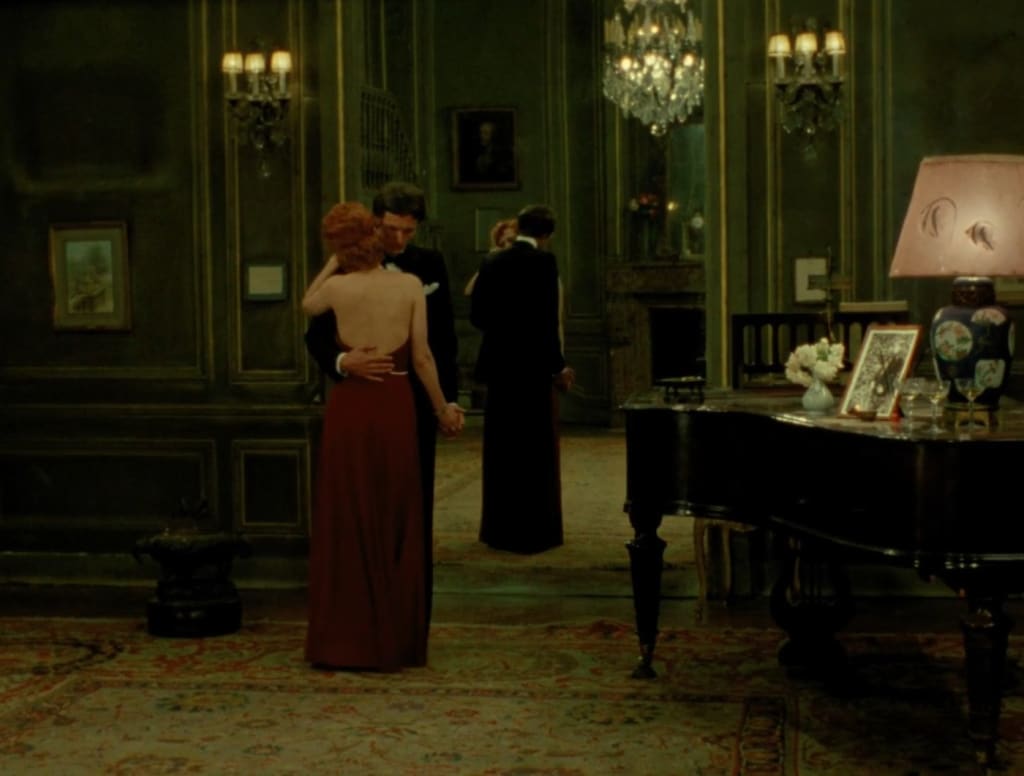
India Song is the story of Anne-Marie's boredom.
To quell that boredom, Anne-Marie (Delphine Seyrig)—the wife of the French ambassador to India living in a colonial villa in Kolkata—embarks on a series of affairs with other consular expats. It's not the worst way to scratch ennui's itch, although the actual narrative of India Song is probably the least interesting thing about this film. India Song's storyline is so bitty that I couldn't tell you who is who between her husband, lovers, and the one she refuses to sleep with—not only does that not matter, in some ways it's purposeful. The function of story in India Song is to act as a flimsy structure for everything in the film to hang off, weave around, and subsume.
The film is full of voices, but lacks speech. The interactions in the film are loaded, but in them not a word is uttered, at least not on camera. Instead, dislocated voices, severed from the actor's bodies, are used as a soundscape to both convey and confuse the narrative. Some of these voices belong to characters we meet, and others to people who never appear in the film—but who, I got the sense, are lingering just beyond the reach of the camera's restricted view.
The near-constant overlayed, often out of sync, utterances and gossip is as incessant—and annoying—as a mosquito's whine. The film is an adaptation of Duras's novel The Vice-Consul, and the voices function to communicate this narrative, yet I didn't gain any richness or depth from what they told me. It is a relief when the voices halt so that the music can be heard, and the visual rhythm takes over. I would have happily watched India Song as a silent film, accompanied by just its musical score composed by Carlos d'Alessio.
The tagline of India Song is that it is 'an experiment with sound'. It's an evasive comment that justly sums up the film's ungraspable nature, and yet what you hear when watching is arguably less interesting, and certainly less enjoyable, than what you see. Yes, Duras finds a way to meld and complicate the realms of diegetic and non-diegetic sound, (diegetic sounds occur within the film's world, e.g. character speech, music playing from a radio; non-diegetic sounds do not originate in the film's world, e.g. a musical score, most voice-over), but to consider the feats of this film largely in terms of sound would be a shame. After all, the mumbled, annoying and confusing sound of the film is in stark contrast to the purposeful, choreographed and organised visuals. In truth, the very best thing about the sound experiment is that it lays the path for a magnificent visual experience.
At the heart of the film's mise-en-scene are smoke and mirrors. Clever ideas and pretty things to mask the insubstantialities of the character's lives, the plot, the voices. It is a visual metaphor that all points of the film converge around. A majority of the film takes place in a drawing-room whose space is disjointed by a wall-sized mirror, where incense is constantly burning, and cigarette holding people move in and out via a staircase in one corner and through French windows in another.
The mirror constantly plays tricks, fracturing the space. It is not until the camera moves, or someone steps into the scene and you see them twice, that you realise you have been watching a mirrored image instead of the actual person. The film does this unfailingly, and the viewer is repeatedly tricked: even when you have learned that there is a mirror there, the camera angles itself slightly differently so the same trick of doubling can be played again and again. The mirror acts as an unstable anchor, doubling and disjointing the space, not dissimilar to the slippery disembodied voices.
The other point of orientation for the film is Anne-Marie, with her satellite of changing men. All the character's movements are intentional, choreographed to the point where they don't look seamless or natural, but always purposeful, often slightly stilted, whilst at other times the camera deigns to fix them in imperfect stillness. This is in direct contrast to the smoke that's almost always present, which has fluidity and freedom of movement—something the characters' bodies lack not just in the choreography but as expats. Everybody in the film is trying to find something, or someone, to hold onto, and often that thing is Anne-Marie, who will not be tied down or do as expected. Like the smoke, she slips through everyone's fingers.
In an original review of the film, Vincent Canby, a film critic for The New York Times, levied criticism at India Song for being shallow and restings on its aesthetics, 'no content, all style'. He's perhaps not wrong; the acute organisation of the aesthetics, the complexly complimentary score and visuals, is what gives the film its greater depths. Stylistic choices can be radical, particularly when you take note that Duras was a female director in a male-dominated realm. Just as Anne-Marie found a way to stake out her identity and assert her agency in the swarm of men attempting to engulf her.
Duras's break from traditional, linear narrative structure to rest more on physical expression has something decidedly feminine about it, aligning it with another landmark of french feminism that came to being that year. In 1975 Hélène Cixous published her seminal essay 'The Laugh of Medusa', advocating for écriture féminine, a form of female writing where women can reclaim their bodies and voices. Cixous' thesis is that both writing and women have been subject to and oppressed by men for time immemorial, and from here springs the need for women to forge their own forms of expression. As Cixous writes,
I wished that woman would write and proclaim this unique empire so that other women, other unacknowledged sovereigns, might exclaim: I, too, overflow; my desires have invented new desires, my body knows unheard-of songs.
In her own way, Duras had been grappling with the filmic lexicon to express the felt, heard, and experienced life of a woman, as a woman, about women and their desires, dissatisfactions, and quest for autonomy.
About the Creator
Keep reading
More stories from Miranda Weindling and writers in Geeks and other communities.
Silver Screen Magic with Mae West
American actress and singer Mae West became a popular film actress during the Great Depression. She started entertaining in vaudeville, then performed on Broadway, and finally went to Hollywood. She signed up with Paramount Pictures and made her debut in the 1932 film “Night After Night.” She also starred in musicals, comedies, and crime dramas. The American Film Institute named her one of the best classic Hollywood actresses.
By Rasma Raisters3 days ago in Geeks
Emma Watson, Sir Lenny Henry and Sir Elton John lead British Diversity Awards
The prizes will be handed out at a glittering ceremony in London on March 25 2026 and Harry Potter actress/activist Watson will compete with Henry and John for the top gong of Media Personality of the Year with the musician competing alongside his husband David Furnish.
By Dena Falken Esqabout 15 hours ago in Geeks




Comments
There are no comments for this story
Be the first to respond and start the conversation.