
Book Review: "The Weimar Years" by Frank McDonough
3/5 - A surface-layer analysis of Germany's most complex era...

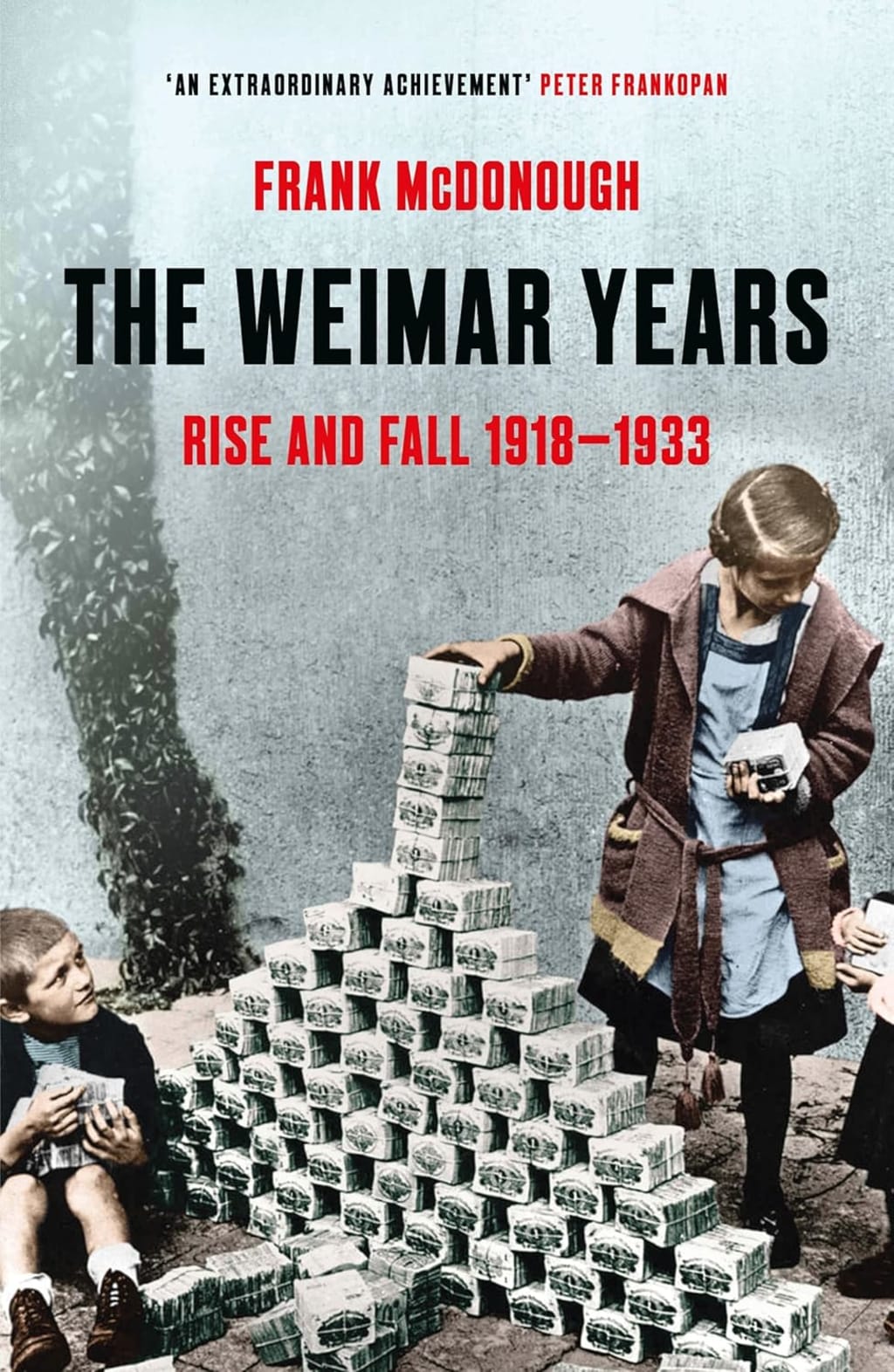
As you know, I am obsessed with learning about Weimar Germany and I think it's quite possibly one of the most fascinating artistic and cultural times in European History and quite possibly, like the French Revolution, one of the beginnings of the modern world. It was that turning point where the old became the new, where the dark became the darker and where the fall was great, but hitting the ground was much greater. Its cultural output included Bauhaus and German Expressionism, its cinema included the works of FW Murnau, Fritz Lang and the acting power of Conrad Veidt. It was truly a time as fascinating as it was philosophically existential. It fostered both beauty and terror.
This book opens by detailing the collapse of the German Empire following World War I, including the abdication of Kaiser Wilhelm II in November 1918. The Weimar Republic is established amidst revolutionary turmoil, with Friedrich Ebert of the Social Democratic Party (SPD) leading the provisional government. The Spartacist Uprising of January 1919, led by communist revolutionaries Rosa Luxemburg and Karl Liebknecht, is brutally suppressed by the Freikorps, highlighting the fragile and polarised political landscape. McDonough explores the challenges of uniting a war-weary and divided nation under a democratic framework. I think that this is pretty surface layer stuff. Mostly anyone who took World War One history understands how the Weimar era began but it was still interesting to read as the author goes through the different accounts that were given later on in say, the 1960s, about the killing of Rosa Luxemburg especially.

The book explores the structure of the Weimar Republic, highlighting its democratic aspirations and inherent weaknesses. The constitution, drafted in 1919, introduces universal suffrage and proportional representation, aiming to reflect the will of the people. However, McDonough explains how proportional representation leads to fragmented parliaments, making coalition governments unstable. Article 48, allowing the President to rule by decree during emergencies, is revealed as a double-edged sword, intended to protect democracy but later exploited by authoritarian forces. It was this article that made the Weimar Republic so militant and I think that the author though he does go into some depth about it, is still working within the realms of what most people understand about the era. I mean, people who are interested in the Weimar Republic are going to read a book of almost 600-pages about it. It takes a long time to get into the depths.
McDonough vividly portrays the economic devastation Germany endures during the early Weimar years. The government’s inability to pay reparations leads to the French and Belgian occupation of the Ruhr in 1923, sparking passive resistance and crippling industrial output. To fund the resistance, the government prints money, triggering hyperinflation. Ordinary Germans see their life savings rendered worthless, with bread prices rising hourly. This economic collapse deepens public disillusionment with the Republic and strengthens extremist movements, particularly on the far right. This is probably one of the most interesting parts of the book even though, again, it is a little obvious. The hyperinflation era was what caused the stagnation of movie-making and yet, also caused the classics of Weimar Cinema to become more renowned because of their lack of expense but their professional experience and set up. They did so much with so little it was actually unbelievable.

Amidst political and economic crises, the Weimar Republic becomes a hub of cultural innovation. McDonough highlights the explosion of creativity in fields such as art, theatre, literature, and film. Figures like Bertolt Brecht, Kurt Weill, and the Bauhaus movement redefine modern aesthetics, while Berlin becomes synonymous with avant-garde experimentation and liberal social norms. However, McDonough also notes that this cultural vibrancy is viewed with suspicion by conservatives and traditionalists, further deepening societal divisions. This is the part that I read the most into because it is the cultural movements that I am the most interested it. Though it is technically well-researched, I cannot say that I read anything that I didn't know from my previous readings into the era. There could have been more here especially as the cultural innovations of the era were directly representative of the experiences of the people living in Germany at the time.
The Wall Street Crash of 1929 triggers a global economic depression, plunging Germany back into financial chaos. Unemployment soars, and poverty spreads, undermining the fragile stability of the Weimar Republic. McDonough describes how extremist parties, particularly the Nazi Party, exploit this despair, offering scapegoats and promises of national rejuvenation. The political system becomes paralysed as coalition governments collapse, and President Paul von Hindenburg increasingly relies on Article 48 to govern by decree. This is definitely something that is still very interesting to me, but as I have said before, it takes an odd turn by focusing so heavily on Hitler even though in the preface of the book, it only makes a mention of the other two books in the series being about Hitler - taking place from 1933 to 1945.
All in all, I enjoyed this book but it is so heavily weighted on the making and rise of Hitler that I think that the title The Weimar Years is a little bit misleading. When it comes to the meaty parts of Weimar Germany itself, we never really get there though we are constantly waiting for it. If you are starting off in your Weimar Germany journey, then this book is probably better for you than it is for me. But, if you are like me and have been reading this subject for years now, this book might rank a bit lower on the ones you have already read.
About the Creator
Annie Kapur
I am:
🙋🏽♀️ Annie
📚 Avid Reader
📝 Reviewer and Commentator
🎓 Post-Grad Millennial (M.A)
***
I have:
📖 280K+ reads on Vocal
🫶🏼 Love for reading & research
🦋/X @AnnieWithBooks
***
🏡 UK
Keep reading
More stories from Annie Kapur and writers in Geeks and other communities.
Book Review: "Ocean Sea" by Alessandro Baricco
I was searching the realms of the online world in order to find more books like Rites of Passage by William Golding or even The Terror by Dan Simmons (I mean I remember reading The Terror and having the absolute wits scared out of me for about a week). I came across a dark-ish novel that some were recommending written in a post-modern kind of style called Ocean Sea. Now, when I read the blurb I wasn't too sure this was what I was looking for and, after a sample, the book looked a bit empty on the page. However, I gave it a go anyway to see how it would turn out. Honestly, it's a little here and there.
By Annie Kapurabout a year ago in Geeks
Silver Screen Magic with Mae West
American actress and singer Mae West became a popular film actress during the Great Depression. She started entertaining in vaudeville, then performed on Broadway, and finally went to Hollywood. She signed up with Paramount Pictures and made her debut in the 1932 film “Night After Night.” She also starred in musicals, comedies, and crime dramas. The American Film Institute named her one of the best classic Hollywood actresses.
By Rasma Raisters10 days ago in Geeks
Kim Kardashian Wears Sheer Leggings as Pants With a $22,000 Jacket and a Polarizing Shoe
The Gist Kim Kardashian stepped out in Los Angeles last week wearing new NikeSkims footwear. The split-toe shoe is based on Nike's Air Rift, which came out in 1996. The NikeSkims Rift Mesh drops on January 26, 2026.
By Dena Falken Esq3 days ago in Geeks
So You Decided To Become a Nurse Practitioner:
So you decided to become an "Advanced Practice" nurse. Congratulations!... is what I would say if this was a good idea. Grad school? In this economy? What were you thinking? Likely it was something along the lines of either 1) “I've seen these other chucklefucks do it— Why can't I?” or even 2) “I've got a nice career, I should shake it up. I miss feeling like I have no clue what I'm doing.”
By Sandor Szabo6 days ago in Fiction


Comments (2)
Fantastic review!!!
I do have a joint biography of Weill-Brecht, and I am also fascinated by this era. It guaranteed the horrors to come, and shows that any culture can succumb to its worse urges. Just wish it were a better book...