
Book Review: "The Greatest Minds and Ideas of All Time" by Will Durant
2.5/5 - I know it's a low score but a good review, but there are things you simply cannot ignore about this strange book with opinions either baffling or - in some cases - wrong...

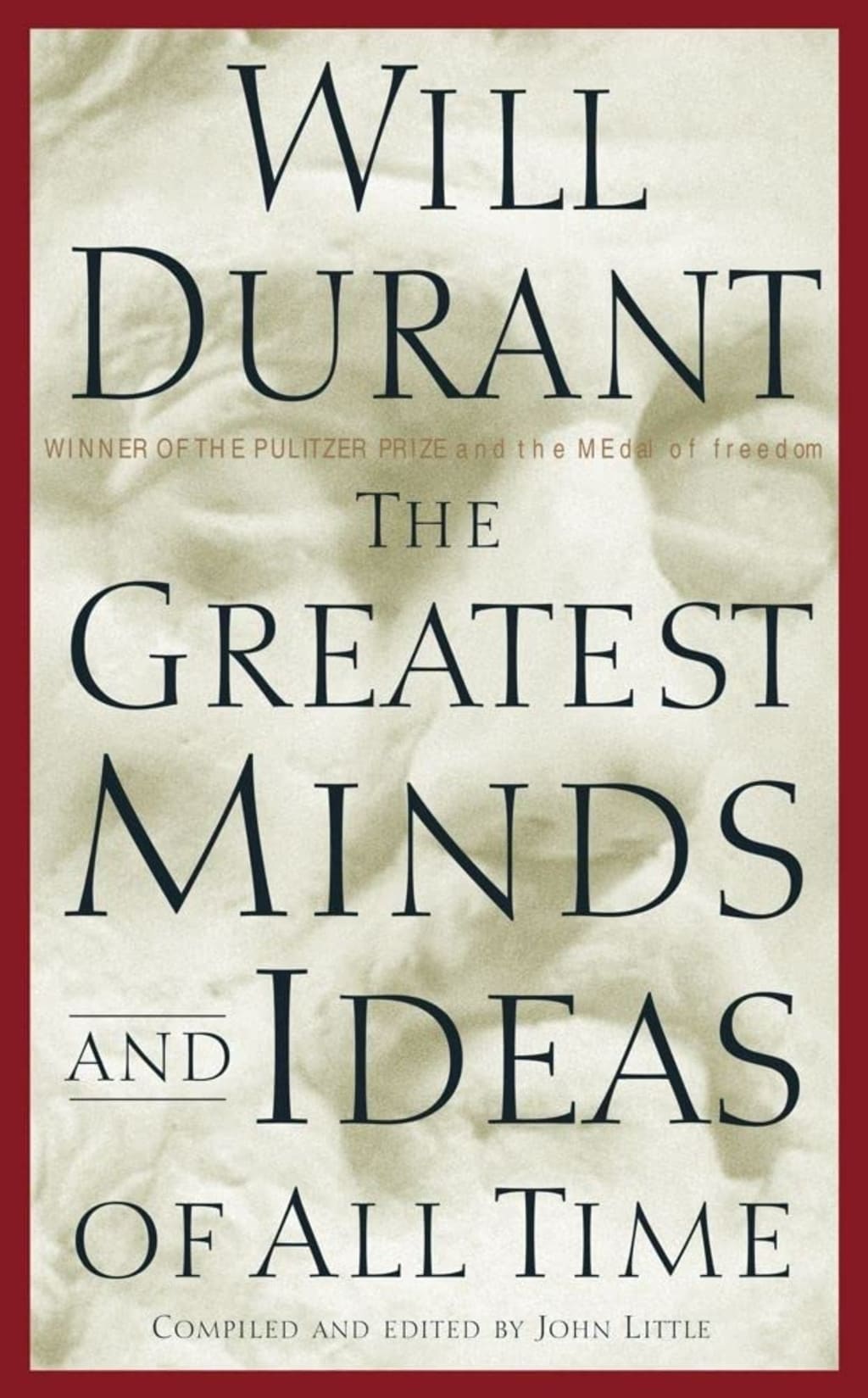
The 'Great Man' theory is a theory I don't believe in by any degree. For those of you who don't know what that is, it is basically where you state that these great men who have changed history have done so through them having some pre-conceived attributes and therefore, they have the ability and the responsibility to change the world for the better. Tolstoy's novels basically disprove the whole theory as do the novels of Dostoevsky and the fact that Hitler existed. Will Durant's book The Greatest Minds and Ideas of All Time may not limit itself to Western history, but it definitely only makes tokens of the Eastern world. I'm not sure how to put this lightly so I'm just going to say it: there's something deeply wrong with how these people have been chosen. Many of them have been selected on the basis of the subjectivity of 'changing the world' rather than actually enduring and changing anything at all. Some of them I agree with, but there are plenty that are perfectly replaceable as we will see.
Let's see first, what I agree with when it comes to philosophers. I'm pretty on board with the fact that Plato was important but, I would have replaced him with Aristotle not, as this book does, have both of them on the list. Though I probably didn't enjoy reading Plato as much as I should have when I was first introduced to him, I understand why he should stick around. Aristotle however, I would argue is far more important when it comes to the way we understand literature, the arts, emotion etc. Plato covers a wide range of topics so I think that's why he was chosen. I think my want to have Aristotle instead of Plato on the list might be personal preference.
Another plus is the fact that on the list of ten greatest poets, Percy Shelley and his mates were featured - and by mates, I mean that Lord Byron made an appearance in the narrative. The story told about Percy Shelley, about the writings of John Keats and the poets of the Romantic era was actually really interesting even though I had perhaps read this narrative a million times before. It is still very intriguing. Wherever Lord Byron, Percy Shelley, John Keats and even the likes of Edward Trelawney and Leigh Hunt are, I will not be far behind waiting to read something about the time and place.
But there are some things that don't add up on these lists as well. For example: I find his inclusion of Francis Bacon on the list of 'greatest thinkers' a bit odd. I have also read people talking about why he shouldn't have included Voltaire however, I think that Voltaire is important for understanding modern libertarianism and the requirement for proper governing bodies and modern democracy. So though I thought it was weird to begin with, the more I thought about it, the more I was won over.
Apparently though, we should definitely read Faust Part 1 by Goethe but not bother with part 2 because he says it is nonsense. Well, I say you're nonsensical Mr Durant. I am trying so hard not to add a profanity here but honestly, what the f-. If you have read, learnt from and enjoyed the first part of Faust then you should definitely check out the second part, especially if you're planning to watch Murnau's 1924 dark comical masterpiece film.
However, I'm all for someone who includes Dante and Shakespeare in their lists of anything with the word 'great' involved. My two main men of literature are perhaps also, hear me out, a little underrated. Dante and Shakespeare are probably the two men I have encountered which everyone around me has read but never took the time to reread. So, if you get some time, read (or reread) Canto XIII of Inferno by Dante and read (or reread) the Richard plays by William Shakespeare. They are lyrically and metaphorically impossible to beat.
I am going to say this though: there is a very clear absence of women in the book and the very idea of a woman is only made in a passing comment as to, probably, save face for the writer and not make him sound like a bigot. However, the clear tokenisation of Eastern philosophy and the lack thereof of Eastern literature has definitely made me think twice about reading more of Will Durant's work. It seems like his scope might be narrower than we once thought.
About the Creator
Annie Kapur
I am:
🙋🏽♀️ Annie
📚 Avid Reader
📝 Reviewer and Commentator
🎓 Post-Grad Millennial (M.A)
***
I have:
📖 280K+ reads on Vocal
🫶🏼 Love for reading & research
🦋/X @AnnieWithBooks
***
🏡 UK
Keep reading
More stories from Annie Kapur and writers in Geeks and other communities.
Movie Review: "Frankenstein" (2025)
This is a spoiler-free review - but seriously, how can you not know the story by now? So I've finally watched the new Frankenstein movie on Netflix and though I probably would have been better off seeing it in the cinema, I have to admit I haven't been to the cinema in a while. Reasons for not attending are between me and my broken brain at this moment in time - all will be revealed perhaps next year. Anyways, Frankenstein seems to be a popular story to adapt but not everyone can do it well. There are various adaptations that didn't try too hard to stick to the book and yet did very well, there are others that tried to stick to the book and did terribly. One thing I think all of the adaptations have in common though is that none of them are entirely a 5/5 production. Why? Well, man is that book wild! You simply cannot capture that insane atmosphere 100% on a screen. But, let's take a look anyways...
By Annie Kapur2 months ago in Geeks
Silver Screen Magic with Mae West
American actress and singer Mae West became a popular film actress during the Great Depression. She started entertaining in vaudeville, then performed on Broadway, and finally went to Hollywood. She signed up with Paramount Pictures and made her debut in the 1932 film “Night After Night.” She also starred in musicals, comedies, and crime dramas. The American Film Institute named her one of the best classic Hollywood actresses.
By Rasma Raisters6 days ago in Geeks
Dilbert creator Scott Adams dies at 68 after a cancer battle.
Scott Adams, a cartoonist whose "Dilbert" comic strip became a standard for millions of readers as a satire of office life, has passed away at the age of 68. On January 13, 2026, his first wife, Shelly Miles, shared a final message from Adams before he passed away from complications from metastatic prostate cancer during an online livestream of his podcast.
By Raviha Imran6 days ago in Geeks


Comments
There are no comments for this story
Be the first to respond and start the conversation.