
Dilbert creator Scott Adams dies at 68 after a cancer battle.
The cartoonist who created the famous satire about the workplace leaves behind a complicated legacy that includes both early success and later controversy.
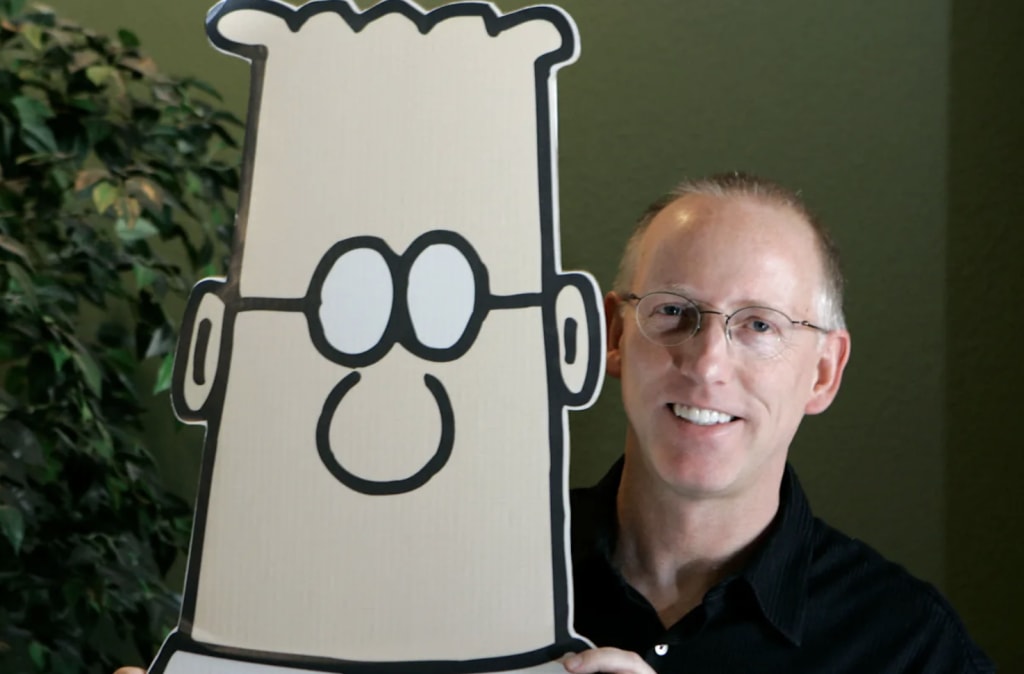
Scott Adams, a cartoonist whose "Dilbert" comic strip became a standard for millions of readers as a satire of office life, has passed away at the age of 68. On January 13, 2026, his first wife, Shelly Miles, shared a final message from Adams before he passed away from complications from metastatic prostate cancer during an online livestream of his podcast.
Adams became well-known for the first time in 1989 when he published "Dilbert," a three-panel comic strip that mocked the absurdities of office life. Its tongue-in-cheek portrayal of cubicle farms, clueless managers and bureaucratic red tape struck a chord with corporate workers worldwide. At its peak, Dilbert was syndicated in about 2,000 newspapers in more than 65 countries and translated into dozens of languages, becoming an enduring part of workplace culture.
The main character of the strip was a bespectacled engineer with a red tie that was always crooked. His mishaps perfectly reflected office frustrations. Adams' reputation as one of the most commercially successful cartoonists of his generation was established by Dilbert, which also inspired books, animated television adaptations, and merchandise.
However, Adams’ career took a sharp turn in 2023 after comments he made during a livestream were widely condemned as racist. Major newspaper syndicates and his publisher Andrews McMeel Universal severed ties with him and removed "Dilbert" from their comics pages due to his remarks, which included inflammatory remarks about Black people. As a nod to the controversy and an indication of how quickly Adams' standing in the public eye had shifted, the strip's blank space was featured in some publications.
Adams continued to independently produce content after the cancellation. He hosted the podcast "Real Coffee with Scott Adams," where he provided commentary on political and social issues, and he relaunched a version of the comic called "Dilbert Reborn" on platforms that are popular with conservative audiences. Even though the work remained popular, much of his later work involved political commentary and polarizing viewpoints, which further distanced him from his earlier mainstream success. Adams' private life was just as complicated as his public persona.
Before working at Pacific Bell and other corporations, he earned a bachelor's degree in economics from Hartwick College and an MBA from the University of California, Berkeley. He began sketching the concepts that would become "Dilbert" during this time. His own experiences as a corporate worker navigating office politics and bureaucracy were the source of many of the insights in the strip. In May 2025, Adams revealed he was battling metastatic prostate cancer that had spread to his bones, a diagnosis he shared publicly on his podcast.
In early 2026, as his health declined rapidly, he entered hospice care and candidly discussed the aggressive nature of the disease. Adams reflected on his life, expressed gratitude to those who valued his work, and urged fans to "pay it forward" by being helpful to others in a moving final message written before his death. Some accounts of his final days described how Adams, surrounded by loved ones and nurses, faced the end of life at his home in Northern California.
Fans, coworkers, and even public figures, like former President Donald Trump, who acknowledged his passing on social media, responded to his death. Adams' early contributions to the comics industry continue to be influential, despite the controversy that characterized his later years. The mishaps of Adams' characters served as a mirror for readers' own frustrations, and "Dilbert" helped define a new kind of workplace satire. Many people fondly remember the “Dilbert Principle” and the comic’s ability to highlight the absurdities of corporate culture with wit and simplicity.
However, Adams' legacy cannot be separated from the juxtaposition of his initial success with his subsequent public controversies. Even though critics pointed to his remarks and positions as examples of harmful rhetoric that overshadowed his earlier creative accomplishments, supporters argue that his willingness to speak provocatively embodied a kind of free speech advocacy.
In recent years, the shift from mainstream syndication to self-publishing and political commentary illustrated how Adams navigated a changing media landscape. Some of his fans continued to follow him because of his unfiltered views and work on his own, while others struggled to reconcile the humor they once enjoyed with his divisive statements, which ultimately led to his isolation from the professional world.
Scott Adams had two marriages and is survived by family members who helped care for him in his final days and supported him throughout his life. Adams's death marks the end of a career that had repercussions far beyond comic strips, whether he was praised for his early work or panned for his later public persona.
About the Creator
Keep reading
More stories from Raviha Imran and writers in Geeks and other communities.
Timothy Busfield, an actor on The West Wing, is facing an arrest warrant for alleged child sex abuse
According to court documents, veteran actor and director Timothy Busfield, who won an Emmy for his role on "The West Wing" and had a long career in both television and film, is now the subject of an arrest warrant issued in "Albuquerque, New Mexico" for child sexual abuse.
By Raviha Imran2 months ago in Geeks
The Politics of Playing Dress-Up
Well, to start off I'd like to say a happy world book day to all who celebrate. I know I haven't really posted anything on my socials about it but I'm not a jubilant kind of person. I lay low most of the time. Let's start off with a popular anecdote from the vaults...
By Annie Kapur8 days ago in Geeks


Comments
There are no comments for this story
Be the first to respond and start the conversation.