
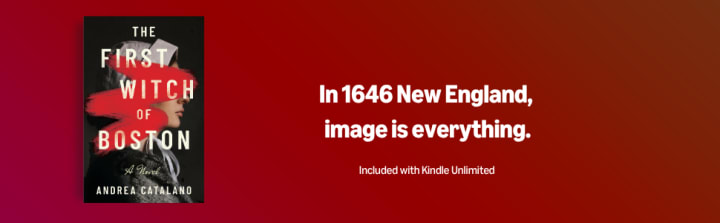
Book Review: "The First Witch of Boston" by Andrea Catalano
5/5 - a truly immersive reading experience...a story of a woman wronged...


When Amazon keeps advertising something to you over and over again there is going to be a point where you just go 'hey, I guess I'll give it a go'. Or maybe you believe that it's a good idea because the algorithm knows you better than you know yourself. Well, this book was pretty much following me around. I saw it in my recommendations, across social media, any time I was on book websites. It was everywhere. So I guess, I read it. And now I know what it's all about. The First Witch of Boston is a surprisingly good book, I hope you enjoy reading about it too...
Thomas and Maggie Jones leave England during a turbulent period of civil unrest and religious strife. Let's put it this way, it's the 1640s and when I say that, you can almost completely understand the 'strife' that is happening. Thomas is a carpenter hopeful for stability in a “New World.” Maggie, several years his junior, is heavily pregnant and already known for her sharp wit and skill with herbs. As we know, being 'skilled with herbs' is not a wise choice of profession for women in a certain time period.
The sea voyage is brutal with cramped quarters, sickness, storms, and superstition among passengers. They dream of a freer life in Massachusetts Bay, not realising that the colony is even more rigid and watchful than the England they left behind. Heading for a Puritanical regime again, is not wise for a woman who is skilled with herbs. You can see where this is going. I love the writing style, especially the fact that we have Maggie's journals and that the writer made a genuine effort to make them read like a woman's journals from the 1640s. It was a very immersive experience.
Settling in Charlestown, Maggie quickly notices the strict codes of Puritan life. Women are silent in church, dissent is punished, and even minor deviations draw suspicion. Thomas integrates quietly, working as a carpenter and building a modest home, while Maggie who is outspoken and unwilling to “lower her eyes” seemingly attracts attention. Now, if you are a dissident woman of the 1640s that is one thing, but add that to the interest in herbs and the reader is now gritting their teeth, holding on to the chair and screaming at Maggie to stop before she gets hurt. We get glimpses of Thomas's memories integrated into the story as well, but the journals of Maggie are what played the biggest part in the reader learning about her true nature and her strong status as a woman who won't back down.
Maggie becomes a sought-after healer: she eases childbirth pains, prepares salves for burns, and treats fevers with herbs. Some neighbours whisper that she is blessed by God; others mutter that she meddles with forces she shouldn’t. A jealous rival midwife, or a spiteful widow who resents Maggie’s influence, begins to sow rumors. “She looks too deeply into your eyes,” some say. “She knows things no one should.” What was once gratitude curdles into suspicion. And I think 'curdles' is the right word, like sour milk. I was so driven to find out how Maggie's life was going to be impacted by all this superstition even though I knew damn well what was going to happen, I just kept thinking about her as a woman wronged. I got quite upset over her and it was an intense read.
The colony’s ministers notice the growing attention around Maggie. Governor John Winthrop’s writings which are woven into the novel, record unease with “women out of place.” Maggie, outspoken even in the meetinghouse, refuses to silently endure slander. Her sarcasm toward self-righteous elders further brands her as “proud” which is definitely a dangerous label in a time that demands female humility. This is definitely something I recognised as modern rhetoric amongst right-wing spaces today, which seek to lead men in punishing women and minorities for being 'proud' or celebrating 'pride'. As if the word 'sin' actually means anything at all.
Accusations escalate when a child Maggie once treated dies despite her care. Envious rivals whisper that she “bewitched” the child instead of saving it. A woman she once helped in childbirth testifies that Maggie’s “unnatural” knowledge frightened her. Misfortune after misfortune such as: failed crops, sudden deaths, sick livestock are blamed on Maggie. Her herbal remedies, once praised, are rebranded as “spells.” We see this whole thing slowly unfold, teeth-gritted, palms clenched and of course, at the very edges of our seats. But it is still not surprising (shocking as it may be) when Maggie is taken away to be accused of witchcraft - the first in Boston.
We witness the court proceedings, the cruelty of the trial, the bashing of the female voice which feels all too modern as well as old-world. I loved the raw depictions of reality in this book that work up to the absolute and inevitable. The great wave of sadness that washes over the reader and the sense of injustice that plagued those years definitely are two of the things that make this book insanely readable. This is a must for anyone in our day that feels as though they are on the side of sanity.
About the Creator
Annie Kapur
I am:
🙋🏽♀️ Annie
📚 Avid Reader
📝 Reviewer and Commentator
🎓 Post-Grad Millennial (M.A)
***
I have:
📖 280K+ reads on Vocal
🫶🏼 Love for reading & research
🦋/X @AnnieWithBooks
***
🏡 UK
Keep reading
More stories from Annie Kapur and writers in Geeks and other communities.
Book Review: "Death Spell" by David Sodergren
Again, I'm reading David Sodergren novels and honestly, I wish I could get enough of these but I can't. After reading books like The Forgotten Island and The Haar which were both brilliant, I moved on to several other texts in the man's bibliography. A severely underrated writer, I have yet to read a book by him that I consider to be 'bad'. In this book about a Faustian pact and some sociopathic behaviour, there is no reason why Death Spell shouldn't be up there as another one of his great books. I mean just check out what this book has to say and then read it for yourself...
By Annie Kapur5 months ago in Geeks
Silver Screen Magic with Mae West
American actress and singer Mae West became a popular film actress during the Great Depression. She started entertaining in vaudeville, then performed on Broadway, and finally went to Hollywood. She signed up with Paramount Pictures and made her debut in the 1932 film “Night After Night.” She also starred in musicals, comedies, and crime dramas. The American Film Institute named her one of the best classic Hollywood actresses.
By Rasma Raisters5 days ago in Geeks



Comments (2)
I may have to find this one.
Whoaaaa, Maggie is so badass. It sad that her fate turned out to be like that. Loved your review!