
Book Review: "Surrounded by Liars" by Thomas Erikson
2.5/5 - don't talk about the data problem, don't talk about the data problem, don't talk about the data problem...

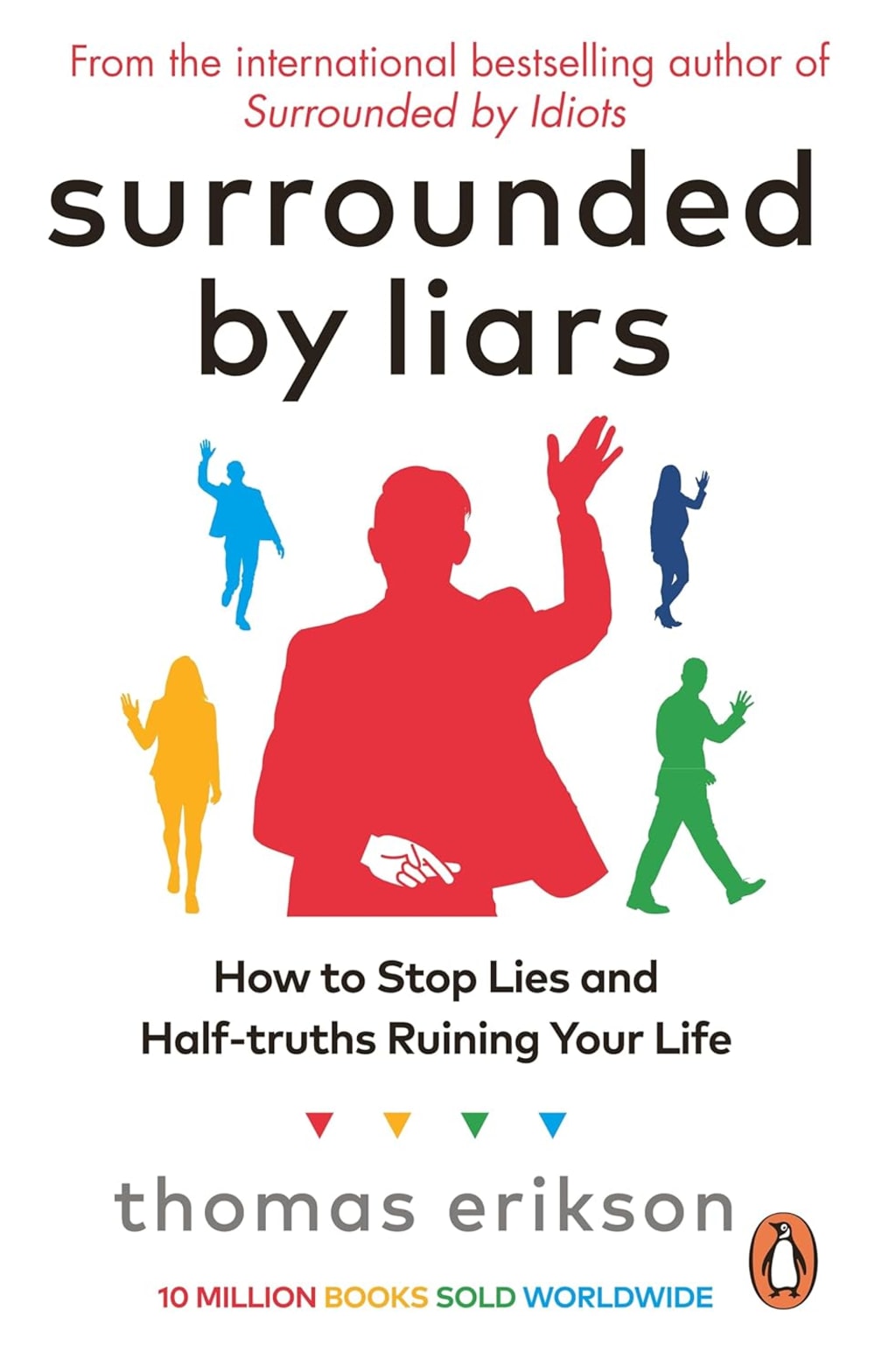
You guys probably remember when I read Surrounded by Idiots by Thomas Erikson some time ago when I was staying in Manchester for a bit. You also probably remember how I said it had a huge data problem in which it didn't really have very much research going on at all. Unfortunately, this trend has spilt over into Surrounded by Liars but that does not mean it's no fun to read. The book is still quite a lot of fun if you're not going to take it too seriously and so, that being said, I'm going to move away from the obvious data problem because I've already looked at that. Instead, let's just focus on what the book has to say about liars and lying.
Erikson begins by addressing how lying is not just a rare or extreme behaviour but something nearly everyone does. He notes that research shows people are likely to lie within moments of meeting someone new, emphasising that this instinct is deeply rooted in human interaction. He explains that even simple, seemingly innocent fabrications often serve as a way to create a controlled, more appealing version of ourselves.
Understanding this innate impulse helps readers become more aware of how easily deception enters everyday communication. Hey look, it's Captain Obvious again! I thought we all already knew this but of course, it takes a pop-sociology book to tell us all that because how else would it end up on the WH Smith travel shop paperback shelf? This section did go on for far too long.
Another point is that social environments create intense pressure to conform, which often prompts people to lie in order to be liked, respected, or simply to fit in. Erikson describes how individuals are willing to compromise on honesty to maintain harmony within a group or to seem more accomplished. These lies often stem from a fear of rejection and illustrate how dishonesty can be a tool for social survival.
I think this is interesting because I tend not to do this purely because I'm older and know it's fruitless. But with younger people I've often observed this happening a lot. I wonder why people tend to grow out of it and yet, the author seems to think that this happens a lot with adults as well. I'm not sure which adults this man is meeting because this is not an adult thing to do. Being an adult means not caring for superficial things like this.
Erikson addresses the common belief that small lies are harmless, pointing out that these “white lies” can accumulate, damaging trust and intimacy. Over time, what started as minor fabrications can erode relationships and establish a dangerous pattern. By underscoring the compounding effect of small lies, Erikson argues that integrity in minor matters is foundational to preserving long-term trust. When I said that adults don't do the social lying thing I would like to point out that adults almost exclusively do the 'white lie' thing.
Deliberately bending the truth, telling a white lie, believing it won't hurt anyone - these are things that adults do all the time. All the time. However, I don't think enough time in the book is spent on this because this happens on every single scale of society, in every job and in every social context. It is far bigger than the one that constitutes 'social preservation'. The focus of this book therefore, seems a bit skewed towards what is popular rather than what is actually interesting on a research level.
Erikson emphasises that lying is often emotionally taxing for the liar, leading to stress, anxiety, and in some cases, guilt. He notes that while lying may offer immediate rewards, it burdens individuals with the need to remember and manage their fabrications. Over time, this mental strain can harm one’s well-being and lead to a constant state of apprehension and tension.
I'm not going to lie but again, this is something that feels very obvious because everyone in the history of everyone has lied about something no matter how big or small it is. Therefore, this is an experience that is somewhat universal to everyone. Again, this feels like a pop-sociology point rather than actually going into any research depth. I enjoyed it, but that doesn't mean it was of any value.
All in all, I felt like this book had some similar problems to the last book in which there was little to no research but it also had other problems in which it was attempting to ride the coat-tails of the previous book by not going into any depth but rather referencing 'if you've read my previous book called 'Surrounded by Idiots'' every other chapter. One book plugs the other and therefore, loses a lot of my interest as I remember not thinking too much of the previous book. Maybe I'm thinking too deeply into it. But I will say one thing again: fun does not always mean good.
About the Creator
Annie Kapur
I am:
🙋🏽♀️ Annie
📚 Avid Reader
📝 Reviewer and Commentator
🎓 Post-Grad Millennial (M.A)
***
I have:
📖 280K+ reads on Vocal
🫶🏼 Love for reading & research
🦋/X @AnnieWithBooks
***
🏡 UK
Keep reading
More stories from Annie Kapur and writers in Geeks and other communities.
Book Review: "Making Evil: The Science Behind Humanity's Dark Side" by Julia Shaw
Have you ever wanted to read a book but wanted to also wait until you were financially comfortable before going on another bookish shopping spree? Yeah, me neither. I got this book only recently, after paying a ton of bills and so - I was lucky it wasn't too expensive. Making Evil is a book that I was initially quite excited about, however after I began to read it I found a few holes here and there, and some things that I wanted to be defined most definitely were not. Be that as it may, it was an enjoyable book on the whole. So let's have a look at what this book has to offer...
By Annie Kapurabout a year ago in Geeks
Silver Screen Magic with Mae West
American actress and singer Mae West became a popular film actress during the Great Depression. She started entertaining in vaudeville, then performed on Broadway, and finally went to Hollywood. She signed up with Paramount Pictures and made her debut in the 1932 film “Night After Night.” She also starred in musicals, comedies, and crime dramas. The American Film Institute named her one of the best classic Hollywood actresses.
By Rasma Raisters6 days ago in Geeks
Grant Gustin's Chances Of Returning As The DC Universe's Flash Have Just Increased After New Update
The Flash has yet to be cast for the new DC Universe, and after a new update, the rumors of Grant Gustin's return as Barry Allen in the new franchise have gained strength once again. Gustin made history by playing Barry for The Flash's nine seasons. The actor also starred in multiple Arrowverse crossovers, becoming one of the franchise's fan-favorites.
By Dena Falken Esq4 days ago in Geeks


Comments
There are no comments for this story
Be the first to respond and start the conversation.