
Book Review: "POPism" by Andy Warhol and Pat Hackett
5/5 - an autobiography of a man, in a time period, creating an artifice out of identity...

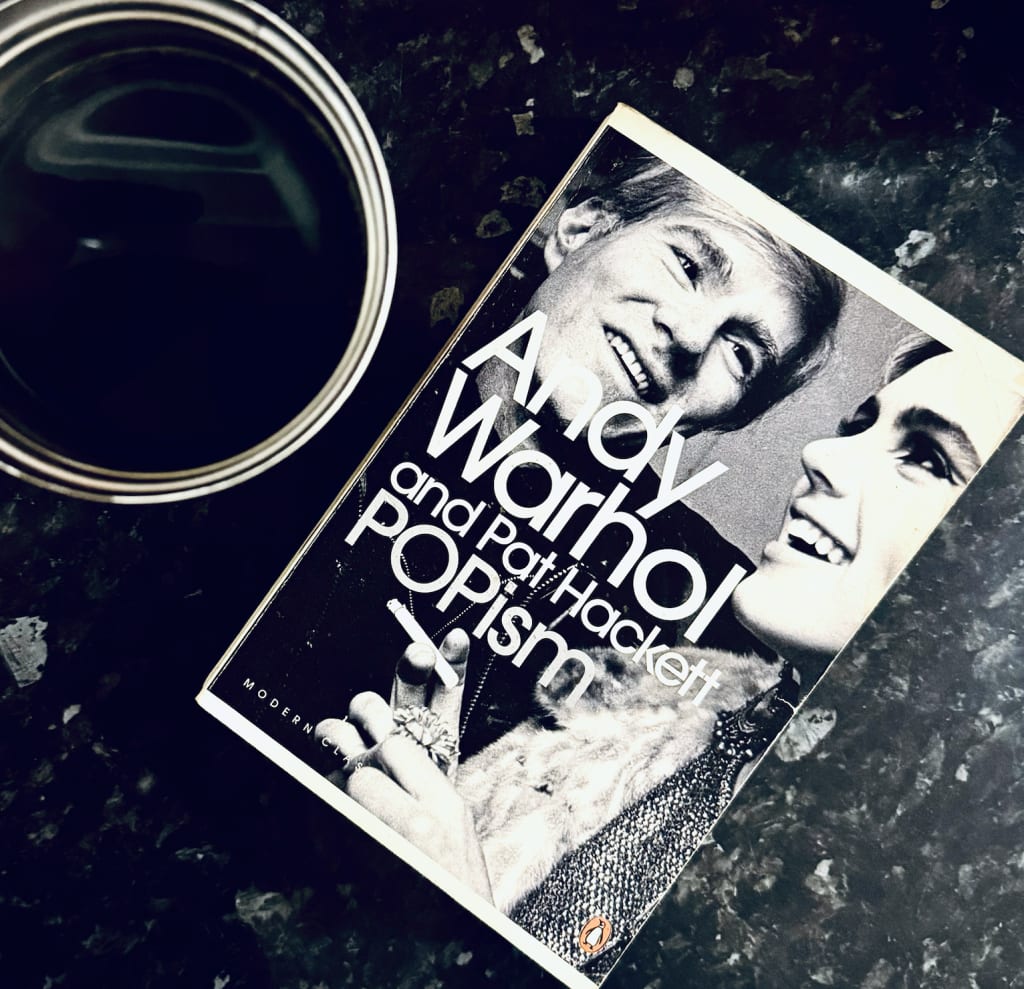
You have probably read my review of The Philosophy of Andy Warhol and if you haven't then you probably want to get yourself over there. POPism is a much longer book and has more of Andy Warhol himself in it - it is less about his philosophy and more about his life. It begins in a pretty odd place and sometimes he even talks about getting shot. At the moment, I'm pretty confused about the state of Jackson Pollock but on the whole, I've enjoyed this text. Don't worry, there's no narrative about weird stuff I find in a book to go with this one. But the book itself is a whole different story...
Andy Warhol's collective memories of an era now gone are some of the most entertaining and strange you will read. He describes how the revolutionary thinkers of the 1960s and the revolutions they brought with them turned a corner and allowed for 'pop art' to flourish. It is true that Warhol is usually detached from regular folks' reality but there is something strangely intimate in his voice. He manages to draw us into his world by also leaving us on the outside at the same time. Instead of taking the trajectory we all thought was the rage - from avant-garde artist to commercial artist, Warhol seems to do the opposite. He goes from being a commercial working artist doing drawings for companies, to being an avant-garde artist with a whole philosophy. You know it's real when an artist has a 'philosophy'.
Warhol is like art's court jester. Instead of doing what everyone else is doing, he's busy satirising them, making fun of artists who criticised his work for lacking meaning and being mechanical. He draws soup cans to challenge what people actually believe is 'depth' with something that definitely comments on the nature of American consumerism. This is where we get into the nature of 'The Factory' - Warhol's group of misfits who once lived in Manhattan. Honestly, I believe the 'Factory' idea was a total failure but it definitely depicted Andy Warhol's philosophy of creativity and excess managing to exist in the same space in an appropriate way - and that was through chaos.
Warhol recounts his pivot from painting to filmmaking, beginning with minimalist experiments like Sleep (a six-hour film of a man sleeping) and Empire (an eight-hour shot of the Empire State Building). He describes these works with his characteristic understatement, as if making a film about “nothing” were simply the next logical step. Eventually, he moves into narrative films like Vinyl, Chelsea Girls, and Flesh, featuring his "Superstars" (factory regulars) as actors. The book’s film chapters blend production anecdotes, drug-fuelled improvisations, and social commentary, showing how Warhol blurred art and life until they were indistinguishable. Some people may think he was crazy for doing this stuff but his pivot into filmmaking definitely did show one thing - the filmmaking world of the 1960s and 70s was ready for new and innovative ideas - which is a far cry from what film is nowadays.
The artist writes, with eerie calm, the 1968 shooting that nearly killed him. Valerie Solanas, a radical feminist writer associated with The Factory, shoots Warhol at close range, believing he has stolen her work. He describes the event briefly and without melodrama, his tone emotionally flat but haunted. The shooting becomes a symbolic end to the free-spirited 1960s era of The Factory; afterwards, the atmosphere changes irrevocably. Warhol becomes more cautious, both personally and artistically, signaling the end of his most experimental decade. Warhol definitely becomes more reserved after this and describes early on in the book, what it was like reading the headline of his own shooting in a newspaper. There's something really dark and strange about this part because you can feel the emotional numb flavour of the book and how the whole tone and atmosphere changes and dies down.
All in all, I thought this book was fantastic. Do I have anymore books on Andy Warhol to read? Not right now. But I wil definitely be seeking out anything else he has written - especially if it is about himself. The art and music, and even the film world of the 1960s and 70s allowed for creative expression and of course, some say that reading this kind of stuff is a longing for when creatives were actually respected.
About the Creator
Annie Kapur
I am:
🙋🏽♀️ Annie
📚 Avid Reader
📝 Reviewer and Commentator
🎓 Post-Grad Millennial (M.A)
***
I have:
📖 280K+ reads on Vocal
🫶🏼 Love for reading & research
🦋/X @AnnieWithBooks
***
🏡 UK
Keep reading
More stories from Annie Kapur and writers in Geeks and other communities.
Sons and Lovers by DH Lawrence
Published in 1913, Sons and Lovers by D.H. Lawrence is a semi-autobiographical novel that draws heavily from Lawrence’s own experiences growing up in a working-class mining community in Eastwood, Nottinghamshire. The novel was Lawrence’s third, following The White Peacock (1911) and The Trespasser (1912), and it marked his emergence as a significant literary figure.
By Annie Kapur3 months ago in Geeks
Silver Screen Magic with Mae West
American actress and singer Mae West became a popular film actress during the Great Depression. She started entertaining in vaudeville, then performed on Broadway, and finally went to Hollywood. She signed up with Paramount Pictures and made her debut in the 1932 film “Night After Night.” She also starred in musicals, comedies, and crime dramas. The American Film Institute named her one of the best classic Hollywood actresses.
By Rasma Raisters4 days ago in Geeks
‘If You’re Flushing the Toilet with Grey Water, People Should Know’: How China Turned Rain into an Asset
China, a nation grappling with rapid urbanization, rising populations, and the mounting pressures of climate change, has taken an innovative approach to one of humanity’s oldest challenges: water management. In cities stretching from Beijing to Shenzhen, rainwater is no longer merely something to drain away—it’s an asset, captured, reused, and integrated into urban infrastructure. This approach, blending modern engineering with environmental foresight, is redefining how millions of Chinese citizens interact with water, whether it’s drinking, bathing, or flushing their toilets. Grey Water and Urban Innovation One of the key components of China’s water management strategy is the extensive use of grey water. Grey water refers to wastewater from sinks, showers, and washing machines—essentially, water that is not heavily contaminated by human waste. Rather than sending this water directly to treatment plants, cities across China are filtering and redirecting it for secondary purposes, such as irrigation, industrial cooling, and even flushing toilets in residential buildings. As one Chinese environmental engineer candidly put it, “If you’re flushing the toilet with grey water, people should know.” Transparency and public education have been central to the success of these programs, ensuring that residents understand how recycled water is treated and reused safely. This awareness is crucial in overcoming cultural stigma and building public trust around non-traditional water sources. Capturing Rainwater: Turning a Seasonal Resource into Daily Utility China’s approach goes beyond recycling household wastewater. Urban planners have transformed entire cityscapes into rainwater catchment systems. Green rooftops, permeable pavements, and underground storage reservoirs are now common in many Chinese cities. These systems not only mitigate urban flooding during the rainy season but also provide a supplementary water supply during dry periods. In Shenzhen, for instance, a city of over 17 million residents, municipal authorities have installed expansive rainwater harvesting networks. Rainwater is channeled through pipes into filtration systems and stored for later use in gardens, parks, and even residential complexes. These initiatives have reduced dependence on distant reservoirs and groundwater extraction, lowering the ecological footprint of water consumption. Public-Private Partnerships Fueling Progress The scale of China’s urban water innovations would not have been possible without collaboration between government authorities, private enterprises, and local communities. Companies specializing in water filtration and smart monitoring systems have partnered with municipalities to ensure that rainwater and grey water meet rigorous quality standards. Smart meters track usage, detect contamination, and regulate distribution, ensuring that every drop of recycled water is both safe and efficiently deployed. In residential complexes, dashboards display daily water savings, raising awareness among tenants and motivating more sustainable practices. This blend of technology and community engagement has been a cornerstone of China’s success in turning rain and grey water into valuable urban resources. Environmental and Economic Benefits The impact of China’s water strategy is multifaceted. Environmentally, recycling grey water and capturing rainfall reduces strain on natural water bodies, helps maintain groundwater levels, and cuts the energy required for pumping and treating fresh water. Urban rivers and lakes benefit from reduced runoff and pollution, while green spaces thrive on sustainable irrigation. Economically, the strategy reduces water procurement costs for municipalities and homeowners alike. In some regions, residents have reported up to 30% savings on their monthly water bills by utilizing grey water systems and rainwater harvesting. For cities facing the twin pressures of population growth and climate-induced water scarcity, these savings are substantial. Challenges and Lessons Learned Despite its successes, China’s approach is not without challenges. Ensuring consistent water quality, maintaining infrastructure, and educating the public about grey water usage remain ongoing priorities. Some residents initially expressed concern about potential health risks, highlighting the importance of transparency and rigorous monitoring. China’s experience offers lessons for other countries facing similar water scarcity issues. By integrating urban planning, technology, and public engagement, cities can transform water from a limited resource into a renewable asset. It is a reminder that infrastructure investments, when paired with community awareness, can produce sustainable solutions for the 21st century. The Future of Water in Chinese Cities As climate change intensifies and urban populations grow, China’s innovations in water management are likely to become even more critical. Policymakers are exploring expanded applications, including industrial reuse, advanced filtration for potable water, and artificial recharge of aquifers. The ultimate goal is a resilient urban water ecosystem where rain and grey water reduce dependency on conventional sources, minimize environmental impact, and support sustainable growth. By turning rain and grey water into assets rather than waste, China is demonstrating that scarcity can drive ingenuity. Citizens are learning to embrace the idea that the water they use, even in the bathroom or laundry, can serve multiple purposes if treated and managed wisely. The transformation is not just technological—it’s cultural, signaling a shift in how humans value one of their most essential resources.
By Fiazahmedbrohi about 17 hours ago in Geeks


Comments (2)
Andy Worhal, Tom Ford, & Freerunning. Great coffee table books, Thank you.
Excellent! BTW, I had some drama with my phone and had to take care of certain pop-ups that would not go away. Be careful! My last piece for Vocal got blocked because of this, and the fact that I had to suspend thid-party cookies for the site.