
Sons and Lovers by DH Lawrence
Why It's a Masterpiece (Week 85)

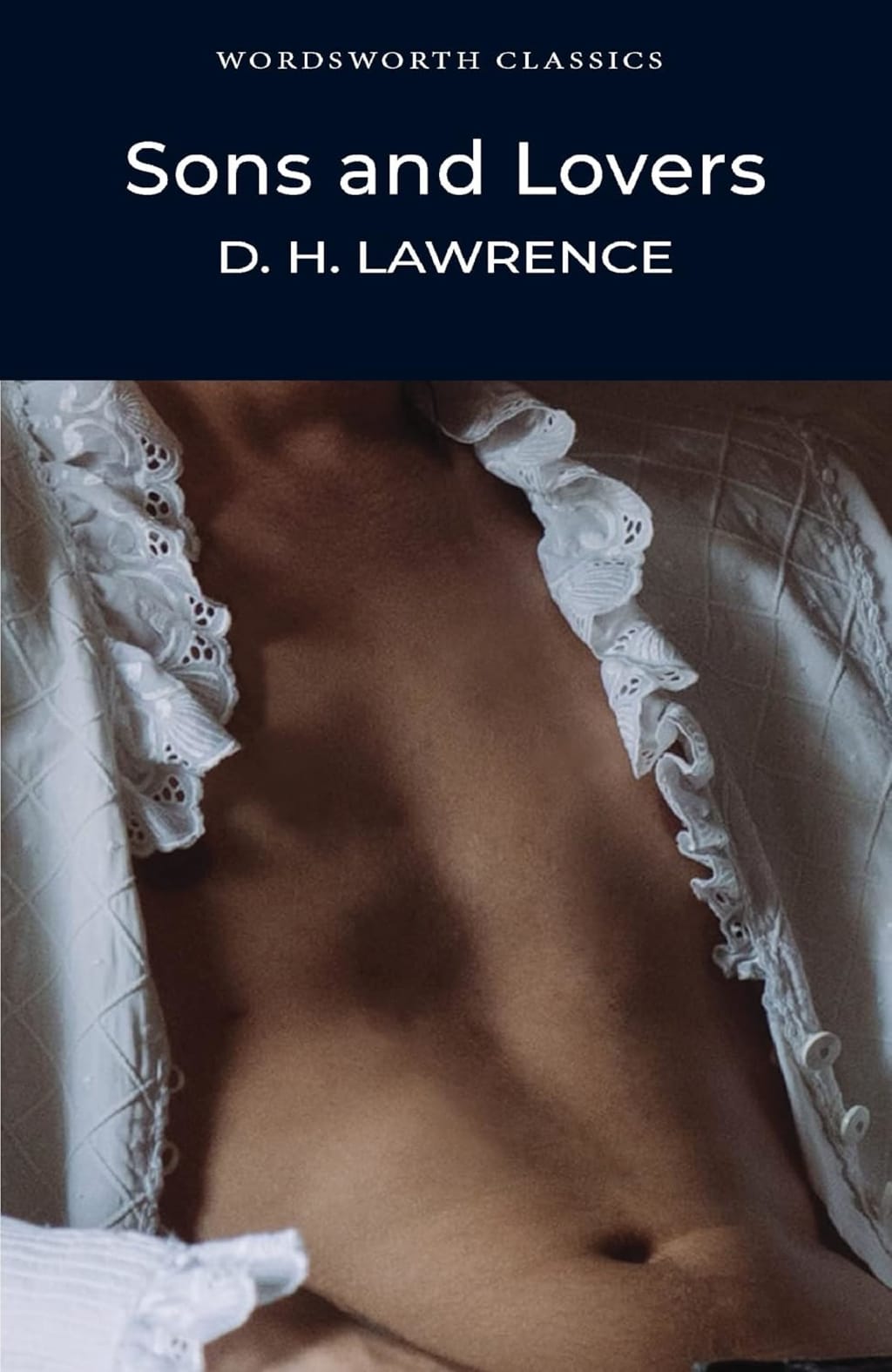
Published in 1913, Sons and Lovers by D.H. Lawrence is a semi-autobiographical novel that draws heavily from Lawrence’s own experiences growing up in a working-class mining community in Eastwood, Nottinghamshire. The novel was Lawrence’s third, following The White Peacock (1911) and The Trespasser (1912), and it marked his emergence as a significant literary figure.
The story was originally titled Paul Morel, after its protagonist, but Lawrence revised it after feedback from his editor, Edward Garnett, and his literary mentor, Jessie Chambers. Sons and Lovers is known as Lawrence’s personal history, particularly his complex relationship with his mother, Lydia Lawrence, and his struggles with romantic relationships. His mother’s aspirations and emotional dominance over him informed the creation of the character Gertrude Morel, whose influence shapes the trajectory of the entire novel.
Plot

Sons and Lovers focuses on the Morel family, living in a Nottinghamshire mining village. Gertrude Morel, a proud and ambitious woman, is deeply unhappy in her marriage to Walter Morel, a coarse and unrefined coal miner. Disillusioned by her husband’s drinking and lack of ambition, Gertrude channels her love and aspirations into her children, particularly her two sons, William and Paul.
The eldest son, William, initially becomes the focus of Gertrude’s affections. He moves to London and secures a respectable position but begins to distance himself from his mother as he falls in love with a superficial woman, much to Gertrude’s dismay. William’s untimely death devastates Gertrude, and her emotional dependence shifts to her second son, Paul.
Paul is a sensitive and artistic young man who struggles to balance his loyalty to his mother with his desire for independence. His romantic relationships with two women, Miriam Leivers and Clara Dawes, are fraught with tension and ambiguity. Miriam, a deeply spiritual and intellectual young woman, loves Paul passionately but feels overshadowed by his devotion to Gertrude. Paul, in turn, is frustrated by Miriam’s idealism and hesitates to commit fully.
Paul’s affair with Clara Dawes, a married suffragist, represents his attempt to assert his independence and explore physical passion. However, their relationship lacks emotional depth, and Paul remains tethered to his mother’s influence. Gertrude’s health declines, and Paul dedicates himself to caring for her in her final days. Her death leaves Paul adrift, grappling with his identity and future.
The novel ends ambiguously, with Paul standing alone, determined to forge his own path but haunted by the loss of his mother and the unresolved tensions of his relationships. It is a thoroughly philosophical ending to an emotionally charged novel.
Into the Book

Gertrude and Her Sons:
The bleeding heart of Sons and Lovers lies in the intense and often suffocating bond between Gertrude Morel and her sons, particularly Paul. Gertrude’s dissatisfaction with her husband leads her to invest her ambitions and emotions in her children, creating a dynamic that stifles their independence. Her love for Paul is both nurturing and possessive, shaping his relationships with others.
Paul’s struggles with Miriam and Clara are underscored by his inability to fully detach from his mother. He admits, “I’ve never had a mother, not really—she’s never let me go.” This dependence highlights the emotional and psychological cost of Gertrude’s dominance, as Paul is torn between his loyalty to her and his desire for autonomy. Gertrude’s death serves as a turning point, forcing Paul to confront his identity and his unresolved feelings.
The theme reflects Freudian psychoanalytic ideas, particularly the Oedipal complex, as Lawrence examines the complexities of love, dependence, and individuation within the family dynamic. I often found it ironic that both Paul and Hamlet's mother are named Gertrude...
“Recklessness is almost a man's revenge on his woman. He feels he is not valued so he will risk destroying himself to deprive her altogether.”
- Sons and Lovers by DH Lawrence
Social Mobility:
Lawrence’s depiction of the Morels’ working-class life offers a vivid commentary on class and social mobility. The contrast between Gertrude, who comes from a middle-class background, and Walter, a miner, underscores the tensions between aspiration and reality. Gertrude’s resentment of Walter’s coarse behaviour and lack of ambition reflects her yearning for a better life, which she projects onto her sons.
William and Paul represent the possibility of social mobility, but their attempts to transcend their class are fraught with challenges. William’s success in London isolates him from his family, and Paul’s artistic aspirations conflict with the practical realities of working-class life. Lawrence captures the beauty and hardship of working-class existence, offering a nuanced portrayal of its limitations and aspirations.
Through the Morel family, Lawrence critiques the rigid social structures of the time and explores the interplay between class, ambition, and personal fulfilment. He shows that perhaps, social mobility is stated though it may not be all it is cracked up to be. There's a huge amount of trepidation and possible isolation that comes from even trying to dip your foot into the waters...
“Sleep is still most perfect, in spite of hygienists, when it is shared with a beloved. The warmth, the security and peace of soul, the utter comfort from the touch of the other, knits the sleep, so that it takes the body and soul completely in its healing.”
- Sons and Lovers by DH Lawrence
Love and Sexuality:
Love and sexuality are central to Sons and Lovers, particularly in Paul’s relationships with Miriam and Clara. Paul’s connection with Miriam is spiritual and intellectual, but he grows frustrated with her idealism and lack of physical passion. He tells her, “You make me feel like a beggar—you’ve got everything to give me, and I’ve got nothing to give you.”
Paul’s affair with Clara, in contrast, is rooted in physical desire but lacks emotional connection. These contrasting relationships highlight Paul’s struggle to reconcile his needs for intimacy, independence, and self-fulfilment.
Lawrence’s explicit exploration of sexuality was revolutionary for its time, challenging Edwardian norms and delving into the psychological dimensions of desire. We all know what happened with Lady Chatterley's Lover. The novel’s treatment of love and sexuality is deeply intertwined with its exploration of identity, class, and familial ties.
“And in this passion for understanding her soul lay close to his; she had him all to herself. But he must be made abstract first.”
- Sons and Lovers by DH Lawrence
Why It's a Masterpiece

Sons and Lovers is hailed as a masterpiece for its psychological depth, lyrical prose, and groundbreaking exploration of human relationships. D.H. Lawrence’s semi-autobiographical narrative captures the complexities of family, love, and class with unparalleled insight.
The novel’s portrayal of the mother-son relationship is both universal and deeply personal, reflecting Lawrence’s ability to explore the dynamics of emotional intimacy. Gertrude Morel’s possessive love and its impact on Paul’s identity and relationships resonate with readers, offering a profound commentary on familial bonds and personal autonomy.
Lawrence’s depiction of working-class life is vivid and empathetic, mixing social realism with poetic language. His ability to convey the beauty of the natural world, the rhythms of daily life, and the struggles of social mobility definitely shows us his own time, and possibly gives us something to comment on our own.
Conclusion

I recall sitting in a Caffe Concerto in my hometown of Birmingham before university (so this would have been at least a decade ago) sipping an espresso and reading an edition of Sons and Lovers. The one thought I could never stop having was how much this was a) influenced by DH Lawrence's own life and b) influenced by 'Hamlet' by William Shakespeare. There is something in the inaction that leaves a Shakespearean taste on the tongue. It definitely lingers there for some time.
Next Week: The Thirty Nine Steps by John Buchan
About the Creator
Annie Kapur
I am:
🙋🏽♀️ Annie
📚 Avid Reader
📝 Reviewer and Commentator
🎓 Post-Grad Millennial (M.A)
***
I have:
📖 280K+ reads on Vocal
🫶🏼 Love for reading & research
🦋/X @AnnieWithBooks
***
🏡 UK
Keep reading
More stories from Annie Kapur and writers in Geeks and other communities.
Book Review: "The Butcher" by Jennifer Hillier
I've never read a book by Jennifer Hillier before and well, I got this one on my phone because it was cheaper. I want to read more creepy and scary novels because obviously, Halloween is coming up. The Butcher is a book that fits that scary vibe but alongside that it also has a comment on power dynamics in which we can see the modern world through the lens of something that is horrifically wrong. There are so many possibilities in this book and though it keeps you on the edge of your seat, it also gives you a lot to think about.
By Annie Kapur3 months ago in Geeks
Marvel Zombie
The last entry into our 2025 superhero projects catalogue is Marvel Zombies. This was a show that was anticipated by absolutely no one and it disappeared from the public consciousness as quickly as it was released. There was nothing special about the project that made it a must see, or a must remember. In fact if anything it's a must forget.
By Alexandrea Callaghan20 days ago in Geeks



Comments
There are no comments for this story
Be the first to respond and start the conversation.