
Book Review: "Patriot" by Alexei Navalny
5/5 - a true story of a political hero...


Now, before anyone starts saying something about Putin I just want to say that this review has nothing to do with Putin (as stated in the title) but instead has to do with the system that he is not only an important component but is also supporting at the moment in the months after the *coughs* 'accidental' prison death of the author in question.
Navalny's autobiography presents an interesting point of view which those who live outside of Russia and typically, do not follow Russian politics too closely, will not realise - that the people of Russia are politically complex. There are people in Russia who do actually politically oppose Putin and whatever regime he represents but, on the outside, we rarely ever see a different face representing the country of Russia.

As we begin to get into the life of Navalny, we see him on a plane where he feels like he is about to die from the horrific nerve agent poisoning set upon him in 2020, only a few years before he is destined to die in prison under shady and myserious circumstances a day after appearing on a visual broadcast where it is thought that there was little wrong with him. Navalny is an interesting figure because even on the plane, he admits that he had no way of articulating what was happening to him and yet, we have a vivid description of this inability in the book. I found that really puzzling but also fascinating to read about.
As we go back into his life after witnessing him lying on a hospital bed making up a haiku about a Japanese surgeon who lost a two year old child, we see the true horrors of the Soviet Union in which his mother has to put the landline telephone underneath a pillow whenever the family talk politics. It was really strange but opens up your eyes on to what extent the Soviet Union went to in order to stop people's basic freedoms and, as a big critic of the Soviet Union and its methods, I thought this was so compelling to read about. How insecure does your political basis have to be that you are now policing free speech? Oh, wait...

There is quite a lengthy section on education in which he admits that though he now knows that his education was not normal as he grew up in the Soviet Union and yet, admits that he went to a good school though he did not get into university first time around. As he talks about the 1990s, there is movement back towards the political stratosphere and then he brings it back to how the once collapsed Soviet Union has been slowly clawing itself back into the public consciousness through certain people and certain parties.
He also speaks of working as a lawyer and how he barely got paid and when he did, there was not much in the office and so, he brought his own stuff to support it. He talks about his wedding and the birth of his first child, how it turned him back towards religion whilst also continuously developing on the topic of politics - looking at the 2003 elections. There was something really strange for him at this time and you can really read him describing how even though he wanted to progress, there were some obstacles in the way of it.

But I have to say the most compelling part of the book was the final part in which he is taken to prison. As we know, Navalny was killed in jail and no matter which way you look at it, he was killed - nobody dies randomly like that. He talks about there being cameras in the ceilings and how he was a given a psychologist plus, how he knew he had to keep a diary. It is always a joy to read about how he wanted so badly to overcome adversity - how before he even landed in his homeland, he was arrested. The motif of reading and books constantly comes back as he references one of his favourite novels, Resurrection by Leo Tolstoy.
The incredible tale of constantly overcoming adversity is one that we are used to reading in fiction, but the reality of this man's life is something else entirely. A whole new level of doing things that everyone else was too scared to do whilst doing it with a great amount of intelligence. I mean, how good do you have to be for a regime that is so controlling to kill you because you're too intelligent for them? Even Putin saw him as a threat and that's why this book is so important.
About the Creator
Annie Kapur
I am:
🙋🏽♀️ Annie
📚 Avid Reader
📝 Reviewer and Commentator
🎓 Post-Grad Millennial (M.A)
***
I have:
📖 280K+ reads on Vocal
🫶🏼 Love for reading & research
🦋/X @AnnieWithBooks
***
🏡 UK
Keep reading
More stories from Annie Kapur and writers in Geeks and other communities.
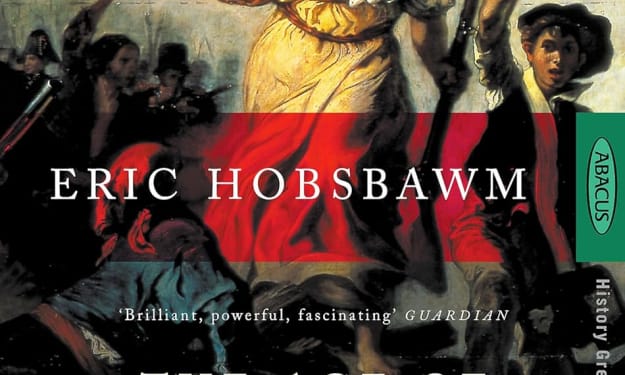
Book Review: "The Age of Revolution: 1789-1848" by Eric Hobsbawm
I read a few chapters of this book when I was in university, almost ten years' ago now. I was pretty sure that one day I would actually bother to read the whole thing and yet, though I owned the book, I never did. Textbooks and philosophical texts, literature and criticisms took over and this got pushed to the background. Recently, after unpacking things, I found it again and felt a little compelled to read it, especially after reading The Enlightenment by Ritchie Robertson. So, as I went back to start at the beginning, I was quite excited to step into such a rich and fascinating time in history. Let's have a look...
By Annie Kapurabout a year ago in Geeks
Marvel Zombie
The last entry into our 2025 superhero projects catalogue is Marvel Zombies. This was a show that was anticipated by absolutely no one and it disappeared from the public consciousness as quickly as it was released. There was nothing special about the project that made it a must see, or a must remember. In fact if anything it's a must forget.
By Alexandrea Callaghan26 days ago in Geeks
Sabrina Carpenter To Appear In Her First-Ever Super Bowl Ad
Sabrina Carpenter will appear in her first-ever Super Bowl advertisement during the big game in early February. Carpenter is featured in a Pringles campaign, to be aired during Super Bowl LX on February 8.
By Dena Falken Esq2 days ago in Geeks
Thoughts on Vocal and the way the world is
"Death cannot stop true love, only delay it." – Wesley in The Princess Bride. I decided to come back to Vocal on a very cold and dark night at the end of December. I had been, and still am, convalescing from a horrible staph infection that had gone misdiagnosed for months. This, paired with the increasing challenges of being healthy, making the best choices for my co-parented child, being a wife, and being a director at a new job, was a lot to manage.
By Jazzy 4 days ago in Confessions



Comments (1)
I remember the "Free Navalny" sticker on my favourite book box. I remember the stories I heard from the parents of friends who escaped to Canada after the Berlin Wall fell. I remember that history can often be like a record that skips. Thank you for this review. I had no idea "Resurrection" was his favourite Tolstoy novel (I found a free copy in that same box and admired this late masterpiece). And your last paragraph is going to haunt me for at least the next four years...