
Book Review: "The Age of Revolution: 1789-1848" by Eric Hobsbawm
5/5 - insights on the prophecy brought around by the beginning of the modern age...


I read a few chapters of this book when I was in university, almost ten years' ago now. I was pretty sure that one day I would actually bother to read the whole thing and yet, though I owned the book, I never did. Textbooks and philosophical texts, literature and criticisms took over and this got pushed to the background. Recently, after unpacking things, I found it again and felt a little compelled to read it, especially after reading The Enlightenment by Ritchie Robertson. So, as I went back to start at the beginning, I was quite excited to step into such a rich and fascinating time in history. Let's have a look...
Hobsbawm’s argument revolves around two transformations: the French Revolution (1789) and the Industrial Revolution (which began in Britain in the late 18th century). The French Revolution reshaped the political order in Europe, overthrowing monarchies, challenging feudal privileges, and introducing ideas of democracy, equality, and nationalism. It set off a wave of revolutionary movements across Europe and Latin America.
Simultaneously, the Industrial Revolution transformed economies from agrarian-based to industrial, introducing mechanised production, factory systems, and mass urbanisation. Hobsbawm argues that these "dual revolutions" not only transformed Europe but had profound consequences worldwide, setting the stage for modern capitalism and imperialism, as well as reshaping global class structures and economic relations.
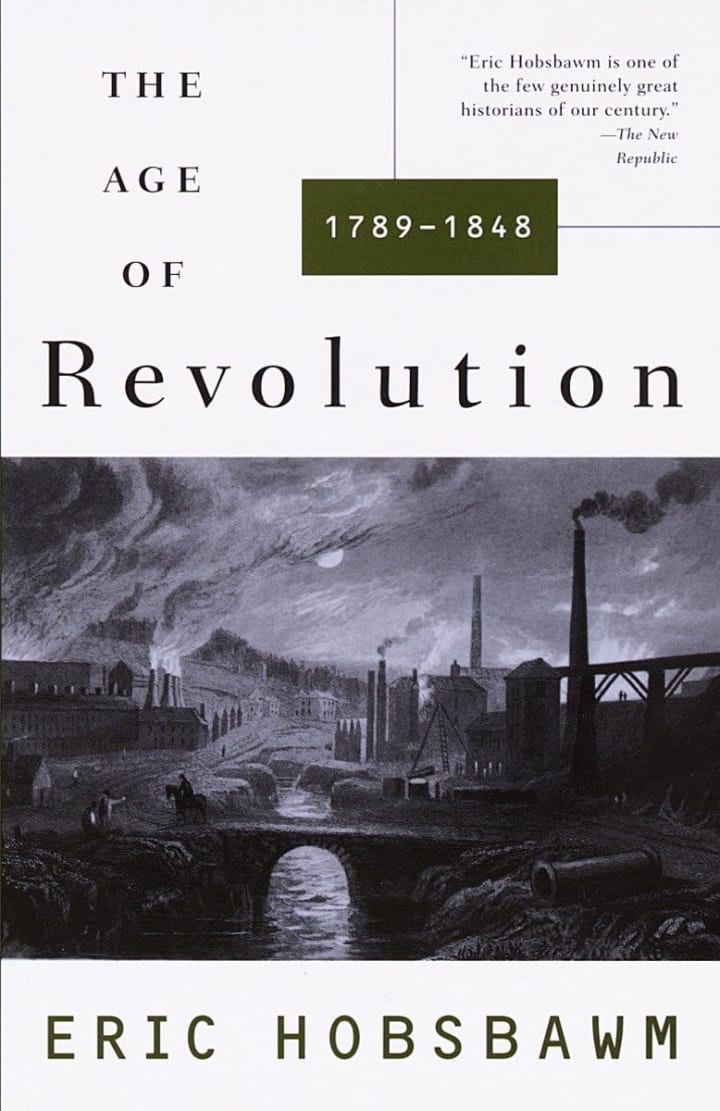
Nationalism emerged as a powerful political force during this era, driven by the revolutionary ideals of liberty, equality, and national self-determination. The author highlights how the French Revolution, particularly its call for a nation of citizens rather than subjects, ignited national consciousness across Europe. This shift was reinforced by the Napoleonic Wars, which spread revolutionary ideas and inspired resistance to foreign rule.
Nationalism became a tool for both liberation and oppression—while it helped unify fragmented regions, it also fostered tensions within multi-ethnic empires such as Austria-Hungary. Hobsbawm argues that nationalism was often tied to the middle class, who saw the nation-state as a means to secure economic and political power. This ideology would later evolve into a central organising principle of modern politics, contributing to both state-building and imperialism.
The Industrial Revolution led to unprecedented urbanisation, as people moved from rural areas to cities in search of work in factories. Hobsbawm provides a detailed account of how industrial cities like Manchester, Birmingham, and Glasgow expanded rapidly, often without adequate infrastructure. Living conditions for the working class were dire: overcrowded tenements, poor sanitation, and long working hours in dangerous conditions were the norm.
The author also describes the creation of a new social class—the proletariat—who laboured in factories and mines under harsh conditions. The growing working class became increasingly aware of their exploitation, leading to labour unrest, strikes, and the formation of early trade unions. This urbanisation also altered social relations, as traditional community structures were replaced by anonymous, industrial cities, where the division between the rich and poor became increasingly volatile.
The author describes liberalism as the dominant ideology of the bourgeoisie during this period. Liberals advocated for constitutional government, the rule of law, free trade, and individual rights, challenging the absolute power of monarchs and the entrenched privileges of the aristocracy. This ideology found its most complete expression in the revolutions of 1830 and 1848, where liberals sought to establish constitutional monarchies or republics that would solidify these values.
Hobsbawm points out that while liberalism promoted political freedoms, it was often tied to economic interests, particularly the protection of private property and capitalist enterprise. As a result, liberals were frequently at odds with more radical movements such as socialism, which called for the redistribution of wealth and greater economic equality.
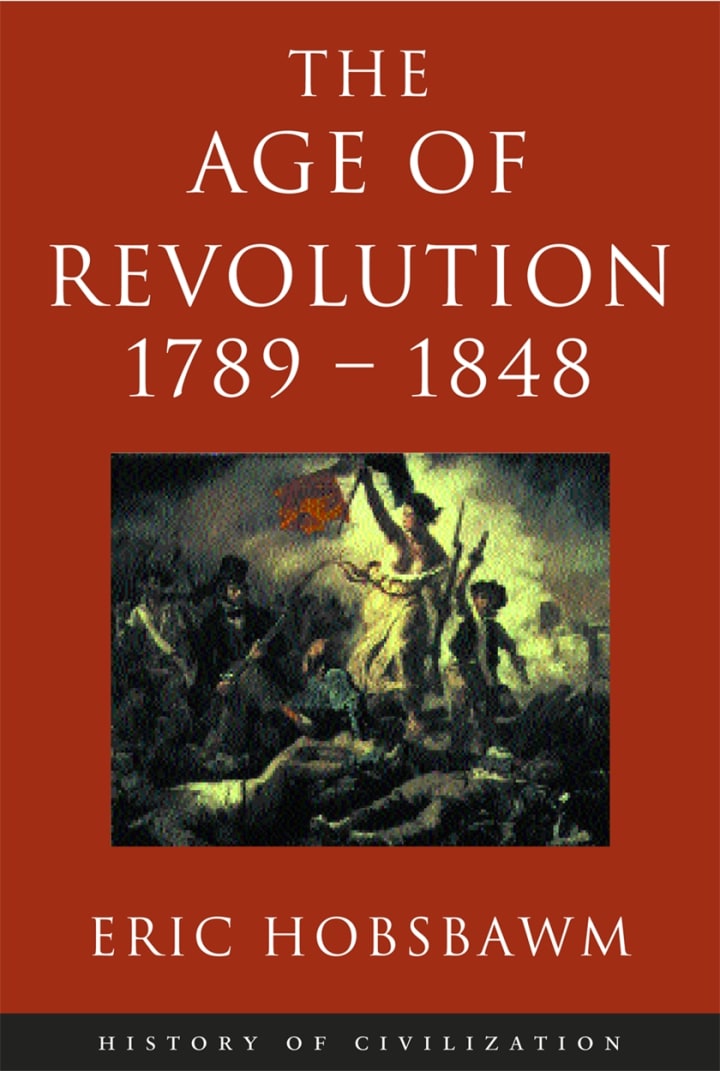
The Age of Revolution was also a period of intellectualism. Hobsbawm explores the rise of Romanticism: a cultural movement that emerged as a reaction against the rationalism of the Enlightenment and the mechanisation of industrial society. Romantic thinkers and artists emphasised emotion, individualism, and a reverence for nature and the past. This movement had significant political implications, as it fuelled nationalist movements by glorifying folk traditions and national identities. At the same time, new socialist and communist ideologies began to emerge, most notably with Karl Marx’s critique of capitalism.
As you can see, I went through this book with a fine tooth comb this time; noting how this argument basically produces the conclusion that the Industrial Revolution may have been great for the middle class and created some social flourishing for those who already had money. But the poor and the disillusioned became agitated at the speed at which it took hold in pushing towards the capitalist system which now today, governs our lives. I have always taken it as a warning because one day it will hit a critical mass if it has not already.
About the Creator
Annie Kapur
I am:
🙋🏽♀️ Annie
📚 Avid Reader
📝 Reviewer and Commentator
🎓 Post-Grad Millennial (M.A)
***
I have:
📖 280K+ reads on Vocal
🫶🏼 Love for reading & research
🦋/X @AnnieWithBooks
***
🏡 UK
Reader insights
Outstanding
Excellent work. Looking forward to reading more!
Top insights
Compelling and original writing
Creative use of language & vocab
Easy to read and follow
Well-structured & engaging content
Expert insights and opinions
Arguments were carefully researched and presented
Eye opening
Niche topic & fresh perspectives
On-point and relevant
Writing reflected the title & theme
Keep reading
More stories from Annie Kapur and writers in Geeks and other communities.
Book Review: "A Voyage Around the Queen" by Craig Brown
I've read a few books by Craig Brown before such as One, Two, Three Four which is his book about the Beatles and Ma'am Darling which is his book about Princess Margaret. It seems like the book A Voyage Around the Queen has been more anticipated than both of them put together even though I was personally losing it waiting for Ma'am Darling to come out before it did. This book is not just any book about Queen Elizabeth II, it is a book about everything around her. It isn't a story of her life, but rather a story of her changing surroundings and how she changed with them. It is practically a story about everyone, everything and all of it. Here's what I mean...
By Annie Kapurabout a year ago in Geeks
Marvel Zombie
The last entry into our 2025 superhero projects catalogue is Marvel Zombies. This was a show that was anticipated by absolutely no one and it disappeared from the public consciousness as quickly as it was released. There was nothing special about the project that made it a must see, or a must remember. In fact if anything it's a must forget.
By Alexandrea Callaghan26 days ago in Geeks
Autonomy Is The Real Privilege
Good morning, freedom-seekers! Today we’re gonna be looking at autonomy. A strange word, I know; one many would probably look at blankly and run away from on sight. We’re gonna figure out what it actually means, consider how it’s achieved, and decipher just how deeply most of us are tangled up in dependence without realising it.
By That ‘Freedom’ Guy2 days ago in Humans



Comments (1)
I've read the twentieth century work by this author, but I need to check this one out. History is a cycle we cannot seem to break.