
Book Review: "Night Walks" by Charles Dickens
5/5 - a perfect read for the on-coming autumn/winter nights...


Reading Dickens is always a treat as the nights become darker and the weather gets a little chilly. I make it a habit of re-reading stories like The Signal-Man around this time because it makes me feel all warm and cosy inside. As we run up to cold weather and of course, Halloween - stories set in the nighttime or those that feel a bit eerie definitely give us a whole new sense of atmosphere. I'm very happy that the horrible hot weather is going and now, I can be depressed and cold in peace. At least I have a good book and I'm wrapped up warm.
'But it was always the case that London, as if in imitation of individual citizens belonging to it, had expiring fits and starts of restlessness.'
- Night Walks by Charles Dickens
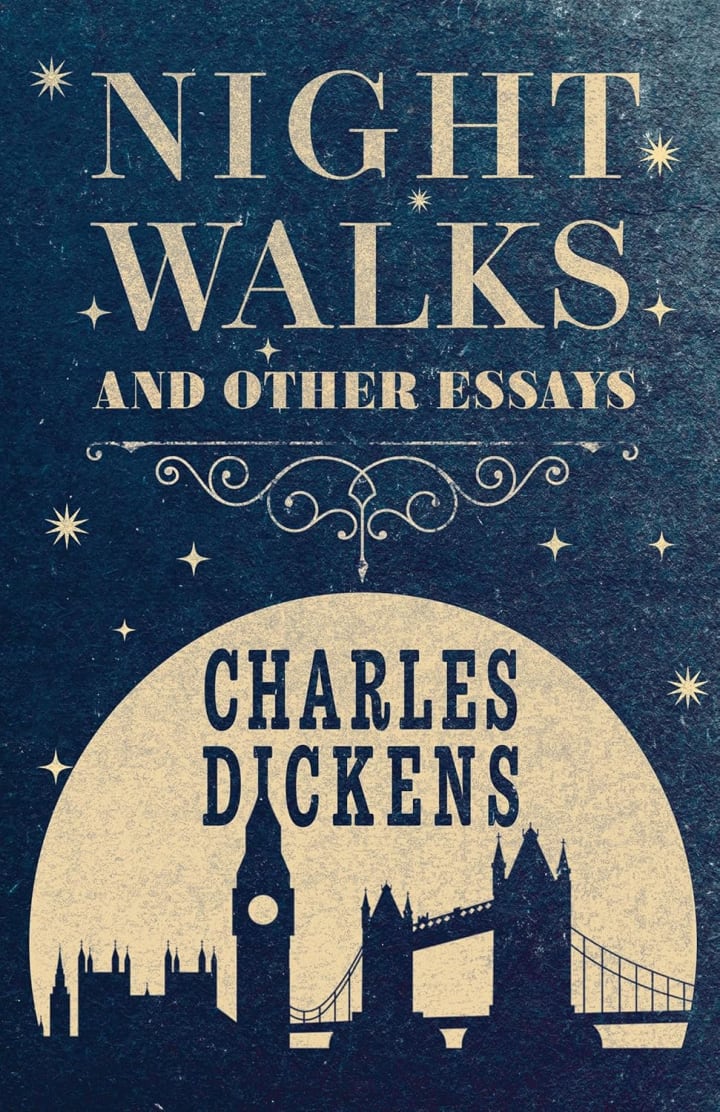
Dickens explains that recurring insomnia pushes him out of bed and into the London streets after midnight. These nocturnal walks begin as a cure for restlessness but soon take on a deeper purpose: they expose to him a city radically different from the one he knows by day. The familiar avenues become deserted, church bells sound eerily loud in empty spaces, and even grand architecture takes on a haunted character. In this altered world, Dickens experiences London as both dreamlike and brutally real. There are so many images of the reality of the waking sleeplessness that resonate to anyone who has ever even paced their bedroom whilst awake at night. It is the perfect opening to a new season.
He encounters groups of homeless men, women, and children who spend their nights wandering aimlessly because they have nowhere to sleep. They form what he calls a sort of “walking club,” moving endlessly to keep warm, too poor to afford lodgings and too desperate to stop moving. Dickens is struck by how exhaustion and poverty reduce them to shadows of humanity, and he condemns a society where survival depends on constant motion without rest. This is kind of relative to the times where Dickens writes about public hangings and the way in which society doesn't have empathy for other people in his journalism and sketches. Dickens' shock at the way in which the poor are treated has obviously come from his own experience, but this is even more realistic because it's based on his own viewing experiences at the most vulnerable times of the night.
Another way in which Dickens shows his disgust at the way the poor are treated is through his vivid descriptions. Many of Dickens’ sharpest images come from finding people sprawled on cold stone steps, huddled in alleyways, or curled against bridge walls. He describes their skeletal thinness, ragged blankets, and the sheer vulnerability of sleeping exposed. Unlike the comfortably housed middle classes, these people live out their nights in the open, on the very edges of respectability. Dickens lingers on their faces, noting both the resignation of the adults and the raw suffering of children, turning each encounter into a moral accusation against Victorian indifference.
Prolonged wakefulness blurs Dickens’ perception. Empty streets feel like theatre sets, and he writes of statues and shadows that seem animate, of familiar landmarks that appear spectral in moonlight or fog. A solitary figure on the bridge looks ghostly until Dickens approaches and discovers a shivering boy. These dreamlike distortions highlight the liminal space between wakefulness and sleep, reality and nightmare. The night amplifies loneliness, creating an atmosphere where London becomes at once strange and terrifyingly intimate. I love the varying descriptions of London throughout. All at once, it feels like a dark black-and-white movie, and it also feels like an Old Victorian novel like The Strange Case of Dr Jekyll and Mr Hyde where Utterson and Enfield are walking around at nighttime in Chapter 1.
Passing graveyards at night, Dickens meditates on the thin line between sleep and death. He imagines the silent dead beneath the stones while the living shuffle just above them, equally forgotten by society. The darkness makes mortality impossible to ignore; for Dickens, every homeless sleeper becomes a figure poised between life and death. Victorian society is cruel, unusual and often misrepresents itself as progressive and more so, than other regions and times in history.
All in all, this is an excellent book about the way in which Dickens comes to understand sleep as being like a curse against learning of the world in darkness. The observation of sleep becomes an observation of death and dying, the ideas relative to wakefulness that is forced throughout night become metaphors for how the poor live. Night becomes an economy through people and images. Honestly, as the nights become earlier where you are now summer turns to autumn - this could be your next perfect read. There are other essays in this book as well, but this one has to be the most perfect for the winter nights that are coming towards us.
About the Creator
Annie Kapur
I am:
🙋🏽♀️ Annie
📚 Avid Reader
📝 Reviewer and Commentator
🎓 Post-Grad Millennial (M.A)
***
I have:
📖 280K+ reads on Vocal
🫶🏼 Love for reading & research
🦋/X @AnnieWithBooks
***
🏡 UK
Keep reading
More stories from Annie Kapur and writers in Geeks and other communities.
Book Review: "Exterminator!" by William S. Burroughs
As you know, my encounters with William S Burroughs have been a bit here and there. I have often enjoyed his works but, then again some have missed the mark entirely. Some years' ago I read The Wild Boys which was definitely in the middle of that line it seems, though tipping over to the side of enjoyment from time to time. When I read Queer however, I found out what the problem really was: that it would have been much better if it wasn't William S. Burroughs who had written it. So, let's explore what I thought of the fragmentary experimental novel Exterminator! where yet again, Burroughs has planted himself firmly (it seems) in the autobiography of the character and plot.
By Annie Kapur4 months ago in Geeks
Silver Screen Magic with Mae West
American actress and singer Mae West became a popular film actress during the Great Depression. She started entertaining in vaudeville, then performed on Broadway, and finally went to Hollywood. She signed up with Paramount Pictures and made her debut in the 1932 film “Night After Night.” She also starred in musicals, comedies, and crime dramas. The American Film Institute named her one of the best classic Hollywood actresses.
By Rasma Raisters6 days ago in Geeks
The Devil's Cut
“Comrade, finally you’re awake.” The voice was smooth, sensual. A flickering incandescent bar was all that lit the white, sterile room. All Vladimir remembered was everything going black. He tried to move his arms and found them strapped to the gurney.
By Matthew J. Fromm5 days ago in Fiction




Comments (1)
Thi sounds really interesting, I will add it to my list