
Book Review: "More Die of Heartbreak" by Saul Bellow
5/5 - a fantastic psychological manipulation drama by Saul Bellow about love, melancholy and detachment...

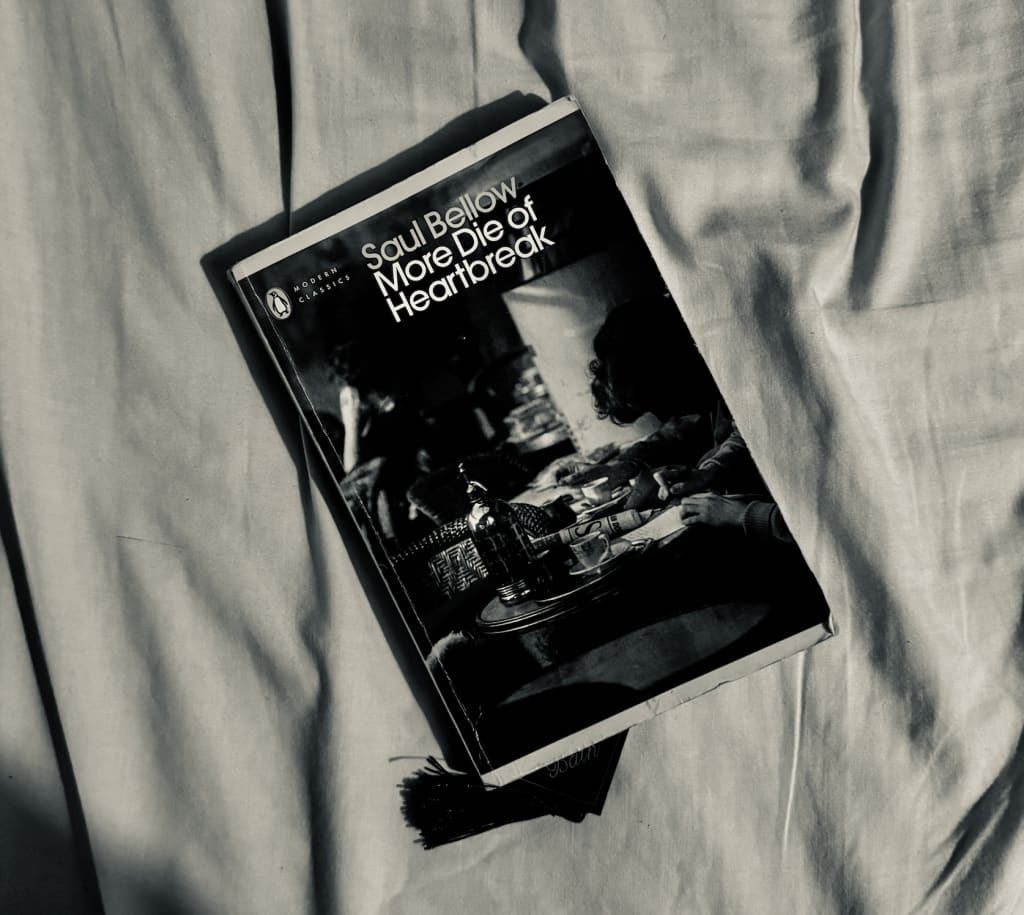
I'm just going to attach some of my past reviews of Saul Bellow novels below if you'd like to read them...
And now, welcome to More Die of Heartbreak. A story that criticises Reagan's America, this book is an 80s classic of existentialism and melancholy. Mixed in is Bellow's classic wit and I have to say, it's probably up there with Ravelstein and Herzog as my top ranked Saul Bellow novels. I was approaching this one carefully because I'm not sure about Saul Bellow still - I often think that when he tries to write novels that are too long it can drag a bit because of his use of wit quite literally everywhere. But, he definitely proves that his longer novels are just as fantastic as the shorter ones here.
The story is narrated by Kenneth Trachtenberg, a young Russian-American academic and lecturer who studies Japanese literature. He's quite a sardonic man, he has several comments on the existentialist state of things and often makes observations that are quite obtuse. Through his witty and self-conscious narration, he introduces us to his beloved uncle, Dr. Benn Crader, a distinguished botanist and environmentalist. This character is a little bit more of an oddball. Though he's described as quite an intelligent man, there are little that make these two normal men in their society. Kenneth idolises his uncle though and we definitely see this through the way in which he is very protective over his status as a distinguished botanist and the way he lives his life.
Benn is gentle, naïve, and emotionally unguarded. He is a man who knows everything about plants and almost nothing about people. Bellow's want to present this man as innocent and pure as physically possible definitely contrasts with the America around him which is packed full of corruption and greed. He seems almost apart from the modern world. It is almost as though America's emerging moral chaos does not impact his life in the slightest. He is entirely detached from it. Kenneth, though younger and sharper in worldly terms, mirrors his uncle’s confusion about modern life. He is divorced, entangled in affairs, and intellectually restless.
Benn impulsively marries Matilda Layamon, a beautiful but emotionally opaque woman from a wealthy and dysfunctional family. Matilda’s father, Valerian Layamon, is a manipulative businessman who treats everyone, including his daughter, as assets or liabilities. This is definitely not the environment he wants to be caught up in nor does he have any experience of battling, but here he is and this is where the centre of the narrative is about to unfold. Benn, the innocent and gentle man of detachment and intellectual possibility and his wife's family - a satire of Reagan's America in one of the most obvious ways Bellow has ever depicted a satire. It is fantastic and also, keeps the reader invested over how much this will impact Benn's life - though we are not fully prepared for how Bellow's wit will turn to darkness and melancholy later on in the text.
Meanwhile, Kenneth is caught in his own failed love affair with a married woman. His intellectual justifications for his passion and his cynicism about love become part of the novel’s running commentary on emotional delusion. Emotional delusion is everywhere and yet, those who are the characters of satire exploit it so much that by the middle of the book the reader is almost losing their mind in trying to protect our beloved character of Benn. Kenneth though, we are not too worried about as he is younger, might recover quicker and has a better grasp on the fact he is delusional. Bellow makes this divide quite clear and yet, we cannot pull ourselves away from seeing a possibly tragic end result.
Benn begins to retreat away from Matilda after seeing her family's exploitation of his being. But, he is also left with physical difficulties because of his crushed emotional state. This is not the only thing that happens but we are left contemplating the America Benn lives in and whether Kenneth must now face the next decades in relatively the same way since he idolises his uncle. We constantly feel like Kenneth is perhaps more aware than his uncle, but if the twists and manipulation get any worse, will Kenneth fall down the same trap? Does intellectualism naturally incur a sort of delusion about the self? Is Saul Bellow trying to tell America to wake up to its own delusion? There are so many questions left by the end of the novel, I was quite surprised I was able to put it down.
About the Creator
Annie Kapur
I am:
🙋🏽♀️ Annie
📚 Avid Reader
📝 Reviewer and Commentator
🎓 Post-Grad Millennial (M.A)
***
I have:
📖 280K+ reads on Vocal
🫶🏼 Love for reading & research
🦋/X @AnnieWithBooks
***
🏡 UK
Keep reading
More stories from Annie Kapur and writers in Geeks and other communities.
Three Lives by Gertrude Stein
Gertrude Stein’s Three Lives was published in 1909 by the Sunwise Turn publishing house. The novel was Stein’s first major work of prose fiction and represents a move away from traditional narrative structures of the past American literary landscape. Before writing Three Lives, the author had lived in Paris, where she was influenced by Cubism, post-impressionist art, and avant-garde movements. The book reflects her involvement with these movements, mostly through her use of language and form, both of which were quite radical for the time and place in which she lived.
By Annie Kapur2 months ago in Geeks
Silver Screen Magic with Mae West
American actress and singer Mae West became a popular film actress during the Great Depression. She started entertaining in vaudeville, then performed on Broadway, and finally went to Hollywood. She signed up with Paramount Pictures and made her debut in the 1932 film “Night After Night.” She also starred in musicals, comedies, and crime dramas. The American Film Institute named her one of the best classic Hollywood actresses.
By Rasma Raisters5 days ago in Geeks
Premier League in Denmark: How to Watch
The 2025–26 Premier League season is underway, marking the 34th edition of the competition and the 127th year of top-flight English football. Liverpool start their title defense with confidence after lifting their second Premier League trophy last season, but the return of Leeds United, Burnley, and Sunderland ensures fresh rivalries – including the long-awaited Tyne–Wear derby, back for the first time since 2015–16.
By David Cook4 days ago in Geeks




Comments (1)
I cannot say I have read anything by Saul Bellow that I remember, but this sounds like another one for my ever-growing list