
Book Review: "Herzog" by Saul Bellow
5/5 - one of the best Saul Bellow novels out there...

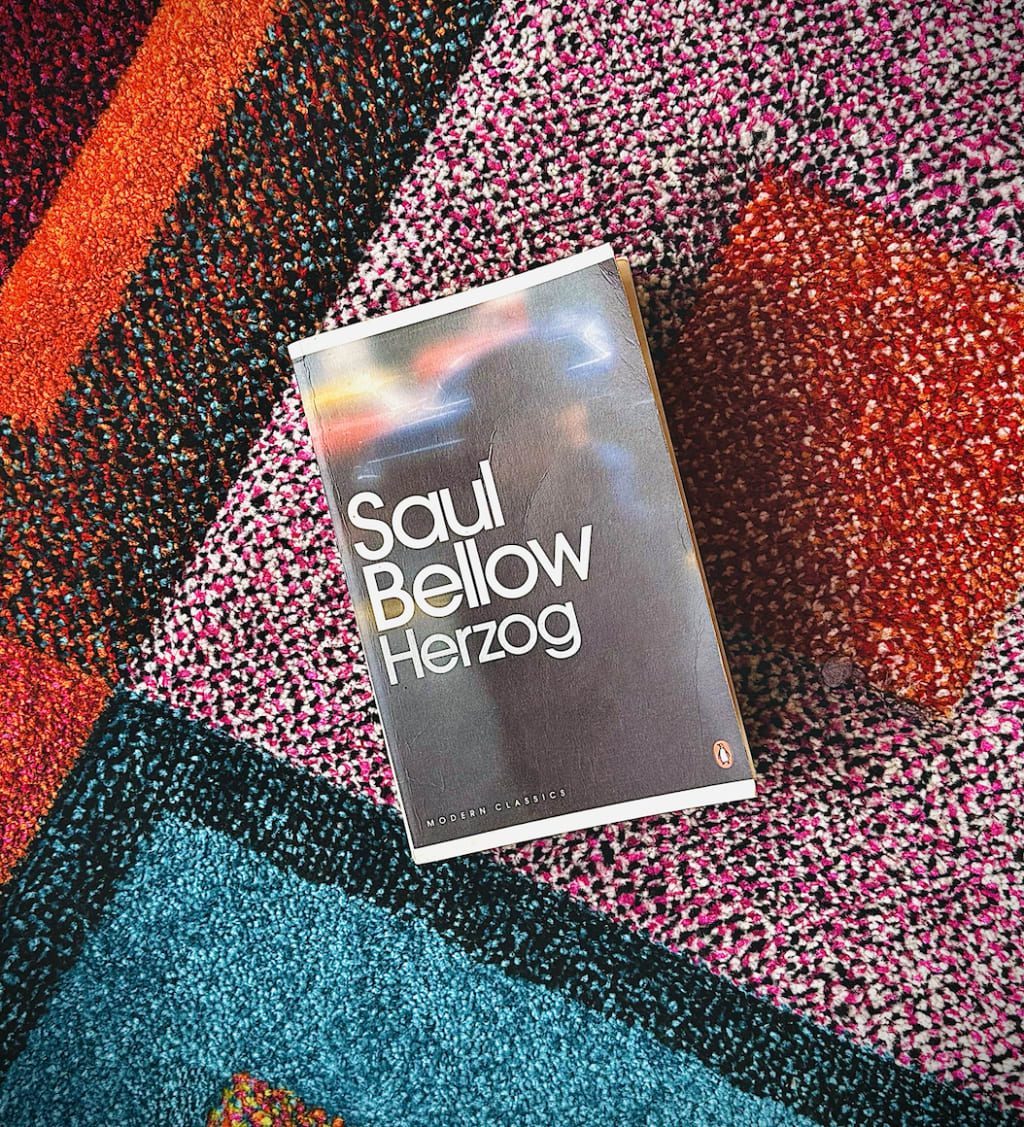
I'm not sure how many of you know this but there was one point in my life where I would not read Saul Bellow's novels purely because a few years' ago I got through The Adventures of Augie March with not a lot of the old 'will to live' left in me. I'm sorry if you loved it, but I just thought it went nowhere. The language is pretty good, but he's written objectively better books. I mean Ravelstein is a book I read much too late and yet, it's a masterpiece. I've tried The Adventures of Augie March more than once but, it seems like it's just not a book I'm going to gel with. Henderson the Rain King is also pretty good and here we are on another one: Herzog. Let's take a look...
Moses Herzog is 47 and encountering an existential crisis point in his life. Recently divorced from his second wife, Madeleine, who left him for his friend Valentine Gersbach, this university professor is upset to say the least. He mentally composes letters he'll never send and these imaginary correspondences give us insight into his character. They are to friends, philosophers, enemies, and historical figures and are less about communication and more about processing his fragmented thoughts. This was actually quite clever. I'd like to commend Saul Bellow by presenting us with this isolated character who shares his thoughts in a universal way. I think we have all thought about what we would say to people about our inner thoughts whether we know the people themselves very well or not.
The letters themselves are rambling, reflective, philosophical, and often self-deprecating. I think one of them might have even been to President Eisenhower or something. (I looked it up and that, is in fact true). Just an odd person to pick at this particular moment, but I understand Saul Bellow's reason for including him in the mix. Bellow's meditation on obsessive thinking is actually quite telling, especially in the fact that Herzog composes unsent letters to philosophers as well.

We learn that Herzog was married before Madeleine. He was married to a woman called Daisy and seems to be pretty upset at the way that marriage went as well. At least there was a quiet dignity to how that marriage ended - which he seems to accept. In his second marriage though, he was cheated on and so, rightly feels a bit more resentment towards his second wife. Above all that though, he is involved with a more liberated woman named Ramona whom he seems to suggest lacks emotional depth. There is definitely something up with this guy's needs and Saul Bellow also explores this in the novel.
A central idea of the novel is the conflict within Herzog himself between his intellectual pursuits and his emotional wants. He is a scholar who once aspired to write a significant philosophical work, but his personal crises have derailed these ambitions. He seems to be a Hamlet-like character in the sense that he is having these long momentary discussions with an imaginary audience which is basically highlighting his ironic inaction: actions he wants to take but simply cannot bring himself to do. I have no idea whether that was intentional by Saul Bellow, but that is definitely what it seems like.
I love a good novel about alienation from modern society and this is one of those novels. Alienation represented through emotional ranting which comments on things like society, materialism and feeling distant from others - it is such a timely critique. Disillusioned with politics, academia, and conventional morality, Herzog sees modern life as hollow and fragmented. We can definitely see that Saul Bellow is trying to do two things: one is to make us realise exactly how absurd and dystopian modern society actually is emotionally and the other is to showcase the true pretention of intellectuals (especially those working in academia). I think there is really one thing we can tell about Herzog through his unsent letters though: he has a yearning for genuine connection, moral clarity, and a return to humanistic values. Sorry Herzog, but we're in 2025 now and I simply don't think it's possible. In fact, it got even worse.
We get to explore people like Herzog's son and others he's become distant from. It's quite a treat to read such a good Saul Bellow novel. It's probably not as absurd as Ravelstein for me but it is definitely one of his best books. I am very impressed by this rage on the epistolary form.
***
Don't forget to enter my unofficial poetry challenge!!!
About the Creator
Annie Kapur
I am:
🙋🏽♀️ Annie
📚 Avid Reader
📝 Reviewer and Commentator
🎓 Post-Grad Millennial (M.A)
***
I have:
📖 280K+ reads on Vocal
🫶🏼 Love for reading & research
🦋/X @AnnieWithBooks
***
🏡 UK
Keep reading
More stories from Annie Kapur and writers in Geeks and other communities.
Book Review: "A Very Easy Death" by Simone de Beauvoir
Is anyone obsessed with getting Fitzcarraldo Editions as soon as the price comes down or whenever they're in the library or even on Kindle Unlimited? Yeah I knew it was only me. I have ✨ no money ✨ (I think that is the first time I've ever used those icon things in a post). But anyways, Simone de Beauvoir is not an author I usually like to read often, I find her philosophies on life to be flawed and her feminism to be fair but injected with light Communism. But, I did however have to read this book by her seeing as I was getting an eye-full of it on social media and the price was basically nothing. So here we go...
By Annie Kapur8 months ago in Geeks
Silver Screen Magic with Mae West
American actress and singer Mae West became a popular film actress during the Great Depression. She started entertaining in vaudeville, then performed on Broadway, and finally went to Hollywood. She signed up with Paramount Pictures and made her debut in the 1932 film “Night After Night.” She also starred in musicals, comedies, and crime dramas. The American Film Institute named her one of the best classic Hollywood actresses.
By Rasma Raisters5 days ago in Geeks
Sadie Sink Found Out About Her ‘Spider-Man’ Casting Via Online Speculation: “There’s Sometimes Some Truth To It”
Although sworn to secrecy by the MCU, Sadie Sink admits there’s sometimes some truth to the online fan theories. The actress, who will star in Spider Man Brand New Day in an undisclosed role, admitted “it’s torture” not being able to tell people which character she’s playing in the fourth installment of the Marvel Studios franchise.
By Dena Falken Esq7 days ago in Geeks



Comments (1)
Brilliantly observed! Your take on Herzog captures its aching intellect and emotional unrest so well.