
Book Review: "A Very Easy Death" by Simone de Beauvoir
5/5 - could this be Simone de Beauvoir's best book?

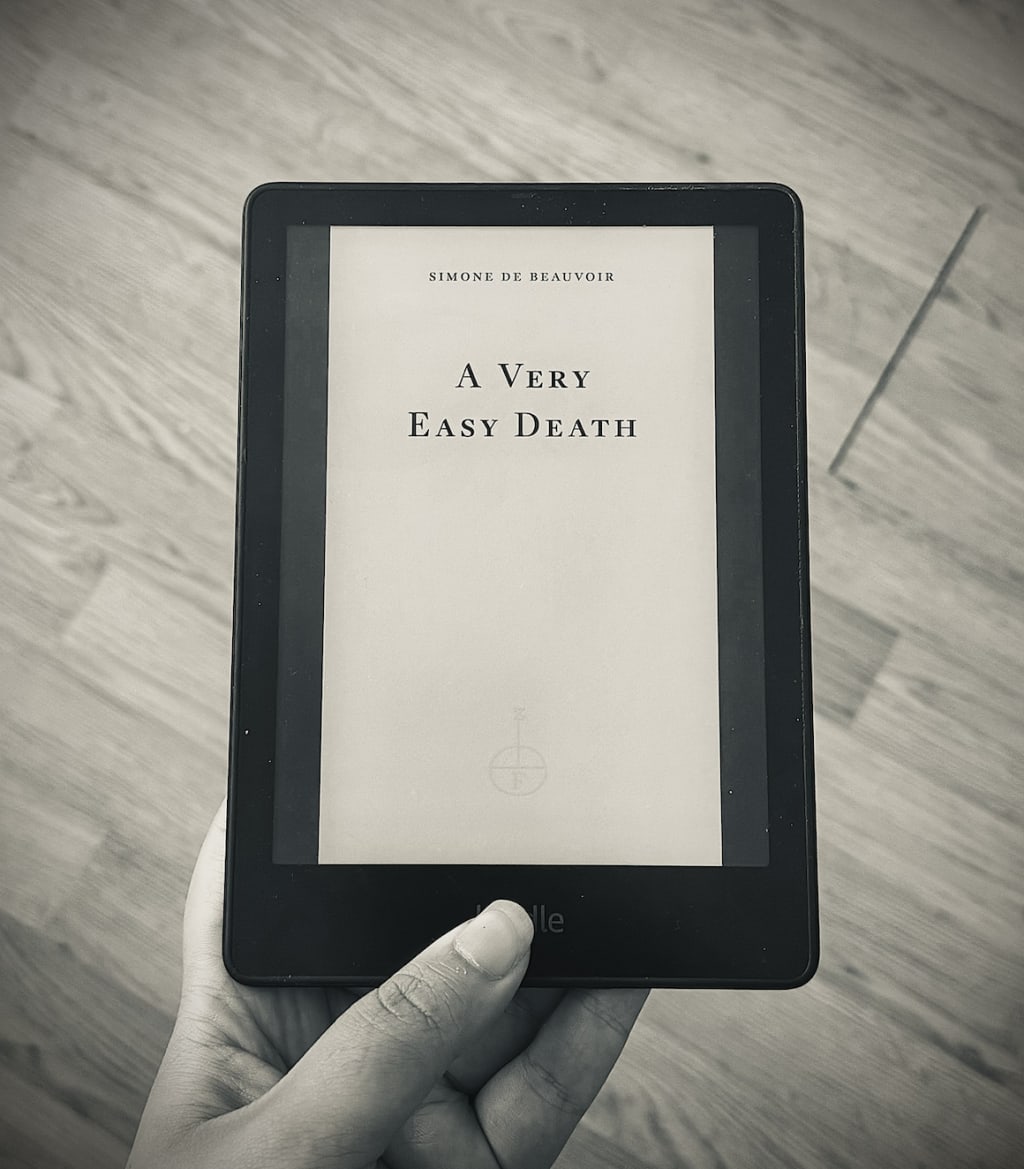
Is anyone obsessed with getting Fitzcarraldo Editions as soon as the price comes down or whenever they're in the library or even on Kindle Unlimited? Yeah I knew it was only me. I have ✨ no money ✨ (I think that is the first time I've ever used those icon things in a post). But anyways, Simone de Beauvoir is not an author I usually like to read often, I find her philosophies on life to be flawed and her feminism to be fair but injected with light Communism. But, I did however have to read this book by her seeing as I was getting an eye-full of it on social media and the price was basically nothing. So here we go...
Documenting the final year of her mother's life, Simone de Beauvoir writes the most emotional thing I've ever read by her. It sort of reminds me of that book Joan Didion wrote; it's called My Year of Magical Thinking. There's so much existentialist philosophy intertwined with the raw emotion of confronting the realities of life and death. After taking her mother to hospital for something quite minor, it turns out that there is a terminal illness there as well. Her mother becomes more frail and Beauvoir starts to look at how the mother-daughter dynamic has been reversed.
She admits that her relationship with her mother was distant at best, going through her past to look at the emotional landscape around that. She was an atheist and intellectual and had rebelled against her mother’s conventional Catholicism and bourgeois values. Yet, faced with her mother’s vulnerability and decline, old resentments soften. However, she still doesn't romanticise the past, she simply accepts it the way it was. She also accepts that impending death can bring changes to people's perspectives. This is perhaps Simone de Beauvoir's most emotionally introspective book. I'm quite surprised to read this after reading The Blood of Others, obviously I didn't really enjoy that one.
She also does a strange critique of healthcare, especially palliative care and dealing with death. It's all very clinical and industrial rather than loving and caring. Doctors and nurses are portrayed as well-meaning but emotionally detached, focused more on procedure than the patient's holistic well-being. I mean I get why they would be, but this is something that hasn't really changed that much in our day. Everyone who says 'the GP doesn't listen to me, they just say what they were going to say regardless of what I was saying' is probably right. Simone de Beauvoir made a pretty good observation here.
Her mother is subjected to procedures without being fully informed, a lack of transparency - something the author resents. Honestly, I can feel that. There is something about witnessing people going through shady medical procedures that they don't fully consent to that are being done in 'their best interest' which is particularly upsetting. Most of the book deals with her mother's experiences of pain whether it be physical or emotional. There is an increasing agony as her mother suffers through invasive treatments in which moments of lucidity are interspersed with confusion. Painkillers sometimes obscure awareness, leading to philosophical musings on consciousness and identity. Are you really still the same person when your body has been so badly wrecked by pain that your mind must be dulled by morphine? It's a big question here.
She writes about how time distorts under visiting her mother, looking at her deterioration through the lens of being a woman and being a religious woman at that. Routines of medications and procedures are mixed in with observations of what a woman truly is, and how everything about womanhood is stripped away with age and hospitalisation: from elegance to modesty all the way to the maternal abilities. It was a really philosophically upsetting section of the book but I also think she was really staying true to her existentialism. She was looking at everything with that eye and it turned into a seriously interesting critique of impending death.
All in all, there is something amazing about this book that I have never really experienced reading something by Simone de Beauvoir after The Second Sex. It is definitely something that I would read again given the chance.
***
Don’t forget to join my unofficial poetry challenge!
About the Creator
Annie Kapur
I am:
🙋🏽♀️ Annie
📚 Avid Reader
📝 Reviewer and Commentator
🎓 Post-Grad Millennial (M.A)
***
I have:
📖 280K+ reads on Vocal
🫶🏼 Love for reading & research
🦋/X @AnnieWithBooks
***
🏡 UK
Keep reading
More stories from Annie Kapur and writers in Geeks and other communities.
Book Review: "A Girl's Story" by Annie Ernaux
It's the end of April 2025 and I know I always start with the rough dates but I do need to say something about that. Often people ask me how I'm able to release new content every day. This book review probably won't be released until June or something I don't know, I sort of choose them at random by this point. Sometimes I work through chronologically to when I wrote something but other times I release what I think sounds good. The truth is, I've got quite the backlog on here in my drafts. So don't get upset about it, I have been writing like this for a while so there's a lot of stories in my drafts sitting around waiting to be released.
By Annie Kapur8 months ago in Geeks
Silver Screen Magic with Mae West
American actress and singer Mae West became a popular film actress during the Great Depression. She started entertaining in vaudeville, then performed on Broadway, and finally went to Hollywood. She signed up with Paramount Pictures and made her debut in the 1932 film “Night After Night.” She also starred in musicals, comedies, and crime dramas. The American Film Institute named her one of the best classic Hollywood actresses.
By Rasma Raisters6 days ago in Geeks
DM Danny: Miami Realtor Helping Celebrities Find Their Homes
In Miami, the world of luxury real estate is fast-paced, competitive, and often driven by high-profile clients who demand both discretion and expertise. Amid this landscape, a new breed of real estate professionals has emerged, blending traditional sales skills with personal branding, networking, and mentorship. One of the most notable examples is a celebrity realtor who has, in just a few years, established a reputation for excellence in South Florida.
By Dena Falken Esq7 days ago in Geeks


Comments (3)
This book ain't my cup of tea. But as always I enjoyed your review. Also, there's a small typo in this sentence. I think you meant "your* body". I hope you don't mind me pointing that out 😅😅 "Are you really still the same person when you body has been so badly wrecked by pain that your mind must be dulled by morphine?"
This book sounds like an incredible experience!
Sounds intense but really moving. Might have to check it out myself.