
Book Review: "HappyHead" by Josh Silver
5/5 - dark, twisted and dystopian...an extended metaphor for quick-fix mental health retreats...

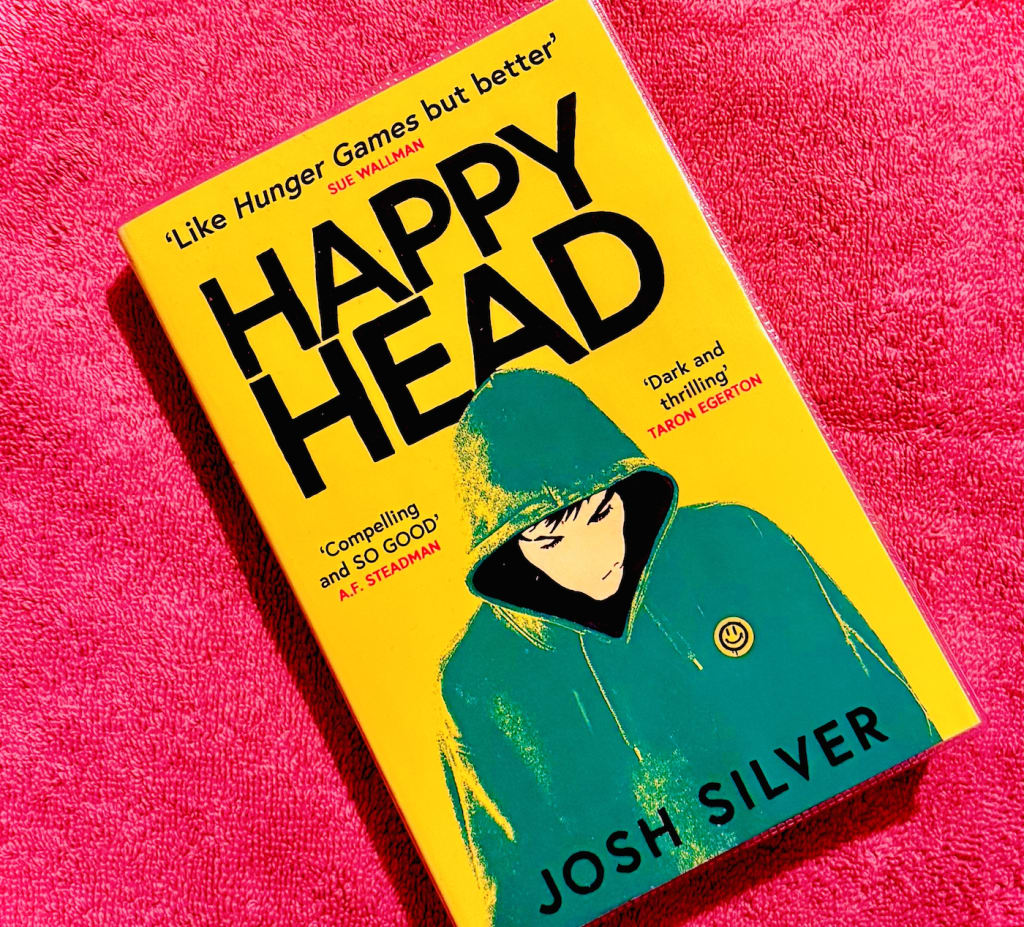
I love being recommended books in real life, but when I'm recommended a book by a teenager it becomes even better because I can see young people are somewhat still reading. This child explained the book HappyHead to me and I was quite interested. I didn't do anything about that for a long time though and then, an adult recommended the same book to me. It made me think about the teenager who told me about it first and I thought 'well, there's two widely different people telling me about this book, it's got to be good...' - and reader, it was...
Seventeen-year-old Sebastian Seaton receives an invitation to join the HappyHead Project, a supposedly groundbreaking government initiative designed to eliminate teenage unhappiness. Though he is skeptical, his parents encourage him to take part, believing it will help him manage his anxiety and uncertainty about the future. You can really see how his parents project their emotions and wants on to their kid. First of all, his mother is very proud that her son was 'selected' whereas the father is ambivalent in his expressions. This is a great metaphor for the sort of helicopter mothering we see out in the world, especially in our modern days.
The program is held in an isolated location on the Scottish coast, far from civilisation. Upon arrival, Seb is introduced to a strictly controlled environment where everything (from his daily routine to his emotions) is carefully monitored. The project is overseen by Madame Gloria Manning, a cold and authoritative figure, along with a team of Assessors who enforce the rules. This reminded me of those projects in America where parents would sign their wayward teenagers to this program where they were basically kidnapped in the middle of the night and some of them died. I think it was called North Star or something.
Shortly after their arrival, Seb and the other teenagers are subjected to an invasive procedure: a microchip is implanted just below their collarbones. The staff claims it is for health monitoring, but Seb immediately suspects there is more to it than they are being told. I'm not going to lie, but for anyone who has seen the Japanese movie Battle Royale, anything that is placed in that area that has a chip in it should immediately be of concern. I loved this connection to classic dystopian survival. Instead of just being a clear homage to The Hunger Games, I would say it is far more relative to a Generation Z Battle Royale. It is far darker than the Suzanne Collins series. Everything is invasive and there is no such thing as privacy and normalcy.
The teenagers are divided into small groups, and Seb is assigned to a team with three others: Eleanor, a determined and ruthless competitor; Ash, who excels in physical challenges; and Finn, a quiet and enigmatic boy who intrigues Seb. They are forced to complete a series of increasingly difficult tasks, designed to test their mental and emotional resilience. It is clear that each of these characters are supposed to represent different qualities of what would be a team of characters that could possibly win. First of all we have the confrontational character, then we have the physically able character, we have the withdrawn but philosophically intelligent character and finally, we have our main character which we are hooked on to as readers. The book therefore is about discovering where Seb fits into this group. It is quite clever because you can see how the team fits together and also, clashes.
What initially appears to be a self-improvement program quickly takes a darker turn. The tests become harsher, forcing participants to betray one another, endure psychological torment, and push their limits in ways that seem dangerous. Some begin to break down under the pressure, while others become disturbingly compliant. This book takes this strange Stanford Prison turn which there is a clear goal of forced compliancy through fear and trauma. This is why I initially said that it reminded me of those camps where teenagers were kidnapped and taken to forced endurance tests. It is dark and it is horrifying.
All in all, this book goes into so much detail and it is fantastic. The darkness gets a lot worse as we start to gain access into the other mechanisms happening within the program. As secrets are uncovered, we wait for what kind of character Seb is going to turn out to be as the amount of people he can trust dwindles.
***
Join my unofficial poetry challenge! Win some money (even though it is not a lot, it is pretty much the best I can do at the moment 😂) and let me read your poetry...
About the Creator
Annie Kapur
I am:
🙋🏽♀️ Annie
📚 Avid Reader
📝 Reviewer and Commentator
🎓 Post-Grad Millennial (M.A)
***
I have:
📖 280K+ reads on Vocal
🫶🏼 Love for reading & research
🦋/X @AnnieWithBooks
***
🏡 UK
Keep reading
More stories from Annie Kapur and writers in Geeks and other communities.
Book Review: "The Empusium" by Olga Tokarczuk
Olga Tokarczuk is a writer I've read before but admittedly probably not as much as the brodernists of Twitter are pretending they have. I've always found her works difficult to access at first, they are perhaps quite obtuse and a little on the slow start side, but the slow burns at vital moments of the text exude her lyrical confidence more than that. I think it's something special about Olga Tokarczuk's literature and why she won the Nobel Prize in 2018. She definitely has a way with description and how she makes you see the very intellectual side of what are mundane details of life.
By Annie Kapur8 months ago in Geeks
Silver Screen Magic with Mae West
American actress and singer Mae West became a popular film actress during the Great Depression. She started entertaining in vaudeville, then performed on Broadway, and finally went to Hollywood. She signed up with Paramount Pictures and made her debut in the 1932 film “Night After Night.” She also starred in musicals, comedies, and crime dramas. The American Film Institute named her one of the best classic Hollywood actresses.
By Rasma Raisters8 days ago in Geeks
Can you watch Super Bowl in UK?
Super Bowl, one of the most exciting sporting nights of the year, is now less than a month away and the excitement is already palpable. Scheduled on February 8, 2026 at Levi’s Stadium in Santa Clara, California, this will be the third Super Bowl held in the San Francisco Bay Area.
By David Cookabout 10 hours ago in Geeks



Comments (3)
Heyyyy, I'm backkkkk! Hehehehehe. This reminded me of Squid Games. It may not be exactly the same but maybe a little along those lines. Loved your review!
Loved reading your take. Now I have to see what Seb becomes. Sounds chilling and brilliant.
Great 👍