
Book Review: "Great and Horrible News" by Blessin Adams
5/5 - we are more similar than we think...

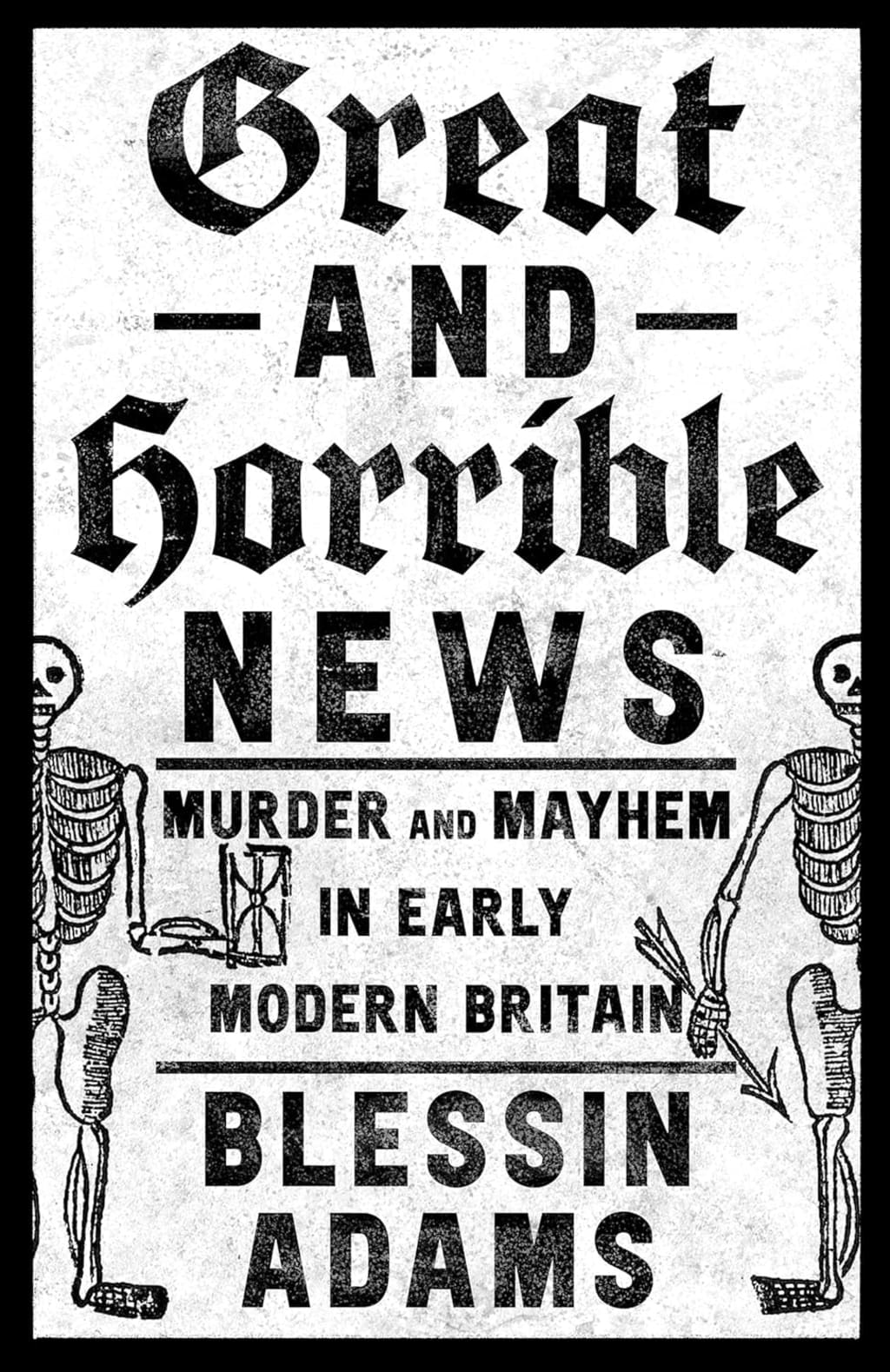
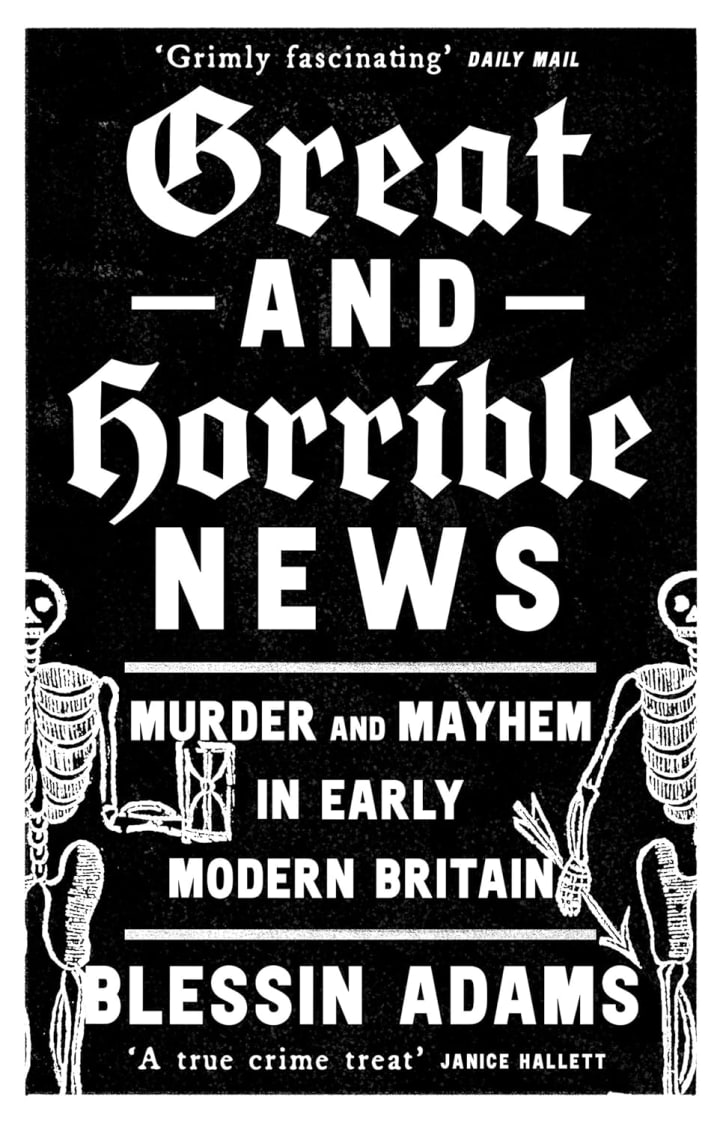
After reading A Taste for Poison Amazon seemingly thought I wanted to read all this old-world true crime, which I did and so I bought the book Great and Horrible News. This book is an exploration of murder in the Early Modern Period. Now, you all know how much I like to read about stuff in the past, for a while I made the realm of 18th Century French Politics my entire personality. At the moment, I have only recently finished it and so, it's still quite alive in my brain. The beginning is actually quite shocking and as we move into the book, we keep that atmosphere.
In the opening chapter, Adams paints a vivid picture of the violent landscape of Early Modern Britain, a time when murder, while not as common as it might be in contemporary urban settings, had profound consequences for society. Public executions and gruesome punishments were integral to the social fabric, reinforcing both political authority and religious power. The book explains how violent acts like murder were seen not only as criminal but as a disruption of God’s order, creating fear and fascination in the public. This context serves as a foundation for exploring how murder was perceived and dealt with in the era. This is propped up with the image of a man who disembowelled himself and then died 9 hours later after on-lookers could come and see him.
The book takes a deep dive into the emergence of true crime pamphlets as a form of mass entertainment and public education. These pamphlets, which began to proliferate in the late 16th and early 17th centuries, were often sensational in nature, presenting lurid tales of crime and punishment, and their purpose was not only to inform but to moralise. These pamphlets made use of exaggerated descriptions of horrific events to instil fear and serve as cautionary tales. Adams explores how these pamphlets became a major part of the media culture, especially in the context of literacy rates rising across the population, making them accessible to a wider audience. So what we can see is that everyone in this time and our own was fascinated by the monstrosity of murder. This was actually quite fascinating to learn.
Adams further explores the moral and religious dimensions of murder in Early Modern Britain, where the Church played a central role in shaping attitudes toward crime. The act of murder was not simply seen as a crime against another person, but as a violation of divine law. Religious figures used murder trials and executions as platforms to preach about the consequences of sin and the importance of repentance. Public executions, where the criminal was often forced to confess their sins in front of a crowd, were designed to demonstrate the divine wrath against those who violated sacred laws. The book delves into how sermons often used these high-profile cases to reinforce societal values and divine justice.
One of the recurring themes in the book is how women were portrayed when involved in violent crimes, especially murder. In Early Modern Britain, women were often either seen as victims or as inherently more dangerous when they transgressed social norms. Adams highlights cases like that of Alice Arden, whose 1551 murder of her husband shocked the public. Arden was accused of orchestrating the murder with the help of her lover, challenging the traditional roles of women in a patriarchal society. Similarly, the 1616 case of Anne Turner, a woman who conspired to poison Sir Thomas Overbury, is used to show how women were not only criminalised for their actions but also subjected to intense public scrutiny due to gender expectations.
The book reflects on how women’s involvement in such high-profile cases added a layer of complexity, where societal perceptions of femininity and morality clashed with the reality of the crime. This was actually really cool to read because you don't really hear much about women committing crime in the Early Modern Era unless they've been falsely accused of witchcraft or something. It adds another layer to our understanding of these people.
We have things like execution as spectacle and murder as a reflection of social anxieties and yet, we are still not complete in our learning. If you're going to read one historical true crime book this year then make it this one. It is absolutely fantastic and fascinating. You will learn so much about how our own times being obsessed with true crime and their time in being obsessed with true crime are not that different. It is a weird way of connecting with those in the past.
About the Creator
Annie Kapur
I am:
🙋🏽♀️ Annie
📚 Avid Reader
📝 Reviewer and Commentator
🎓 Post-Grad Millennial (M.A)
***
I have:
📖 280K+ reads on Vocal
🫶🏼 Love for reading & research
🦋/X @AnnieWithBooks
***
🏡 UK
Keep reading
More stories from Annie Kapur and writers in Geeks and other communities.
Book Review: "She's Always Hungry" by Eliza Clark
I initially read Penance by Eliza Clark thinking it would be not really my thing, but it definitely was my thing. The depth of soul that was embodied by that book made me want to seek out other things she had written. This led me to Boy Parts and eventually, as I was waiting for it to come out: She's Always Hungry. I was surprised to learn that it was a short story anthology. But not only that, I accidentally discovered some more body horror and reader, I was happy again.
By Annie Kapurabout a year ago in Geeks
Silver Screen Magic with Mae West
American actress and singer Mae West became a popular film actress during the Great Depression. She started entertaining in vaudeville, then performed on Broadway, and finally went to Hollywood. She signed up with Paramount Pictures and made her debut in the 1932 film “Night After Night.” She also starred in musicals, comedies, and crime dramas. The American Film Institute named her one of the best classic Hollywood actresses.
By Rasma Raisters6 days ago in Geeks
So You Decided To Become a Nurse Practitioner:
So you decided to become an "Advanced Practice" nurse. Congratulations!... is what I would say if this was a good idea. Grad school? In this economy? What were you thinking? Likely it was something along the lines of either 1) “I've seen these other chucklefucks do it— Why can't I?” or even 2) “I've got a nice career, I should shake it up. I miss feeling like I have no clue what I'm doing.”
By Sandor Szabo3 days ago in Fiction


Comments
There are no comments for this story
Be the first to respond and start the conversation.