Mystery
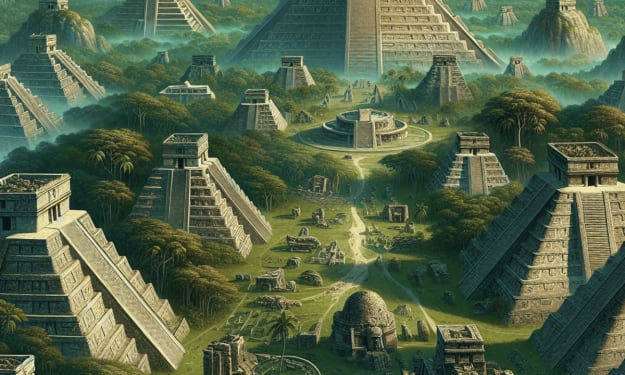
What Happened To The Ancient Mayan Cities?
Introduction Hidden beneath the dense Central American forests are the remains of one of history's most fascinating civilizations. The ancient Maya built magnificent cities across Mesoamerica and built an empire through parts of modern-day Mexico, Guatemala, Belize, Honduras, and El Salvador.
By Ahamed Thousifabout a year ago in FYI
6 Colonial Powers and Their Empires
Motivations for Colonialism Colonialism, the practice of acquiring full or partial political control over another country, occupying it with settlers, and exploiting it economically, was driven by a combination of factors: Economic Gain Resource Acquisition: Colonies provided access to valuable resources like gold, silver, spices, timber, and minerals. Trade Routes: Colonial powers sought to control trade routes and establish monopolies on valuable goods. Labor Exploitation: Colonizers often exploited the labor of indigenous populations, particularly through systems like slavery and indentured servitude. Political Power and Prestige National Glory: Expanding empires was seen as a way to increase a nation's power and prestige on the world stage. Strategic Advantage: Colonies could serve as military bases and supply lines, enhancing a nation's geopolitical influence. Religious and Cultural Influence Missionary Zeal: Many European powers sought to spread Christianity and Western culture to colonized territories. Civilizing Mission: The belief that European powers had a duty to "civilize" and "modernize" colonized peoples. Technological Superiority Military Advantage: European powers had advanced military technology, which gave them a significant advantage over many indigenous populations. Navigation and Exploration: Improved shipbuilding and navigational techniques enabled European powers to explore and colonize distant lands. It's important to note that the motivations for colonialism were complex and often intertwined. While economic gain was a primary driver, factors such as national pride, religious zeal, and the desire to spread civilization also played significant roles. The legacy of colonialism continues to shape the world today, with many former colonies struggling with the economic, social, and political consequences of past exploitation and oppression.
By Moharif Yuliantoabout a year ago in FYI
Why Xenopus Oocytes are an Ideal Model for Molecular Biology Studies
In molecular biology, the choice of model organism can make or break an experimental approach. Scientists often look to organisms with unique and favorable characteristics to gain insights into cellular mechanisms, gene function, and protein behavior. Among these organisms, Xenopus laevis, or the African clawed frog, has emerged as a powerful model, primarily due to the remarkable features of its oocytes (egg cells). Known for their large size, accessibility, and unique biochemical properties, Xenopus oocytes serve as a versatile and effective tool for studying processes in molecular biology. Over the past several decades, they have contributed to major breakthroughs, including identifying ion channels, investigating gene expression patterns, and exploring cellular mechanisms.
By Jessi Margretabout a year ago in FYI
It's Time to Talk Numbers
I just read some very interesting history about minimum wage. I wish to share this excerpt before I begin editorializing: The federal minimum wage in the United States has been $7.25 per hour since July 2009, the last time Congress raised it.[45] Some types of labor are exempt: Employers may pay tipped labor a minimum of $2.13 per hour, as long as the hour wage plus tip income equals at least the minimum wage. Persons under the age of 20 may be paid $4.25 an hour for the first 90 calendar days of employment (sometimes known as a youth, teen, or training wage) unless a higher state minimum exists.[46] The 2009 increase was the last of three steps of the Fair Minimum Wage Act of 2007, which increased the wage from $5.15 per hour in 2007 to $7.25 per hour in 2009. (from https://en.wikipedia.org/wiki/Minimum_wage_in_the_United_States)
By Shanon Angermeyer Normanabout a year ago in FYI
6 Countries with the Newest Train Stations
1. Singapore Singapore, a city-state known for its modern infrastructure and efficient transportation systems, boasts some of the newest and most technologically advanced train stations in the world. The Changi Airport MRT Station, located within the award-winning Changi Airport, is a prime example of this. The station features a sleek and modern design, with ample seating, free Wi-Fi, and a variety of retail and dining options. It seamlessly connects to the airport's terminals, making it convenient for travelers to navigate.
By Moharif Yuliantoabout a year ago in FYI
Death Row
Let me explain the whole story behind it. In the death row prison, time passes under a heavy silence, with everyone aware that in just one hour, a fellow inmate will face the end of their life. The echo of a guard’s footsteps increases the weight of the anticipated fate. This is the story of a man in his final moments.
By Zeynep Gözütokabout a year ago in FYI
Top 5 Countries with the Most Populous Markets
The term "market" can refer to various economic and social concepts. In the context of this prompt, we will focus on retail markets, which are physical places where goods and services are bought and sold. Here are the top 5 countries with the most populous retail markets, based on factors such as population density, economic development, and consumer culture:
By Moharif Yuliantoabout a year ago in FYI
Top 5 Countries with Floating Markets
Floating markets, a unique and fascinating cultural phenomenon, offer a glimpse into the daily lives of people living near waterways. These markets, often held on rivers or canals, provide a platform for vendors to sell their Floating markets, a fascinating and unique cultural phenomenon, offer a glimpse into the daily lives of people living near waterways. These markets, often held on rivers or canals, provide a platform for vendors to sell their goods directly to consumers.
By Moharif Yuliantoabout a year ago in FYI
The World’s Most Mysterious Book:
Deep within Yale University’s Beinecke Rare Book and Manuscript Library lies the only surviving copy of an enigmatic 240-page tome. Known as the Voynich Manuscript, this extraordinary artifact dates back to around 1420, as confirmed by carbon dating. Its vellum pages are filled with intricate, looping handwriting and imaginative illustrations that seem to have leaped from the realm of dreams. The manuscript showcases a variety of content, including depictions of real and mythical plants, floating castles, bathing women, astrology diagrams, zodiac rings, and celestial images of suns and moons with faces. Measuring 24x16 centimeters, the Voynich Manuscript stands as one of history's greatest unsolved mysteries, primarily because no one has deciphered its text.
By DANIEL AKAM OKOabout a year ago in FYI