
The Planet That Shouldn’t Exist… But Does
How a Massive World Defied the Laws of Physics—and Shook Astronomers to the Core


Imagine a planet where storms rage at 5,000 miles per hour. A place where it doesn’t rain water—but molten glass. Sideways.
Welcome to HD 189733b.
Located 63 light-years away in the constellation Vulpecula, HD 189733b is a gas giant exoplanet that looks deceptively calm. From afar, it appears like a beautiful deep-blue marble, eerily similar to Earth. But that serene color hides a truly alien world—one so violent and bizarre, it challenges everything we thought we knew about weather, physics, and survival.
Discovered in 2005, HD 189733b was one of the first exoplanets where scientists were able to analyze the atmosphere. What they found left them stunned. The planet orbits incredibly close to its host star, so close that a "year" on this planet lasts only about 2 Earth days. That proximity blasts the planet with intense radiation, creating atmospheric temperatures of nearly 1,000 degrees Celsius (1,800°F).
But it gets stranger.
Thanks to powerful space telescopes like Hubble and Spitzer, astronomers were able to determine the presence of silicate particles in the atmosphere. That means the beautiful blue hue we see from afar isn’t from oceans—it’s from glass particles suspended in 2,000-degree winds.
Those winds? They howl across the planet at speeds of up to 5,400 mph (8700 km/h)—faster than a speeding bullet, and many times the speed of sound. Now imagine that wind is carrying sharp, molten glass. That’s what happens here. On HD 189733b, it quite literally rains glass sideways.
This kind of weather system is unlike anything Earth has ever seen. On Earth, hurricane winds top out at about 200 mph. This alien storm system is over 25 times more powerful. If a spacecraft—or human—ever entered that atmosphere, they would be shredded instantly by the microscopic glass traveling at hypersonic speeds.
So how does a planet even survive such chaos?
The answer lies in its classification. HD 189733b is a “hot Jupiter”—a class of exoplanets that are massive, gaseous, and orbit very close to their stars. Because of their size and gravitational fields, they can maintain extreme atmospheric compositions that would tear apart smaller planets.
It’s also “tidally locked,” meaning one side of the planet always faces its star, while the other is permanently in darkness. This creates a massive temperature gradient that fuels the planet’s terrifying winds.
Yet somehow, amidst the chaos, HD 189733b remains intact—a glowing, violent, blue marble in space.
But here’s what’s truly mind-blowing.
Scientists used light filtering—essentially watching starlight pass through the planet’s atmosphere during transits—to discover these strange properties. That means we can read alien weather using nothing but light. We can detect glass in a storm, 63 light-years away, just by decoding the way light bends and shifts.
And this is just one planet.
There are thousands—maybe millions—more like it out there. Each with their own bizarre climates, strange chemical reactions, or even forms of life beyond our imagination.
So, what does HD 189733b teach us? That the universe is far weirder than fiction.
That weather—something we take for granted—can reach extremes we never dreamed possible. That even something as simple as "rain" can become a deadly, sideways storm of molten glass.
And that perhaps, just perhaps, there’s more to learn not just by exploring planets, but by questioning the limits of what we think is “normal.” Because when it comes to the cosmos, normal doesn’t exist.
This story is based on real astronomical research using data from NASA's Hubble and Spitzer Space Telescopes. HD 189733b continues to be one of the most studied and extreme exoplanets known to science. The more we learn about it, the more we realize how little we truly understand about the universe we live in.
About the Creator
Sai
Life science graduate & author of Echoes of the Gayatri (Notion Press). I write articles & books blending science, spirituality & social impact—aiming to inspire, inform, and uplift through purposeful, transformative writing.
IT Solutions Powering Modern Manufacturing Operations
Manufacturing has always been shaped by technology, from mechanized looms to assembly lines. Today, the transformation is less about physical machinery alone and more about the digital systems that connect, monitor, and optimize every step of production. Information Technology (IT) solutions now sit at the center of modern manufacturing operations, quietly enabling factories to work faster, smarter, and with greater resilience.
By Davin Convaya day ago in Futurism
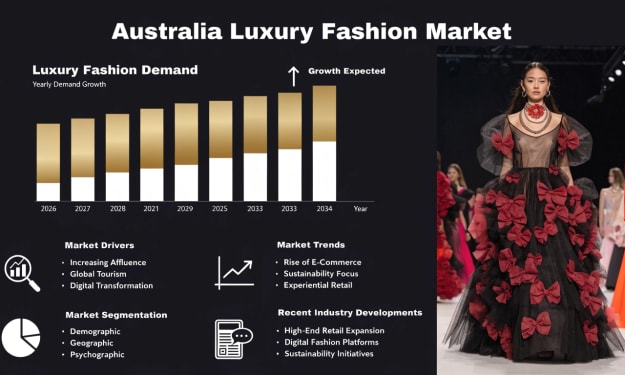
Australia Luxury Fashion Market: Rising Affluent Demand, Digital & Retail Expansion & Sustainability Trends
According to IMARC Group, the Australia luxury fashion market reached USD 5.2 Billion in 2025 and is projected to grow to USD 6.8 Billion by 2034, exhibiting a compound annual growth rate (CAGR) of 2.95% during 2026–2034. The steady expansion of the market reflects rising disposable incomes, growing affluent consumer segments, and evolving lifestyle aspirations across Australia. Luxury apparel, footwear, handbags, and accessories are increasingly viewed as lifestyle investments rather than occasional indulgences. As digital retail channels expand and sustainability becomes central to brand positioning, Australia luxury fashion market share continues to evolve within a competitive global landscape.
By Kevin Cooperabout 19 hours ago in Futurism


Comments
There are no comments for this story
Be the first to respond and start the conversation.