
Titan’s Strange “Wandering Dunes”: A Discovery That Redraws the Map of This Alien World
Space


When the Cassini spacecraft first mapped the surface of Titan with radar, researchers realized they were looking at one of the most Earth-like worlds in the Solar System—but in a dark, chemically exotic form. Titan, Saturn’s largest moon, is a place of methane rains, hydrocarbon lakes, seasonal storms, and dense orange haze. Its valleys, channels, and sedimentary plains resemble terrestrial landscapes carved by water and wind, only here the fluids are liquid hydrocarbons and the “sediment” is organic dust.
Now, a new discovery adds another surprising twist: Titan hosts vast dune fields that do not simply sit in place—they migrate. And they move in a direction that contradicts the moon’s prevailing winds.
This finding, built on years of Cassini data and new atmospheric modeling, suggests Titan is far more dynamic and unpredictable than scientists once believed.
A World of Methane, Haze, and Organic “Sand”
Titan’s surface temperature hovers around –180 °C. In this deep cold, water behaves like rock, while methane and ethane cycle through the atmosphere like rain, fog, and flowing rivers. Above this alien terrain, ultraviolet sunlight triggers chemical reactions in Titan’s thick atmosphere, producing complex organic molecules. Over time, these particles settle out as a fine, dark, sticky powder—something like a cross between soot, sand, and crushed plastic.
This organic dust accumulates and is pushed across Titan’s plains by winds. Over millions of years it forms immense dune fields that can reach up to 100 meters high and stretch for tens of kilometers in nearly perfect parallel ridges. The sight would be familiar—waves of sand under a dim sun—but every ingredient of this landscape is profoundly unearthly.
The Puzzle: Dunes Moving Against the Wind
For many years, scientists assumed that Titan’s low-level winds blow from east to west. Climate models, atmospheric circulation patterns, and seasonal observations all pointed in that direction.
But the dunes themselves tell a different story.
By analyzing their internal layering, the orientation of slip faces, and the displacement of surface particles over time, researchers uncovered a contradiction: the dunes are slowly shifting from west to east.
This is equivalent to finding desert dunes on Earth migrating uphill or moving against the trade winds—something that cannot happen without powerful, unusual forces.
The implication is clear: Titan’s surface is shaped not by constant breezes, but by rare, intense, and possibly seasonal windstorms that temporarily overpower the prevailing atmospheric flow.
How the Dunes Move
Although Titan’s dunes migrate slowly—on the order of tens of centimeters to several meters per year—that motion is significant given the moon’s frigid climate and sticky, electrostatic sediment.
Several factors make this movement possible:
- A Dense, Heavy Atmosphere
Titan’s air is 4–5 times denser than Earth’s, meaning even gentle winds exert substantial force on sand-sized particles.
- Unusual Organic Grains
Laboratory experiments suggest Titan’s sand is lightweight, clumps easily, and carries static charge. This makes it easier to lift in gusts but also helps it settle into coherent dune structures.
- Seasonal Megastorms
Titan’s year lasts 29 Earth years, and its seasons each span more than 7 years. During seasonal transitions, Titan likely experiences powerful methane-based storm systems strong enough to reshape entire dune fields.
The combined effect is a landscape that shifts subtly but continuously—an evolving system where storms, chemistry, and gravity interact over astonishing timescales.
Why This Discovery Matters
Moving dunes might seem like a small detail, but on Titan they have profound implications:
- Climate Models Require Revision
The dune migration suggests Titan’s climate includes bursts of extreme weather far more intense than earlier models predicted.
- Future Missions Must Account for Shifting Terrain
NASA’s Dragonfly mission—a nuclear-powered drone scheduled to explore Titan—will rely heavily on accurate models of surface features for safe navigation and landing. Understanding how dunes migrate is essential.
- New Clues for Prebiotic Chemistry
Titan’s “sand” is a reservoir of complex organic molecules. As dunes move and mix, they may process these materials in ways that imitate—or even enable—primitive chemical evolution.
- Planetary Engineering and Habitat Planning
Should future explorers consider Titan a target for exploration or habitation, knowing how its landscape changes over time is critical for designing infrastructure.
- Imagining the Landscape
Picture a scene reminiscent of Earth’s Namib Desert, but transformed by alien physics. Beneath a dim orange sky, rows of dark, almost black dunes rise like massive frozen waves. Their crests are smooth and flowing, shaped by winds you cannot see. The ground feels powdery yet oddly cohesive, like compressed ash. In the distance, barely visible through the thick atmospheric haze, lie faint streaks—evidence that these dunes, silent and slow, are on the move.
The Next Steps
Researchers hope to combine Cassini’s archival radar maps with new supercomputer models and, eventually, direct surface observations from Dragonfly. Tracking dune movement in real time will reveal:
- the true speed and direction of near-surface winds,
- the frequency and power of methane storms,
- the physical behavior of Titan’s unusual organic materials.
Titan, once thought to be a quiet, frozen world, is proving to be a dynamic environment where landscapes drift, storms sculpt the ground, and chemistry dances across an ever-changing surface.
Its wandering dunes are a vivid reminder that even in the outer Solar System, worlds can surprise us with motion, complexity, and life-like dynamism.
About the Creator
Keep reading
More stories from Holianyk Ihor and writers in Futurism and other communities.
A TRIPLE BLACK HOLE SYSTEM IS SPIRALING INWARD — AND ASTRONOMERS HAVE FINALLY CAUGHT IT IN ACTION
For the first time in observational astronomy, researchers have witnessed something once considered so rare that it bordered on theoretical speculation: a system of three black holes simultaneously spiraling toward one another. This extraordinary discovery offers a new window into the evolution of galactic cores, the mechanisms that accelerate black hole mergers, and the origins of some of the most powerful gravitational-wave events ever detected.
By Holianyk Ihorabout a month ago in Futurism
About Binding Prometheus
I want to start actively advocating on behalf of my own work, and the most valuable part of my canon is, without a doubt, Binding Prometheus, the play I have been working on since 2019 and only finished in 2023 as part of my MA. The play itself is an amalgamation of a million different inspirations. On one end, it evokes the Ancient Greek myth-play, deriving its own title from the earliest extant work of Western drama we have, Aeschylus’s Prometheus Bound. On the other end, it borrows significantly from the sci-fi bulwarks from over the years, namely Mary Shelley’s Frankenstein and Karel Capek’s Rossum’s Universal Robots. The play could be an episode of Black Mirror, I fear. I don’t know. I’ve only ever seen one episode of Black Mirror.
By Steven Christopher McKnight11 days ago in Futurism
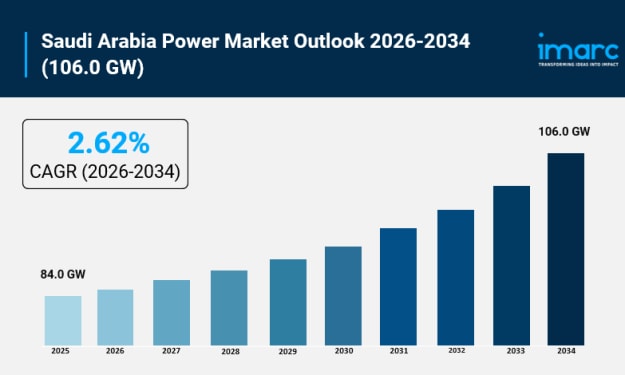
Power Market in Saudi Arabia: Renewable Integration, Demand Growth & Infrastructure Upgrades Under Vision 2030
According to IMARC Group's latest research publication, the Saudi Arabia power market size reached 84.0 GW in 2025. Looking forward, IMARC Group estimates the market to reach 106.0 GW by 2034, exhibiting a CAGR of 2.62% from 2026-2034.
By Jeffrey Wilson3 days ago in Futurism



Comments
There are no comments for this story
Be the first to respond and start the conversation.