
What if we travel at the speed of light?
A Journey to the Edge of Physics

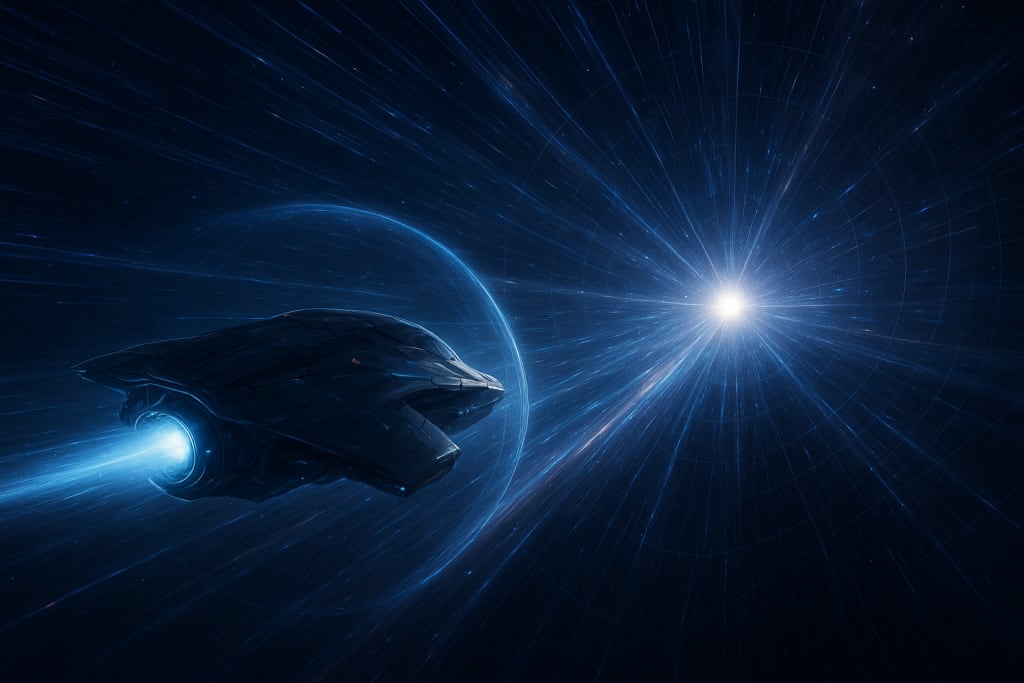
Imagine strapping yourself into a spaceship, its engines thrumming with power, and leaving Earth behind. You accelerate, faster and faster, slicing through the void of space. What would the universe look like if you approached the speed of light? How would reality warp before your eyes?
Let’s embark on a journey where physics itself becomes a spectacle......
At first, nothing feels strange. Inside the spaceship, speed is invisible. Your body senses only acceleration. Just like sitting on a speeding train, you cannot tell whether you’re moving or standing still. The hum of the engines pressing you into your seat is the only evidence of motion.
Yet, even at moderate velocities, the universe begins to transform before your eyes.
Stars ahead appear to draw closer, converging like a tunnel of light. Those behind seem to stretch and fade, as if the sky itself is pulling away. This is the aberration of light, an effect that warps perception at high speeds.
Imagine standing in a car as rain pours vertically, yet it seems to slam into the windshield from the front. In space, starlight behaves the same way, and the faster you go, the more extreme the illusion becomes.
As your velocity climbs, perspective becomes surreal. Objects twist and rotate in ways that defy intuition; a phenomenon known as Terrell-Penrose rotation. Planets, stars, and even entire grids of cosmic distances appear contracted, bent, or angled toward you. The universe is no longer a static backdrop; it’s a dynamic, flowing spectacle of light and geometry.
Time itself begins to betray expectations. The faster you move, the slower the outside world ticks. From your ship, Earth’s clocks lag, people’s movements stretch into slow motion, and distant stars appear frozen in the past.
This is time dilation, a core prediction of Einstein’s special relativity. Return home after decades of near-light-speed travel, and you may have aged years less than those who stayed behind.
Meanwhile, distances shrink. A star that seemed billions of kilometers away now feels just within reach. This length contraction is real, physical, not merely optical. To you, the journey across the cosmos could take days, hours, even moments. To Earth-bound observers, millennia might pass. You are living in a different temporal rhythm, surfing the river of spacetime at extraordinary speeds.
And yet, there is a limit: the speed of light itself......
No matter how powerful your engines, the universe enforces this cosmic speed limit. You can approach light’s velocity, but you will never surpass it. In your frame, light always escapes ahead, untouchable. Optical phenomena intensify: the forward universe blazes with brightness, the rear collapses into darkness, and the visible cosmos contracts into a tunnel. The trip feels instantaneous, yet reality outside your ship continues its inexorable march.
But what if we bend spacetime itself?
General relativity allows for the unimaginable: a “warp drive,” propelling a bubble of space faster than light. Inside this bubble, the ship moves not through space but with it, surfing on a wave of spacetime itself.
Light can no longer keep up; parts of the universe vanish from view, while others stretch and split like a cosmic mirage. From inside, the universe ahead appears contracted and brilliant, while behind, darkness swallows whole regions of stars. From the outside, the ship seems to blink into existence, a phantom riding the folds of spacetime.
The universe at near-light-speed is a theater of extremes. Light bends, time slows, distances collapse, and space itself can be manipulated in ways that defy human intuition.
So let's put it this way.......
If you had a spacecraft traveling close to the speed of light, according to laws of physics, you can shrink the distance to the Andromeda galaxy and therefore the time it takes to get there. Closer you get to speed of light, the more you can shrink it. And so you can make those 2 million lighty years. You could traverse across that distance in principle in a minute according to physics.
Sounds amazing Huh..........? BUT,
The downside is that you couldn't come back........ Your loved one? Your parents? Your partner? Child? your pet?
Those whom you promised that you'll come home soon?................
If you came back to the Earth at that speed to tell everybody what you'd found, at least 4 million years would have passed on the Earth. We could in principle explore the galaxy and beyond, but getting to chat to everybody about what you found is forbidden...
It is forbidden.........
About the Creator
Sakuni Bandara
Just Another average girl !
Keep reading
More stories from Sakuni Bandara and writers in Futurism and other communities.
The day the Sun dies...
Control Tower: “Horizon, this is Mission Control. Final systems check complete. Countdown begins in “10…” The cabin thrummed beneath our boots. My heart matched the rhythm of the engines, deep and steady, like a giant taking long breaths.
By Sakuni Bandaraabout a month ago in Futurism
About Binding Prometheus
I want to start actively advocating on behalf of my own work, and the most valuable part of my canon is, without a doubt, Binding Prometheus, the play I have been working on since 2019 and only finished in 2023 as part of my MA. The play itself is an amalgamation of a million different inspirations. On one end, it evokes the Ancient Greek myth-play, deriving its own title from the earliest extant work of Western drama we have, Aeschylus’s Prometheus Bound. On the other end, it borrows significantly from the sci-fi bulwarks from over the years, namely Mary Shelley’s Frankenstein and Karel Capek’s Rossum’s Universal Robots. The play could be an episode of Black Mirror, I fear. I don’t know. I’ve only ever seen one episode of Black Mirror.
By Steven Christopher McKnight10 days ago in Futurism
Australia Industrial Drying Equipment Market: Smart Manufacturing, Energy Efficiency & Future-Ready Processing
In 2024, Australia industrial drying equipment market reached USD 48.80 Million. Looking ahead, the market is expected to expand steadily to USD 85.07 Million by 2033, exhibiting a compound annual growth rate (CAGR) of 6.37% during 2025–2033.
By Kevin Cooper3 days ago in Futurism
Getting Serious About Comedy (Part I)
If I were asked to remark on my life and the childhood that paved some road leading me to this point, I would have to say something about all the funny people who surrounded me for the last 26,872 days (and counting). Somewhere along that road, I became a big fan of laughter and the comedy that spawns it – and, I mean not only my own laughter, but the laughter of others, some of which I have actually been responsible for inducing.
By John Oliver Smith2 days ago in Humor


Comments
There are no comments for this story
Be the first to respond and start the conversation.