how to
How to create science fiction and technology projects in a simplistic, easy manner.
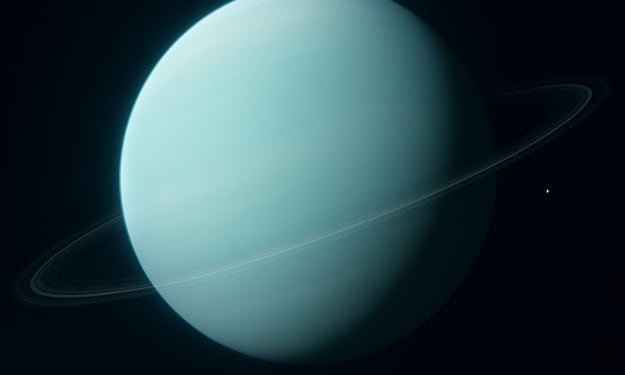
A New World in the Shadows: Uranus Gains a Newly Discovered Moon, S/2025 U1
For decades, Uranus seemed like one of the quietest and least explored giants in our Solar System. Its pale-blue disk, distant and dim, concealed only a modest collection of known moons—until now. In 2025, astronomers announced a remarkable discovery: a previously unseen miniature satellite orbiting Uranus. The moon, currently designated S/2025 U1, is tiny, elusive, and scientifically promising. Despite its minuscule size—no more than 8 to 10 kilometers across—it adds an important new piece to the complex and dynamic architecture of Uranus’s moon system.
By Holianyk Ihorabout a month ago in Futurism
Euclid Has Found Hidden Giant Threads of the Cosmic Web — And They Are Challenging Our Models of the Universe
For decades, cosmologists have suspected that the Universe is woven together by an enormous and invisible scaffold: a vast network of filaments, bridges, knots, and voids known collectively as the cosmic web. This web is not a poetic metaphor. It is the real, physical structure of the cosmos on the largest scales—hundreds of millions of light-years across—shaped by dark matter, threaded by hot gas, and lit here and there by strings of galaxies.
By Holianyk Ihorabout a month ago in Futurism
Web2 to Web3: A Practical Guide for Modern Businesses. AI-Generated.
Digital systems have evolved constantly, but the jump from Web2 to Web3 represents something deeper than a routine upgrade. It changes how data is handled, how users interact, and how trust is established online. Many companies are curious about this shift, yet worry about disrupting what already works. The goal of this guide is to break the transition into clear, manageable steps.
By David Hazeabout a month ago in Futurism
Space Medicine Aboard the Station: How Astronauts Stay Healthy Beyond Earth
Life on an orbital space station is far more than breathtaking views and scientific breakthroughs. For astronauts, living in microgravity is a full-body experiment—one that never stops. Every minute spent in orbit reshapes the human body, changes how organs function, and challenges the limits of our biology. That’s why space medicine has become one of the most crucial, innovative, and fascinating branches of modern science.
By Holianyk Ihorabout a month ago in Futurism
Sports and Exercise in Space: How Astronauts Stay Fit Beyond Earth
When most people imagine life in space, they picture astronauts floating gracefully in a state of weightlessness, drifting between control panels while gazing at the blue glow of Earth through the station window. But behind these cinematic visuals lies a tough physical reality: the human body is not designed for life without gravity. Muscles shrink, bones weaken, and even the heart begins to lose strength.
By Holianyk Ihorabout a month ago in Futurism
Abundance of Caution’: How Flight Hit by Solar Flare Sparked Rush for Airbus Fix. AI-Generated.
When passengers boarded a routine international flight earlier this month, no one expected it to become the center of a global aviation alert. Yet, within hours, what was supposed to be an ordinary journey turned into an unprecedented safety concern—one triggered not by turbulence, engine trouble, or bad weather, but by something far more distant: a solar flare erupting from the sun.
By Fiazahmedbrohi about a month ago in Futurism
From Cordova to React Native: Migrating a Mobile App for Better Performance and UX
The limitations of legacy Cordova applications, particularly sluggish performance and a non-native look and feel, often hinder mobile app experience. Strategic migration to React Native can address these challenges. By moving from a WebView-based architecture to one rendering native components, you can achieve significant gains in speed, fluidity, and long-term maintainability. This article outlines the core benefits, common hurdles, and a proven path for a successful legacy application modernization.
By Sergey Laptick2 months ago in Futurism
The Crescent Planet: A World with a Permanent Terminator Line
Imagine a world where the sun never rises and never sets. A world where one hemisphere burns beneath an unmoving star while the other drowns in eternal night. Between them lies a narrow ring of twilight—an endless borderland where day and night touch but never mingle.
By Holianyk Ihor2 months ago in Futurism
How Planetary Defense Works: The Modern Methods Behind Tracking Asteroids
When we look up at the night sky, it often appears calm, steady, and predictable. But beyond that serene view lies a dynamic neighborhood of drifting rocks, icy remnants, and fast-moving objects. Among them are asteroids—cosmic leftovers from the early Solar System that occasionally wander a little too close to Earth.
By Holianyk Ihor2 months ago in Futurism
Understanding the Growing Role of Edge AI in Modern Technology
How Edge Computing Shapes Real‑World Innovation Edge computing has become an essential part of how data is processed today. Instead of relying solely on distant servers, devices can now analyze information closer to where it’s generated. This shift has opened the door to new possibilities, including the development of edge AI hardware, edge AI devices, and edge AI solutions. Companies working in this field, such as Geniatech, contribute to the broader movement toward distributed intelligence—though the focus of this article is on understanding the trend, not promoting any specific brand.
By charliesamuel2 months ago in Futurism