habitat
The natural home and environment for all things sci fi, including future homes and territories.
The Coolest Star in the Universe: WISE 1828+2650, the “Room-Temperature” Star
When we think of a star, we imagine something blazing hot — a roaring sphere of plasma like our Sun, burning at thousands of degrees and flooding space with light. But the cosmos loves to challenge our assumptions. Somewhere out there, about 40 light-years away, floats a celestial oddball that defies everything we expect from a “star.”
By Holianyk Ihor3 months ago in Futurism
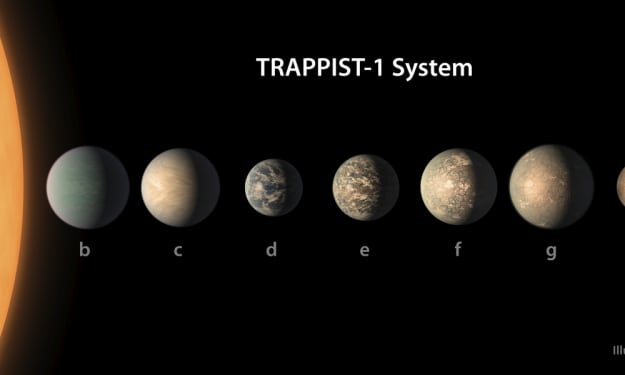
New Discoveries in the TRAPPIST-1 and LHS 1140 Systems: Rethinking What “Habitable” Really Means
For decades, the dream of discovering a second Earth has driven astronomers to peer deep into the cosmos, searching for rocky planets orbiting distant stars. Two of the most intriguing targets in that quest—TRAPPIST-1 and LHS 1140—have recently revealed surprising new details thanks to observations from the James Webb Space Telescope (JWST). These discoveries are changing how scientists think about habitability, atmosphere loss, and what a truly “Earth-like” world might be.
By Holianyk Ihor3 months ago in Futurism
Parker Solar Probe: Unveiling the Fiery Secrets of the Sun’s Corona
When NASA’s Parker Solar Probe launched in August 2018, it set out on one of the most daring missions in space exploration: to “touch” the Sun. For the first time in human history, a spacecraft would fly directly through the Sun’s outer atmosphere—the corona—collecting data from a region that had always been seen, but never experienced.
By Holianyk Ihor3 months ago in Futurism
New Frontiers in Space: How Microsatellites and CubeSats Are Revolutionizing Space Technology
In the past, sending something into space was a privilege reserved for national space agencies and billion-dollar aerospace companies. But in the last decade, a quiet revolution has been unfolding — one driven by tiny, affordable, and surprisingly powerful satellites known as microsatellites and CubeSats. These small wonders are reshaping everything we know about space exploration, communication, and even climate research.
By Holianyk Ihor3 months ago in Futurism
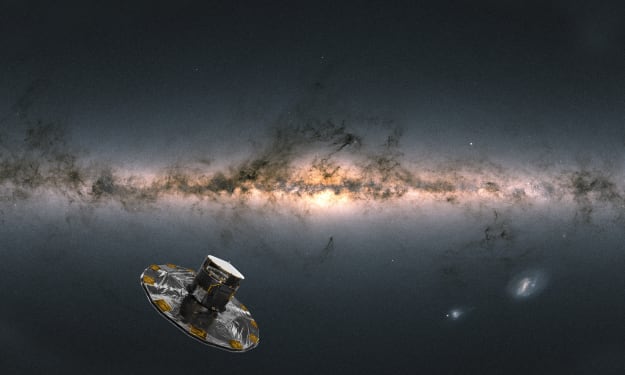
The End of an Era: Gaia’s Mission Comes to a Close — and Its Legacy Is Just Beginning
In early 2025, the European Space Agency’s Gaia spacecraft officially ended its operational life after more than a decade of mapping the Milky Way with breathtaking precision. It’s a bittersweet milestone for astronomers worldwide: while Gaia has stopped collecting new data, the treasure trove it leaves behind will keep fueling discoveries for decades.
By Holianyk Ihor3 months ago in Futurism
Washing Moon Dust for Helium-3: The New Space Gold Rush
The Promise of a Lunar Treasure For decades, the Moon has been more than a symbol of human curiosity — it’s been a promise. A promise of knowledge, exploration, and now, perhaps, limitless clean energy. Among all the minerals and exotic materials believed to lie within its dusty surface, one element stands out as a true cosmic prize: helium-3.
By Holianyk Ihor3 months ago in Futurism
Rebel Worlds: Exoplanets with Reverse Rotation and Bizarre Atmospheres
When astronomers began discovering planets beyond our Solar System in the 1990s, most expected to find familiar worlds — something like a Hot Jupiter here, a cold Neptune there, maybe the occasional rocky Earth-twin. Instead, the universe responded with a cosmic smirk and delivered a catalog of planets so strange that even science fiction writers would hesitate to invent them. Among the most mind-bending of these discoveries are exoplanets with reverse (retrograde) rotation and wildly abnormal atmospheres — worlds that defy planetary logic and challenge our understanding of physics.
By Holianyk Ihor3 months ago in Futurism
Nuclear Engines for the Journey to Mars: Why NTR and NEP May Change Everything
For decades, Mars has been the big red prize of human space exploration. We’ve landed rovers, taken selfies on its dusty plains, and mapped its canyons and craters in high resolution. And yet, no human has ever set foot there. The biggest obstacle isn’t distance itself — it’s time. With today’s chemical rockets, a crewed flight to Mars would take six to nine long months one way, and the entire mission could stretch to two or even three years. That means more radiation exposure, more psychological pressure, more supplies, and more risk.
By Holianyk Ihor3 months ago in Futurism
The Hidden Magnetism of Space: Why Objects That Don’t Attract on Earth Pull Together Among the Stars
If you drop a pen and a paperclip on your desk, they just sit there. Nothing happens — no invisible force draws them together. But take those same two objects far away from Earth, into the silent vacuum of space, and something extraordinary begins to happen: they start to move toward each other. Slowly, almost imperceptibly at first, but undeniably. It sounds like science fiction — yet it’s a real and fascinating truth about how the universe works.
By Holianyk Ihor3 months ago in Futurism
Pandora Mission: Opening a Cosmic Box of Secrets
For centuries, humanity has looked to the night sky in wonder — to predict the seasons, to navigate oceans, or to seek meaning among the stars. Today, our gaze has a new purpose: to find out whether we’re alone in the universe. And leading this quest is NASA’s Pandora mission, a small but mighty space telescope designed to study the atmospheres of 39 distant exoplanets — all while watching their host stars and planets simultaneously.
By Holianyk Ihor3 months ago in Futurism
SPHEREx: The Space Telescope That Will Redraw Our Map of the Universe
When we gaze up at the night sky, we see a silent ocean of stars — calm, timeless, and still. But behind that peaceful illusion lies a dynamic history: galaxies forming, stars igniting, and cosmic structures evolving over billions of years. To truly understand where we came from, astronomers must look back — far back — into the cosmic dawn. And soon, a new explorer will help them do just that.
By Holianyk Ihor3 months ago in Futurism
The “Planet Y” Hypothesis: A Hidden World at the Edge of Our Solar System
For decades, astronomers have known that the Solar System doesn’t end with Neptune. Beyond it stretches the Kuiper Belt — a vast, icy frontier filled with dwarf planets, comets, and frozen remnants from the early days of planetary formation. Yet, recent discoveries suggest that something strange is happening out there.
By Holianyk Ihor3 months ago in Futurism