extraterrestrial
Speculation, theory, UFOs and Aliens. Are we alone in this universe or is there life outside Earth?
A TRIPLE BLACK HOLE SYSTEM IS SPIRALING INWARD — AND ASTRONOMERS HAVE FINALLY CAUGHT IT IN ACTION
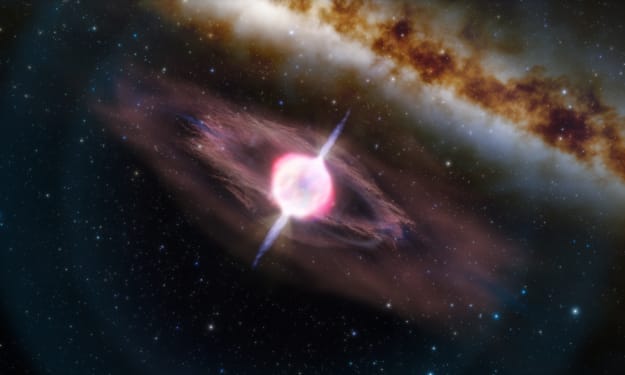
For the first time in observational astronomy, researchers have witnessed something once considered so rare that it bordered on theoretical speculation: a system of three black holes simultaneously spiraling toward one another. This extraordinary discovery offers a new window into the evolution of galactic cores, the mechanisms that accelerate black hole mergers, and the origins of some of the most powerful gravitational-wave events ever detected.
By Holianyk Ihorabout a month ago in Futurism
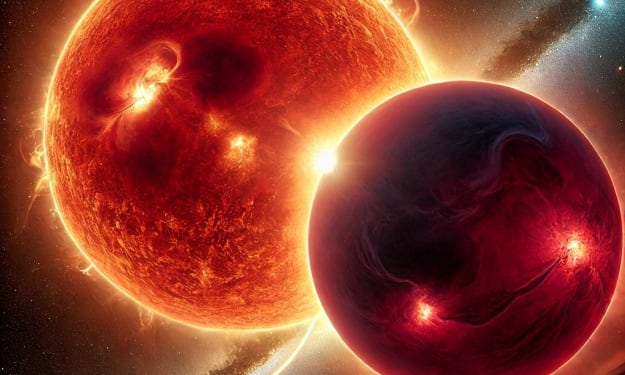
Astronomers Discover an Ultra-Rare Binary: Two Red Giant Stars on the Brink of Collision
Astronomers have announced a discovery that is already being called one of the most extraordinary stellar findings of the decade: a binary system made of two enormous red giant stars so close to each other that their bloated atmospheres are practically brushing together. Systems like this are so rare that many astrophysicists doubted they could survive long enough to be observed at all. Yet this newly identified pair is not only real—it is entering a catastrophic final phase that could end in a spectacular merger.
By Holianyk Ihorabout a month ago in Futurism
New Interstellar Molecules Discovered — A Breakthrough in the Chemistry of Life
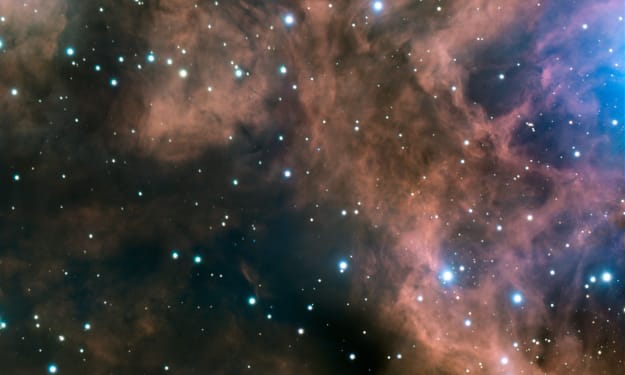
Across the vast darkness between the stars, where temperatures drop to just a few degrees above absolute zero, an unexpected kind of cosmic creativity is unfolding. Astronomers have announced the discovery of several previously unknown interstellar molecules hiding inside dense molecular clouds — the very regions where new stars and planets are born. What makes this discovery particularly compelling is that these molecules play a crucial role in prebiotic chemistry, the set of chemical processes that precede the emergence of life.
By Holianyk Ihorabout a month ago in Futurism
A New Class of Supernovae Discovered: Explosions That Do Not Destroy Their Stars
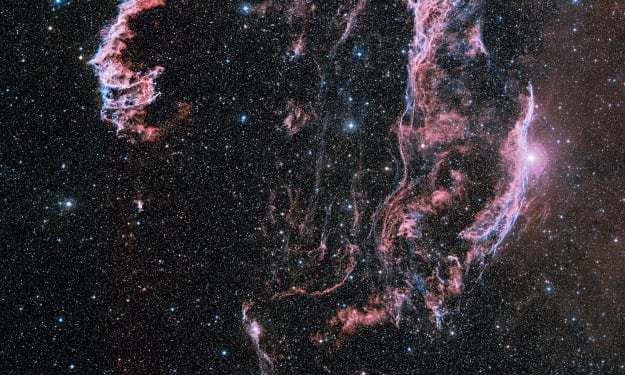
Astronomers have just announced a discovery that reshapes one of the most fundamental ideas in stellar astrophysics. For decades, a “supernova” meant one thing: the violent death of a star. It was the final, catastrophic event in a massive star’s life cycle—a colossal explosion so intense that, for a few weeks, it can outshine an entire galaxy. Afterward, the star is gone forever, replaced by a neutron star, a black hole, or a rapidly expanding cloud of debris.
By Holianyk Ihorabout a month ago in Futurism
Scientists Spot a “Falling Star” for the First Time — A Stellar Body Collapsing Under Its Own Gravity
Every so often, astronomy delivers a discovery that forces us to rethink what we know about stellar evolution. This time, researchers have identified an extraordinary object they refer to as a “falling star.” It is not falling through space, nor plunging toward another body. Instead, it is collapsing inward — pulled relentlessly by its own gravity. For the first time in history, astronomers have managed to observe a star in the rare, almost impossible-to-catch stage of self-destruction.
By Holianyk Ihorabout a month ago in Futurism
A New Image of Black Hole Magnetic Fields Reveals a Stunning, Ultra-Detailed Structure
For decades, black holes have represented the ultimate frontier of observational astronomy: regions so extreme that even light cannot escape, where physics bends into unfamiliar shapes and our best theories are pushed to their absolute limits. Yet each year, astronomers take one step closer to transforming the unseeable into the observable. The latest achievement is nothing short of astonishing: scientists have produced the most detailed image ever made of the magnetic fields swirling around a supermassive black hole.
By Holianyk Ihorabout a month ago in Futurism
The First Evidence of “Pulsating” Emission from a Black Hole’s Accretion Disk
For decades, astronomers have observed mysterious flickers, flares, and quasi-periodic oscillations coming from black hole systems. These rhythmic bursts of radiation—especially in X-rays—have inspired hundreds of theories but offered few firm answers. Were they turbulence? Magnetic reconnection? Random instabilities? Or something deeper, tied to the very structure of spacetime near a black hole?
By Holianyk Ihorabout a month ago in Futurism
A New Idea Takes Shape: Dark Matter Might Be Superfluid — and Early Observations Are Starting to Hint at It
Every so often, astronomy produces a theory that feels almost too bold to take seriously at first glance. Yet these are precisely the ideas that sometimes transform our understanding of the Universe. One such proposal is now regaining momentum: dark matter, the mysterious substance shaping galaxies and cosmic structures, might not behave like a vast cloud of cold, inert particles after all. Instead, it could enter a superfluid state under the right conditions.
By Holianyk Ihorabout a month ago in Futurism
A New Candidate for a Dark-Matter-Free Galaxy — and Why It Challenges Modern Cosmology
For decades, dark matter has been treated as one of the fundamental building blocks of the Universe. According to the dominant ΛCDM (Lambda Cold Dark Matter) model, every galaxy—large or small—should be embedded in a massive halo of invisible, non-luminous matter. This dark halo is not a minor detail; it is a core element of the structure of the cosmos. It dictates how galaxies form, how they rotate, how they merge, and how their stars and clusters behave over billions of years.
By Holianyk Ihorabout a month ago in Futurism
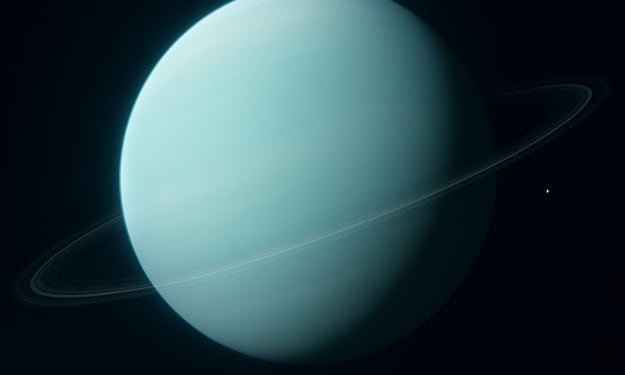
A New World in the Shadows: Uranus Gains a Newly Discovered Moon, S/2025 U1
For decades, Uranus seemed like one of the quietest and least explored giants in our Solar System. Its pale-blue disk, distant and dim, concealed only a modest collection of known moons—until now. In 2025, astronomers announced a remarkable discovery: a previously unseen miniature satellite orbiting Uranus. The moon, currently designated S/2025 U1, is tiny, elusive, and scientifically promising. Despite its minuscule size—no more than 8 to 10 kilometers across—it adds an important new piece to the complex and dynamic architecture of Uranus’s moon system.
By Holianyk Ihorabout a month ago in Futurism
Euclid Has Found Hidden Giant Threads of the Cosmic Web — And They Are Challenging Our Models of the Universe
For decades, cosmologists have suspected that the Universe is woven together by an enormous and invisible scaffold: a vast network of filaments, bridges, knots, and voids known collectively as the cosmic web. This web is not a poetic metaphor. It is the real, physical structure of the cosmos on the largest scales—hundreds of millions of light-years across—shaped by dark matter, threaded by hot gas, and lit here and there by strings of galaxies.
By Holianyk Ihorabout a month ago in Futurism
Space Medicine Aboard the Station: How Astronauts Stay Healthy Beyond Earth
Life on an orbital space station is far more than breathtaking views and scientific breakthroughs. For astronauts, living in microgravity is a full-body experiment—one that never stops. Every minute spent in orbit reshapes the human body, changes how organs function, and challenges the limits of our biology. That’s why space medicine has become one of the most crucial, innovative, and fascinating branches of modern science.
By Holianyk Ihorabout a month ago in Futurism