
United States Soybean Oil Market Size & Forecast 2025–2033
Rising Demand for Edible Oils, Biofuels, and Plant-Based Nutrition Fuels Strong Market Expansion

United States Soybean Oil Market Overview
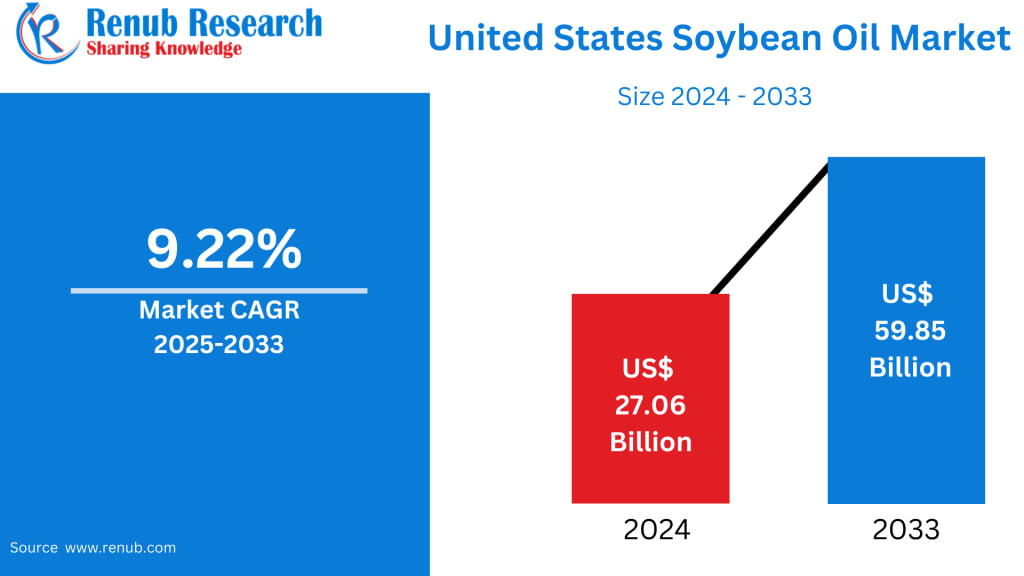
The United States Soybean Oil Market is anticipated to witness robust growth over the coming decade, expanding from US$ 27.06 billion in 2024 to US$ 59.85 billion by 2033, according to Renub Research. This impressive expansion represents a Compound Annual Growth Rate (CAGR) of 9.22% during the forecast period from 2025 to 2033.
Soybean oil remains the most widely consumed edible oil in the United States, deeply integrated into everyday cooking, commercial food production, and a growing range of industrial applications. Its neutral taste, high smoke point, cost efficiency, and nutritional profile have helped it maintain dominance across both household and commercial kitchens.
Beyond food consumption, soybean oil plays a critical role in biodiesel production, industrial lubricants, plastics, and personal care products. As consumer preferences shift toward plant-based, sustainable, and renewable resources, soybean oil is emerging as a strategic commodity supporting food security, clean energy goals, and agricultural sustainability across the United States.
United States Soybean Oil Market Outlook
Soybean oil is extracted from soybeans, one of the most extensively cultivated crops in the United States. Thanks to large-scale domestic soybean production, the country benefits from a stable supply chain, making soybean oil affordable and widely accessible.
In culinary applications, soybean oil is valued for its versatility. It is commonly used for frying, baking, sautéing, and salad dressings. Food manufacturers rely on it to enhance texture, flavor consistency, and shelf life in processed foods such as snacks, frozen meals, sauces, margarine, and spreads.
From a nutritional perspective, soybean oil contains a high proportion of unsaturated fats and omega-3 fatty acids, aligning well with modern dietary recommendations that emphasize heart-healthy fats. These attributes continue to attract health-conscious consumers seeking balanced alternatives to animal-based fats.
The outlook for the U.S. soybean oil market remains highly positive, driven by expanding food consumption, renewable energy mandates, and innovation across food processing and industrial applications.
Growth Drivers in the United States Soybean Oil Market
Increasing Demand for Plant-Based and Healthier Oils
One of the strongest growth drivers is the rising preference for plant-based and health-oriented diets in the United States. Soybean oil is increasingly viewed as a healthier substitute for animal fats due to its low saturated fat content and favorable fatty acid composition.
As vegan, vegetarian, and flexitarian lifestyles gain momentum, soybean oil is finding expanded usage in plant-based meat alternatives, dairy substitutes, and functional food products. Its adaptability and nutritional appeal make it a preferred oil for both consumers and manufacturers.
In December 2022, Bunge Global SA announced plans to invest US$ 550 million in a new soy protein processing facility in Morristown, Indiana, underscoring rising demand for plant-based ingredients and strengthening the soybean oil value chain.
Expansion of Processed Food and Foodservice Industries
The steady growth of the U.S. processed food and foodservice sectors continues to boost soybean oil demand. Quick-service restaurants, bakeries, and packaged food manufacturers rely heavily on soybean oil due to its cost efficiency, heat stability, and consistent quality.
As urban lifestyles accelerate and consumer dependence on ready-to-eat and takeaway meals increases, soybean oil remains a staple frying and cooking medium across restaurants nationwide.
In October 2023, Louis Dreyfus Company announced the construction of a new soybean processing facility in Ohio, incorporating crushing, oil refining, and lecithin manufacturing capabilities to support growing domestic demand.
Rising Industrial and Biofuel Applications
Beyond food uses, soybean oil has become a critical feedstock for biodiesel production. U.S. renewable energy policies and sustainability initiatives continue to encourage the adoption of biofuels, positioning soybean oil as a key contributor to cleaner energy solutions.
Soybean oil is also widely used in industrial lubricants, inks, plastics, cosmetics, and personal care products due to its biodegradable and renewable properties.
In January 2025, the United Soybean Board, along with the American Soybean Association, updated national sustainability targets aimed at reducing greenhouse gas emissions, land use, and energy consumption across soybean production—further reinforcing long-term market growth.
Challenges in the United States Soybean Oil Market
Competition from Alternative Edible Oils
Soybean oil faces increasing competition from other edible oils such as olive oil, canola oil, sunflower oil, and avocado oil. These alternatives are often marketed as premium, organic, or specialty oils, attracting consumers willing to pay higher prices for perceived health or lifestyle benefits.
Olive oil, in particular, holds strong brand recognition as a heart-healthy option, while canola oil competes directly with soybean oil on price and versatility. To maintain market leadership, soybean oil producers must continue emphasizing affordability, nutritional value, and wide applicability.
Price Volatility and Supply Chain Uncertainty
Soybean oil prices are closely tied to soybean crop yields, weather conditions, trade policies, and global demand dynamics. Tariffs, export restrictions, and supply chain disruptions can create pricing volatility, impacting both producers and end-users.
Such fluctuations can complicate long-term planning for food manufacturers and biofuel producers, making supply stability and efficient logistics critical priorities for market participants.
Market Segmentation Analysis
United States Conventional Soybean Oil Market
Conventional soybean oil dominates the U.S. market due to its affordability and widespread availability. It is the preferred choice for households, restaurants, and large-scale food processors, particularly in frying and baking applications.
Its scalability, strong domestic production base, and cost advantages ensure continued dominance despite rising interest in premium alternatives.
United States Organic Soybean Oil Market
Organic soybean oil is gaining traction among health-conscious and environmentally aware consumers. Although priced higher than conventional variants, demand is rising in specialty foods, natural grocery stores, and personal care products.
As clean-label and sustainability trends strengthen, organic soybean oil is expected to experience steady growth within niche segments.
United States Cooking & Frying Soybean Oil Market
Cooking and frying remain the largest application segments. Soybean oil’s high smoke point, neutral flavor, and affordability make it ideal for everyday cooking and commercial frying, particularly within quick-service restaurant chains.
United States Bakery Products Soybean Oil Market
In the bakery industry, soybean oil is valued for improving texture, moisture retention, and shelf life in bread, cakes, cookies, and pastries. Rising consumption of packaged baked goods continues to support growth in this segment.
United States Margarine & Shortening Soybean Oil Market
Soybean oil is a key ingredient in margarine and shortening production. Growing demand for plant-based butter alternatives and vegan baking solutions is further boosting this application segment.
Regional Insights
California Soybean Oil Market
California represents a major consumption hub due to its large population, diverse food culture, and extensive foodservice sector. Demand for organic and non-GMO soybean oil is particularly strong in premium retail channels.
New York Soybean Oil Market
New York’s dense urban population, multicultural cuisine, and robust restaurant industry drive consistent demand for soybean oil across frying, baking, and processed food applications.
Washington Soybean Oil Market
Washington’s focus on sustainability and renewable energy supports demand for organic soybean oil and biodiesel feedstocks, making it an emerging niche market.
Competitive Landscape and Key Players
The U.S. soybean oil market features strong participation from global agribusiness and food conglomerates. Key players include:
Archer Daniels Midland Company
Wilmar International Limited
AAK AB
Cargill, Incorporated
DuPont
Unilever PLC
Associated British Foods
Each company is evaluated across five viewpoints: overview, key leadership, recent developments, SWOT analysis, and revenue performance.
Final Thoughts
The United States Soybean Oil Market is entering a dynamic growth phase, supported by rising food consumption, expanding biofuel applications, and a national shift toward plant-based and sustainable products. With strong domestic soybean production and continuous investment in processing infrastructure, the market is well-positioned for long-term expansion.
While competition from alternative oils and price volatility present challenges, soybean oil’s affordability, versatility, and strategic role in food and energy systems ensure its continued relevance. As sustainability initiatives and consumer awareness grow, soybean oil is set to remain a cornerstone of the U.S. edible oil and renewable resource landscape through 2033.
About the Creator
Keep reading
More stories from Aaina Oberoi and writers in Feast and other communities.
United States Millets Market Size and Forecast 2025–2033
United States Millets Market Overview The United States millets market is gaining strong momentum as consumers increasingly seek healthier, sustainable, and functional food options. According to Renub Research, the United States Millets Market is expected to reach US$ 5.41 billion by 2033, up from US$ 3.36 billion in 2024, registering a compound annual growth rate (CAGR) of 5.44% between 2025 and 2033. This steady growth is supported by rising health consciousness, growing demand for gluten-free grains, and expanding applications across food, beverage, and health-focused product categories nationwide.
By Aaina Oberoi10 days ago in Feast
My Tous les Jours Trip
As someone who lives in a rural area, I don't get the chance to visit fancy restaurants or bakeries that often. So, when a friend told me about a French-Asian bakery that's less than an hour away, I knew I had to check it out and grab some pictures for social media. Tous les Jours ended up providing an immersive experience that went above and beyond my expectations--although I did leave with a few reservations.
By Kaitlin Shanks16 days ago in Feast
United States White Mushroom Market Size and Forecast 2025–2033
United States White Mushroom Market The United States White Mushroom Market is projected to expand from US$ 13.3 billion in 2024 to US$ 22.34 billion by 2033, growing at a CAGR of 5.93% from 2025 to 2033, according to Renub Research. Rising demand for plant-based, healthful meals, growing awareness of nutritional benefits, and continuous improvements in packaging, cold-chain logistics, and distribution are reshaping the industry. White mushrooms—often called button mushrooms—are now more accessible than ever through retail stores, online grocery platforms, and foodservice channels, making them a staple of modern American diets.
By Marthan Sir2 days ago in Feast
Bruce Lee and The God of War: Kuan Ti
It starts with love.. The Power to the God Of War and Wealth Walk into a Chinese restaurant (even in Oklahoma, USA), a Chinese police station, a kung fu martial arts studio or even a Chinese temple and you often see a red faced warrior holding a heavy quan-do (spear like weapon).
By WILD WAYNE : The Dragon King4 days ago in Chapters




Comments
There are no comments for this story
Be the first to respond and start the conversation.