
The True Story of Aristotle
The Mind That Shaped Civilization
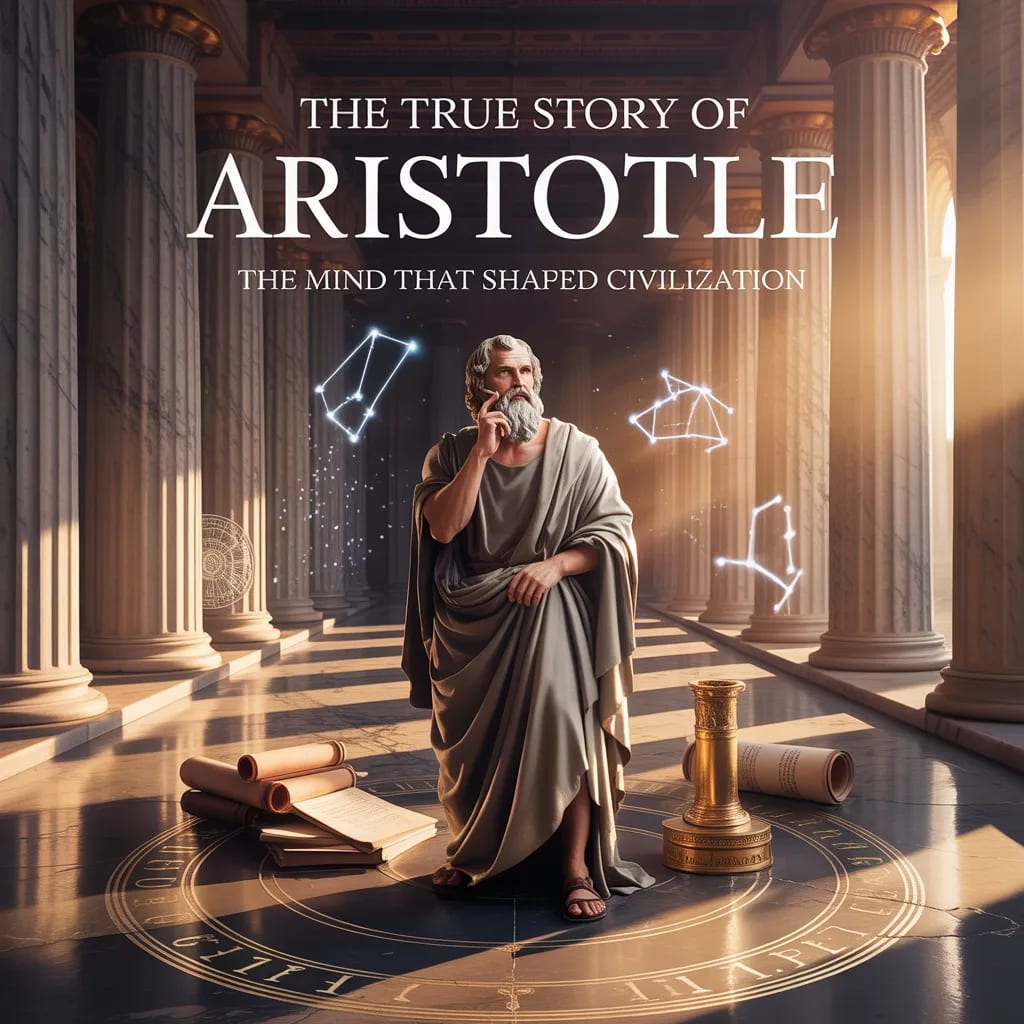
Aristotle was not born into greatness, but into curiosity. He came into the world in 384 BC in Stagira, a small town in northern Greece. His father, Nicomachus, was a physician to the king of Macedon. Surrounded by medicine, Aristotle grew up learning about the human body, nature, and the mystery of life itself. But it wasn’t just science that fascinated him—it was the why behind everything. Why do people act the way they do? Why do stars move? Why do some plants thrive while others die? From a young age, Aristotle was asking questions that most adults couldn’t answer.
When he turned seventeen, Aristotle traveled to Athens—the shining city of learning—to study at Plato’s Academy. For nearly twenty years, he remained there, absorbing the ideas of his teacher, Plato, and debating philosophy with other bright minds. But although Aristotle admired Plato deeply, he did not agree with him on everything. Plato believed that the world we see is just a shadow of a higher, perfect reality. Aristotle disagreed. To him, truth was found here, in the real, physical world. He believed that knowledge came from observing and reasoning about what was right in front of us.
After Plato’s death, Aristotle left Athens. He traveled to Asia Minor and later to the island of Lesbos, where he began studying biology. There, he examined plants, animals, and sea creatures, writing detailed notes that would later form some of the first scientific studies in history. He categorized animals, noted their anatomy, and searched for the purpose behind every living thing. His approach—studying nature through careful observation—was revolutionary.
In 343 BC, Aristotle received an extraordinary invitation. King Philip II of Macedon asked him to become the tutor of his thirteen-year-old son—Alexander. That boy would grow up to become Alexander the Great. Under Aristotle’s guidance, Alexander studied philosophy, science, politics, and ethics. It is said that Aristotle instilled in him a love for knowledge and a sense of purpose beyond conquest. When Alexander began his campaigns years later, he carried with him Aristotle’s teachings—sometimes even books personally prepared by his old teacher.
When Aristotle returned to Athens, he founded his own school: the Lyceum. Unlike Plato’s Academy, the Lyceum was a place of movement and discussion. Aristotle and his students would walk around the gardens as they debated—hence the nickname Peripatetic School (from the Greek word for “walking about”). There, he taught logic, physics, biology, politics, and ethics. He wrote hundreds of works, many of which shaped the foundation of modern science and philosophy. His ideas on logic became the standard for reasoning for nearly two thousand years.
Aristotle believed that everything in the universe had a purpose—a reason for being. In ethics, he proposed that true happiness came not from wealth or power, but from living a virtuous and balanced life, the “Golden Mean” between extremes. In politics, he analyzed governments and declared that the best systems served the common good. In science, he insisted that knowledge began with observation and reasoning.
But like all great thinkers, Aristotle’s time was not without challenge. When Alexander died suddenly in 323 BC, anti-Macedonian feelings surged in Athens. Because of his connection to Macedon, Aristotle was accused of impiety—of not respecting the gods. Fearing for his life, he fled the city, saying, “I will not allow Athens to sin twice against philosophy,” referring to the execution of Socrates. He retreated to Chalcis, where he lived quietly until his death a year later, in 322 BC.
Though centuries have passed, Aristotle’s ideas still shape the way we think. His writings influenced medieval scholars, the Renaissance, and the very birth of modern science. His thoughts on ethics continue to guide moral philosophy, and his logical system remains the basis for reasoning and debate. From medicine to politics, from poetry to physics, Aristotle’s fingerprints are everywhere.
Aristotle once said, “The roots of education are bitter, but the fruit is sweet.” His own life proved those words true. Through endless questioning and tireless study, he turned curiosity into knowledge, and knowledge into wisdom. He was not merely a man of his time—he was a thinker for all time.
About the Creator
My Tous les Jours Trip
As someone who lives in a rural area, I don't get the chance to visit fancy restaurants or bakeries that often. So, when a friend told me about a French-Asian bakery that's less than an hour away, I knew I had to check it out and grab some pictures for social media. Tous les Jours ended up providing an immersive experience that went above and beyond my expectations--although I did leave with a few reservations.
By Kaitlin Shanks20 days ago in Feast
Orange Market Size and Forecast 2025–2033
Orange Market at a Glance (Renub Research) The Global Orange Market is expected to reach US$ 53.74 billion by 2033, up from US$ 38.45 billion in 2024, expanding at a CAGR of 3.79% from 2025 to 2033. Rising consumer demand for vitamin C–rich foods, the rapid growth of juice and beverage categories, health-conscious lifestyles, and the expanding use of oranges in cosmetics, pharmaceuticals, and functional foods are the primary growth engines. Export opportunities and favorable cultivation conditions across major producing regions further reinforce long-term market expansion.
By Aaina Oberoi2 days ago in Feast




Comments
There are no comments for this story
Be the first to respond and start the conversation.