
It's All In the Roux
Gumbo for the Soul



Roux—a Salve for the Soul
Growing up in New Orleans, which has a hodgepodge heritage of American, Spanish, English, and French cultures, it is no wonder French cuisine is favored. It's a no-brainer because it doesn't involve the brain—it's all about the tongue! Even before that, however, it begins from the very first cranial nerve, delivering those luscious smells.
From its bread to its sauces, the French influence offers a bespoke salve for the soul. One such dish is gumbo, whose ingredients are as varied as the imagination is vast. In fact, the name, "gumbo," has been turned into a collquial term for any casual assembly of mixed or disparate ingredients.
While gumbo can be constructed from many ingredients, it is anything but casual. There is a special consideration added that signifies the care and dedication used in preparing it. That is something called the "roux," pronounced rū.
People from New Orleans, pre-Katrina at least, were unlikely to ever leave, making it a cloistered nepotistic breeder reactor of recursive culture. Still, today one is much more likely, instead of asking where you live, where you work, or where you went to college, ask what high school you went to. Everyone knew someone from whatever class you were in, in one of the ubiquitous Catholic high schools there.
But I did leave.
I sought my fortunes elsewhere in a large, nameless city indistinguishable from all of the other large, nameless cities. Such places just seemed soulless. Maybe the music wasn't the same. Maybe the laissez-faire attitude wasn't. Certainly, the food wasn't. If you're fat anywhere else other than New Orleans, you have no excuse.
Playwright Tennessee Williams once said,
“America has only three cities: New York, San Francisco, and New Orleans. Everywhere else is Cleveland.”
But with apologies to Thomas Wolfe, you can go home again if you're from New Orleans.
Author Anne Rice wrote,
"As soon as I smelled the air, I knew I was home. It was rich, almost sweet, like the scent of jasmine and roses around our old courtyard. I walked the streets, savoring that long lost perfume."
Actor John Goodman said,
"There's an incomplete part of our chromosomes that gets repaired or found when we hit New Orleans."
And so I returned. From too much urban efficiency, too many to-the-minute schedules, and too thick the walls by which other people elswhere fortify their privacy. From where it didn't matter where you went to high school.
I returned, and with a broken heart, which is whole 'nother story.
I came home again to the place where, for everyone I knew, there was a high school. What didn't hit me, though, until I sat down at my Mom's table, was (evoking John Goodman) how a hot, spicy bowl of gumbo repaired what deleted genes festered my incomplete chromosomes. Coming back from all the Clevelands abroad (which, ironically, did not include Cleveland), I was home again. I was back into the fold and had my epiphany:
You can't get a good bowl of gumbo outside of New Orleans, and you can't get a bad bowl inside of it. The reason: it's made for you.
Furthermore, there is one truism about gumbo that is so ingrained as to be intuitive in Louisiana:
It's all about the roux.
It's as intuitive as, "Laissez le bon temps rouler," the seduction of a saxophone, the reverence of a second-line at a jazz funeral, or a simple umbrella as a symbol of southern style, femininity, and social grace.
To undersand the specialness of the roux, especially in the gumbo that tucked me in when I found myself back home — à la the prodigal son returning to his kinsmen — one should visit a little history.
Know, however, that this is not written for historical purposes, but to illuminate how food for the body, offered for the right reasons, is food for the soul. And if you do it in New Orleans, you're in the right kitchen of life.

Le Grand Dérangement
In 1775, as the French and Indian War began, nearly 10,000 French inhabitants of Nova Scotia, the "Acadians," refused to take an oath of allegiance to the British Crown. For this defiance and to protect British interests, Governor Charles Lawrence ordered their homes and property confiscated and burned. With nowhere to stay there, even if they could, they were held under guard until hired ships forcibly deported them, mainly to the British colonies to the south. Besides relocating to France, St. Domingue (Haiti), and Quebec, where they could speak their language and practice their religion, other Acadians ended up in Louisiana. Those Acadians became the Cajuns of today.
French Cuisine
As early as the mid-1600s, the roux was used to thicken and bind French sauces, first in Paris, then in other French-influenced areas such as Acadia and Louisiana.
It was a mixture of white flour with butter or fat/oil, in equal or slightly altered ratios, cooked methodically to mitigate the raw flour taste and to darken the color of the sauce.
Like friendship, love, kinship, and going back home again, a roux—a good one—must be done right. To extend the metaphor, it must be done with patience. Nothing like a roux says it better: "What is important is never easy." And the roux is crucial to good gumbo. It is the base of your gumbo. It is the very reason why you won't find bad gumbo in New Orleans and you can't get good gumbo elsewhere.
It's also why coming back home was so beautifully effected by the bowl of it before me. Why?
It's All in the Roux
A great roux takes time, like a friendship. The darker it is, the longer it takes. If you're looking to make a brown or dark brown roux with an oil, you'll need one with a higher smoke point so your roux is less likely to burn. But it is a cautionary tale of balancing heat, time cooked, and ingredients, versus burning it. And it does burn quite easily.
- It burns if the fire's too hot — so use low-to-medium heat.
- It burns if the bottom of the pan/pot is too thin.
- It burns if it cooks too long; know your end-point.
- It burns if it's not continually whisked/stirred. In fact,
- it burns if it's not watched continuously.
It even burns if you look at it wrong. Making a roux is not for the multi-tasker. For those few minutes, you have to devote your life to the roux, which is probably why it speaks volumes of the tenderness and love meant for those for whom it's prepared. I know because I can taste it.
That being said, you should prep your gumbo before completely dedicating yourself to the roux.
Sauté the Holy Trinity of gumbo, i.e, your
- chopped onions,
- garlic, and
- celery.
After that, sauté your okra until it's no longer slimy and cooked through-and-through. Add it to your Trinity. Now, add your seafood stock. (Alternatively, chicken or turkey stock.)
Now it's time to start your roux. Park the other stuff on a very low heat.
What you mix with the flour, be it oil, butter, or other fat, must have a fairly high smoke point, the temperature beyond which it begins smoking. (Beware: smoking = burning = bitter gumbo.) Burned roux cannot be salvaged. There is no mid-course correction for it when it begins smoking. It's like a relationship when you've completely blown it; you must start over.
Savor the Flavor
A roux can vary in its flavoring. For example, while sesame oil has a higher smoke point (that's good) and is less likely to burn (also, good), it has a strong flavor. Not good. The more you get away from neutral in flavor, the more you are meddling in the ultimate flavor of the gumbo itself and the very infrastructure of space and time in the universe.
Some self-appointed experts in roux (same word whether singular or plural) try to jumpstart the gumbo flavor with the roux, but these are amateurs. Real experts go for neutral, tampering with just the color and saving the heavy flavor lifting for the Trinity and okra, the stock to be used (e.g., chicken, seafood, etc.), the actual food ingredients (e.g., shrimp, oysters, crab, sausage, etc.), and their private seasoning secrets. Thus, a neutral oil or butter, ghee, or lawd are neutral enough to mix with your flour.
Seasoning, if miscalculated, can be salvaged and mid-c0urse corrections are allowed. The roux, however, is an absolute. It's either a great roux or it's not a roux you want to use!
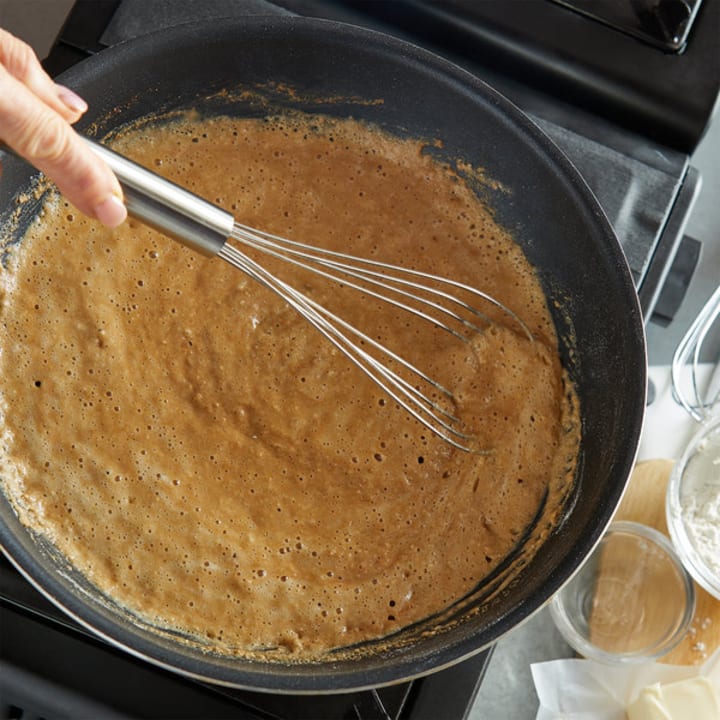
A whisk is best for beginning the mix of flour and fat. After a while, when there are no lumps, you can switch to a wooden spoon. Take care to keep scraping the bottom of the heavy pan clear of clumps which you won't notice burning until it's too late. The heavier the pan/pot, preferably cast iron, less likely it'll burn. There are radiant energy and the laws of physics at work.
The Coup de Grace
So you've performed admirably with you roux — it's perfect! Now what? Certainly, in the pan, it will continue cooking somewhat, even after removing it from your heat source. How do you hit the brakes?
Throw in a cup of ice water. The roux is instantly set, ideally to a consistency of perfect mashed potatos, and then you add it to the other stuff.
The actual food — be it seafood, chicken, andouille sausage — goes last. Especially the shimp, which turns is telltale pinkish color after only a few minutes.
Creole or Cajun — Again, All in the Roux
Historically, Creole gumbo's roux was made with butter, while Cajun gumbo's roux was made with oil or lard. The Creole roux made with butter is lighter, called a blonde roux with the color of peanut butter, and the Cajun roux is darker, i.e., brown. If you try for a dark brown color with butter, you'll burn it.
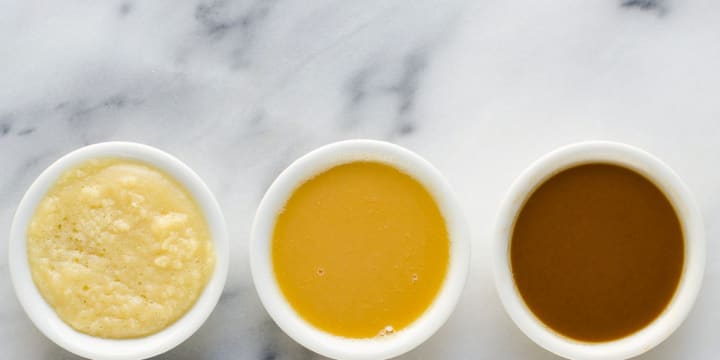
For the Cajun roux, use an oil that is neutral in flavor and, importantly, has a high smoke point. Vegetable oil works well and is cheap. These differences persist after generations because Cajuns didn't have the luxury of butter back in the day. Since a roux is a terrible thing to waste, the subtle variations in culture led people — and their descendants — to continue to use what they knew. You brew the roux you knew.
A "white" roux is used for other types of sauces, creamy soups, gravy, and chowders, and is cooked just enough to neutralize the starch flavor.

Timing and Thickening
- A white roux takes 2-5 minutes.
- A blonde roux takes 5-10 minutes.
- A brown roux takes 15-30 minutes. It is a little nutty in flavor and is great for not only gumbo, but also for etouffees and gravies. Once your roux is brown, going further (going for dark brown) won't add any thickening power. However, the darker the brown the more complex the flavor (that's good).
- Dark brown roux will take 30-45 minutes or longer, depending on the heat source, which ideally should be low and slow. Any strategy to make things go faster (e.g., higher heat) is a wrong strategy.
Thickening is a delicate balance between color and time cooked. The longer (and darker) your roux, the less thick it has become. This is yet another subtlety to master.
Think About the Calories
Although there are, indeed, calories, this section was written to be deleted (which I have already done for your convenience as well as your conscience). Don't think about the calories!
The Rest of the Story
I returned to New Orleans after living abroad, which for New Orleanians is anywhere outside the Orleans and Jefferson Parish lines. I came back with my broken heart and starving for good food and good music and good people.
And family.
Friends, even good friends, are different once they leave the Parish line and scatter to the Clevelands Archipelago. Something in their living life is put on hold, instantly resumed upon return.
On my first night in, my family and loved ones and their generous nourishment (not the very least of which was the food) repaired my chromosomes. I was home again. To the land of jazz and high schools, langniappe and neutral grounds, and gumbo and beignets. To bars open all night. To power lines draped with beads from some previous Mardi Gras ago. To the Y'ats and the Chalmations, the Uptown elite, then French Quarter, the Westbankers, the Lake Pontchartrain submarine races, and to drive-through daiquiri shops.
Returning home to New Orleans is like coming back to Mama. I did both. And both let me back in with the perfect gumbo made with the perfect roux. That's love.
About the Creator
Gerard DiLeo
Retired, not tired. Hippocampus, behave!
Make me rich! https://www.amazon.com/Gerard-DiLeo/e/B00JE6LL2W/
My substrack at https://substack.com/@drdileo
Keep reading
More stories from Gerard DiLeo and writers in Feast and other communities.
Sno-Ball
New Orleans, Louisiana, is a very unique city. Being a port city, the accent the people speak is not Southern. It's not even Cajun, which is the cliché always heard on TV--and badly, too. The accent is a port city accent, more related to New York or Boston than it is to the Southern drawl of any city below the Mason-Dixon line.
By Gerard DiLeo4 years ago in Feast
Astragalus: An Ornamental, Supportive, and Culinary Herb
Astragalus Root/Milkvetch Astragalus is a popular remedy for various ailments today. Commonly found in health food stores and herbal shops in the form of tinctures, grounded encapsulated powders, or as part of an herbal infusion, or sometimes added to teas, astragalus usually makes the list for its purported immune-system and energy-supporting benefits.
By J. Chauncey5 days ago in Feast
Freeze-Dried Powder Microgreens: The Complete Guide to Nutrient-Dense Greens
Getting enough fresh vegetables into your daily routine can be harder than it sounds. Busy schedules, travel, and reliance on convenience foods often mean leafy greens get overlooked. Freeze-dried microgreens powder offers a practical way to bridge that gap. Produced from young vegetable greens harvested at peak nutritional value, these powders provide a concentrated source of vitamins, minerals and antioxidants in a format that is simple to store and use.
By Emily Jones8 days ago in Feast
Two Grumpy Old Men Solve the Problem
Marty and Steve were two grumpy old men who lived together. They had known each other for years. Marty had been a bachelor all his life. Steve said it was because no one could stand to ever live with. Marty’s standard reply was “Well, you are, so what sort of a moron does that make you!”
By Calvin Londonabout 17 hours ago in Humor



Comments (8)
I don't know how I missed reading this one, but having visited New Orleans on more than one occasion (a sister city to Charleston) and having indulged in a wonderful steaming bowl of gumbo while there more than once, I thoroughly enjoyed this piece. I felt the heart and the love in it, and that says it all.
This is a wonderful evocation of "Laissez le bon temps rouler," and the cult of food that exists south of highway 10 and especially in 'Nawlins.' I loved this line: If you're fat anywhere else other than New Orleans, you have no excuse, as well as the Tennessee Williams quote. After we moved away from Lafayette in 1997, I made a few attempts at local restaurants in Annapolis eating what was billed as New Orleans style cuisine and soon gave it up for the reasons you state so eloquently in this story. This piece embodies the spirit of the Nourished Challenge. Congratulations on placing, very well deserved!
Never been to New Orleans but this story made me feel I was there. Congratulations on your win
Fantadt8cnurishment story!!@ Love ir!!!💕❤️❤️ Congratulations on the runner up win!!!
Roux makes cooking so easy
This an excellent, Recipe story. I really enjoyed it from start to finish 👌
I only knew something called gumbo existed when I watched The Princess and the Frog in 2009. I only knew about roux now. You provided such in depth information about it, how to prepare it as well as the history! Very well done! I like how you deleted the nutrition section, lol!
Who knew all this about the roux? I didn't and I'd never associated it with gumbo. Food for the soul indeed. Hope your heart is healed.