
Heritage, Made from Scratch
Sharing more than just a recipe


I grew up in a large and raucous extended family. While my home was only my parents, my older sister, and me, we had a huge list of relatives. Grandparents, great-grandparents, godparents, aunts, uncles, cousins, all the 2nd- and 3rd- and once-removed types of cousins, on both sides. Plus we had the “acquired” family members, part of us because of friendships or relationships, and not necessarily current ones. Thanksgiving dinner happened at our house, with each person responsible for their specialty that came together to create a traditional meal with turkey and stuffing, potatoes and gravy, and so… much… pie!
Christmas, though. Christmas was at “Brown Grandma and Grandpa’s house.” That was where my father’s Italian mother, stepfather, and Italian grandparents lived. That was where Christmas dinner was a little out of the ordinary. There was usually a traditional dish like a roast or ham, but the centerpiece of the meal was all on Nonna – my father’s grandmother. Each year we could count on either gnocchi or ravioli, always made from scratch, and always as authentic as possible.
The holiday gatherings got smaller when my parents divorced. Because my father and my mother’s brother had been best friends in childhood, the two sides of the family didn’t exactly separate completely, but we didn’t do the big dinners with twenty or more people. That was in my sophomore year in high school, and in the spring of my senior year, my Nonna passed away. I left to another state for college in the fall, and my sister moved in with her future husband.
I don’t remember whose idea it was – probably Brown Grandma, who was now more often called Grams – but that first Christmas break, my sister and I were summoned to her house because it was time for us to learn how to make ravioli.
When we walked into the back area of the house that had been Nonna’s “apartment,” we saw a familiar sight, an old door that had long since been sanded down, laid flat and clamped to the small dining table and already with a smearing of flour across the surface. Clamped to that door, an old fashioned crank-type pasta machine. Grams quickly laid out some basics. The ravioli would be a two-day process. The first day was to prep the filling, which had to sit overnight for the flavors to blend. The second day we would make the dough, roll, fill, and cut. And as with any true, traditional recipe, there was no recipe per se. There was a list of ingredients, and years of memories that would clue us in to when it smelled and tasted like it should.
We scrubbed our hands and started on the filling. We took boneless, skinless chicken thighs, ground beef, cut spinach, and shredded Parmesan cheese, and ran it all together through a hand-crank meat grinder. Now, by that time the technology certainly existed to be able to do this the easy way, with food processors and such, but we were going to learn it the right way. We switched off, taking turns pushing the ingredients through and grinding away, until we had a large bowl of filling. Once it was all ground together, with our hands we mixed in salt and pepper, garlic, a few eggs as binding, and a few more spices – hey, we have to keep a few secrets! We covered the bowl with tinfoil, which was never called aluminum foil at that house, and set it in the fridge overnight. Then Grams sent us off to bed in Nonna’s old room, telling us to get some sleep as we had a busy day ahead.
My sister and I are five years apart in age. While we had always been close and loved each other very much, we had also both very much had our own lives, our own groups of friends, our own interests as we were growing up. For the first time, both of us spending the night at Grams’ house was like a fun, silly slumber party. We talked and giggled deep into the night, until Grams called down the hall for us to hush and go to sleep.
Then we still talked and giggled, just more quietly.
The next day we got up fairly early, ate a quick breakfast, and headed back to our project. We made a very basic dough – a volcano of flour, with a couple of eggs cracked into the well of it, and a little water, hand-kneaded until the consistency felt just right. A little more flour. No, that’s too much, so a little more water. Adjusting back and forth until Grams proclaimed it just right, all the while warning us of the danger of working the dough too much. It had to have a certain amount of elasticity before we began to feed it into the roller of the pasta machine, but not so much that it would get rubbery and tough.
We took turns taking large hunks of dough and feeding it through the machine – once at the loosest setting, once at the middle, once at the tightest, to create perfect, thin oblong sheets. One sheet laid out, then large spoons of filling slathered across it, and another sheet laid on top. Then, Nonna’s rolling pin, a special one made just for ravioli, which would roll the dough into little squares. We had to put just the right amount of pressure on the pin so that the squares were formed, but the pin itself didn’t cut through the dough. That was the job of the cutter.
That particular piece of equipment probably has some fancy name when you buy it from Williams Sonoma or Sur la Table, but to us it was just the ravioli cutter – a handle with a small wheel on it, with a zig-zag pattern much like pinking shears. We rolled the wheel along the indentations that the rolling pin made, crimping and sealing each individual raviolo until they were all cut and ready, some to be frozen for a future meal, some to be cooked that night - boiled until they floated, drained, and covered in either a red sauce or a pesto.
As we worked, Grams told us about the days when she was growing up. Our small city actually had a rather large population of Italian immigrants, mostly confined to one small area, though I think that was by choice. When she was a little girl in the 1930s, the majority of those families farmed and some also ran small businesses – Nonna and Nonno had a grocery store where she sometimes worked after school. Devout Roman Catholics, the families would celebrate religious holidays with “festas,” celebrations of the feast days of various saints. Each family would have a festa they were in charge of, although of course all the families participated. The week of a festa, the women would work in the fields with their husbands for the first two or three days, but for the rest of the week they would gather in the house of the festa’s hostess and they would cook. And cook. And cook. Our family oversaw the Festa di San Rocco, and Grams regaled us with tales of coming home from school to a kitchen full of chattering ladies, “There was Lala Luiga [“Lala” being the equivalent of “Auntie”] and Lala Luigina and Lala Josephina and Lala Marina… and Aunt Katie!”
I’m still not sure how we wound up with Aunt Katie.
But after two or three days of cooking, and probably more than a little gossiping, the whole neighborhood would gather to celebrate whatever saint they were celebrating, usually for the whole weekend. By the time I was growing up, that small community had spread and scattered around the city. I never got to experience the festas myself. But every Christmas we literally got a taste of that culture, that part of our heritage. And now that both Nonna and Grams are gone, my sister and I still have that weekend, and the recipe, and the stories, and the knowledge that some recipes are more than just food. They are love.
About the Creator
Sara Farina
Voracious reader and lifelong writer.
Keep reading
More stories from writers in Feast and other communities.
My Tous les Jours Trip
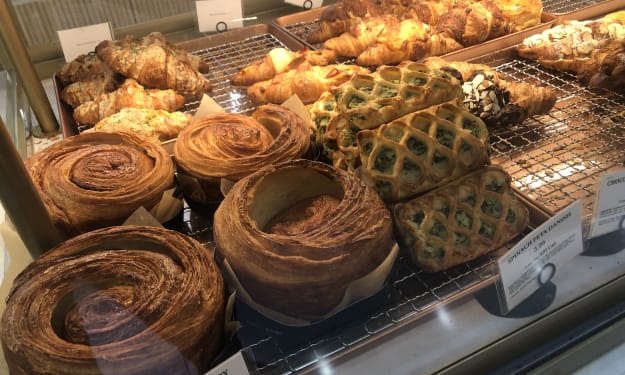
As someone who lives in a rural area, I don't get the chance to visit fancy restaurants or bakeries that often. So, when a friend told me about a French-Asian bakery that's less than an hour away, I knew I had to check it out and grab some pictures for social media. Tous les Jours ended up providing an immersive experience that went above and beyond my expectations--although I did leave with a few reservations.
By Kaitlin Shanks27 days ago in Feast
Europe Coffee Market Size and Forecast 2025–2033: Tradition Meets Innovation in a €66.98 Billion Industry
Introduction: Coffee at the Heart of European Life Coffee in Europe is far more than a beverage—it is a ritual, a lifestyle, and a deeply rooted cultural tradition. From Italy’s espresso bars to France’s sidewalk cafés and Germany’s filter coffee habits, coffee defines social interactions and daily routines across the continent. Today, this cultural legacy is transforming into a powerful economic engine.
By Aaina Oberoia day ago in Feast
Thoughts on Vocal and the way the world is
"Death cannot stop true love, only delay it." – Wesley in The Princess Bride. I decided to come back to Vocal on a very cold and dark night at the end of December. I had been, and still am, convalescing from a horrible staph infection that had gone misdiagnosed for months. This, paired with the increasing challenges of being healthy, making the best choices for my co-parented child, being a wife, and being a director at a new job, was a lot to manage.
By Jazzy 4 days ago in Confessions



Comments
There are no comments for this story
Be the first to respond and start the conversation.