
Global Chicken Market Trends & Summary: How Poultry Became the World’s Fastest-Growing Protein Source
A deep dive into the booming chicken/poultry meat industry, driven by urbanization, rising incomes, foodservice expansion, and global shifts toward healthier, affordable protein options.


The global chicken and poultry meat market has entered a transformative decade—one shaped by shifting consumer preferences, rapid urbanization, technological advances in farming, and changes in the global foodservice landscape. According to Renub Research, the Chicken/Poultry Meat Market is projected to surge from US$ 160.62 billion in 2024 to US$ 268.35 billion by 2033, reflecting a healthy CAGR of 5.87% between 2025 and 2033.
This remarkable expansion underscores chicken’s position not only as the world’s most consumed meat but also as an essential component of global food security. Accessible, affordable, nutrient-rich, and adaptable to virtually every cuisine, chicken has become the protein of choice for billions.
Below is a comprehensive editorial-style analysis of the trends, drivers, challenges, regional insights, and key developments reshaping the global poultry landscape.
A Rapidly Expanding Poultry Industry
Chicken as the World’s Favorite Meat
Over the past century, chicken has overtaken both pork and beef to become the world’s most consumed meat. The reasons are clear: poultry is inexpensive to produce, high in protein, lower in fat, and highly versatile in cooking applications—from street food to fine dining.
In 2024, the United Nations estimated the world population at 8.2 billion, a number expected to reach 9.7 billion by 2050. As the global population grows, so does the demand for affordable protein. Chicken fills this need more efficiently than any other livestock product.
According to the latest OECD-FAO Agricultural Outlook, the number of chickens slaughtered annually—currently around 74 billion birds—is forecast to rise to 85 billion by 2032, marking a 15% increase. This rapid escalation will have profound implications for the environment, economies, and global protein supply chains.
Production Trends
OECD and FAO data indicate that world poultry meat production exceeded 139 million metric tons in 2023, growing nearly 3% from 2022. This steady rise reflects not only increased consumption but also advancements in poultry breeding, disease management, and feed efficiency.
Countries like the United States, Brazil, China, the EU, Thailand, and Mexico continue to dominate production due to advanced farming systems and strong domestic markets. Meanwhile, developing countries, fueled by rising incomes and urban migration, are witnessing unprecedented growth in poultry demand.
What’s Driving Growth in the Global Poultry Market?
1. Rising Global Population & Protein Demand
A growing planet needs more protein—and chicken remains the most efficient solution. Poultry farming is resource-light compared to beef or pork, requiring less feed, land, and water. This makes chicken the preferred protein source for both developed and developing nations.
The affordability factor is especially crucial in middle-income and low-income regions where meat consumption has historically lagged due to cost constraints.
2. Shifting Toward Healthier Eating
Modern consumers are deeply aware of the impact of diet on long-term health. Chicken, with its high protein content, lower saturated fat levels, and reduced calorie count, has become the go-to alternative for those reducing red meat intake.
Younger consumers—especially Millennials and Gen Z—are driving the surge in demand for:
Leaner meats
High-protein ready-to-eat options
Clean-label poultry products
This shift is fueling exponential growth in processed and convenience chicken foods, including sausages, nuggets, deli slices, and marinated cuts.
3. Urbanization & Rising Disposable Incomes
As cities expand, dietary habits change. Urban consumers:
Eat out more frequently
Prefer processed or ready-to-cook foods
Value convenience above tradition
Fast-food chains, quick-service restaurants, and delivery platforms rely heavily on chicken products because they are inexpensive, easy to standardize, and universally popular.
Countries in Asia-Pacific, the Middle East, and Latin America are witnessing the fastest rise in poultry consumption thanks to growing incomes. For example, Asia alone is projected to drive half of global consumption growth over the next decade, according to Euromonitor.
4. Technological Advances in Poultry Farming
Modern poultry farming has evolved rapidly with innovations such as:
Automated climate-controlled housing
Advanced breeding programs
AI-powered monitoring of flock health
Precision feeding systems
These technologies result in:
✔ Higher yields
✔ Reduced mortality
✔ Improved biosecurity
✔ Lower production costs
Countries such as the U.S., Brazil, and China are global leaders in these advancements.
5. Government Investments in Poultry Infrastructure
Government intervention plays a significant role in boosting poultry capacity.
For instance, Ghana’s US$ 541 million investment in 2023 aims to restore domestic poultry production, cut import dependency, and improve food security. Similar initiatives are emerging across Africa, Asia, and Latin America.
These investments help modernize production systems, enhance distribution efficiency, and improve disease management.
Global Consumption & Trends Across Regions
United States
The U.S. remains one of the world’s largest producers and consumers of chicken. Key drivers include:
High demand for affordable protein
Growth of fast-food chains
Expansion of processed chicken products
While the market is strong, challenges persist, including disease outbreaks, feed price volatility, and consumer concerns about antibiotic use and animal welfare.
United Kingdom
The UK poultry market is expanding steadily. Trends include:
Strong shift toward lean meats
Ethical consumerism (free-range, organic, welfare-certified poultry)
Rising demand for ready-to-cook and ready-to-eat chicken meals
Despite Brexit-related supply chain disruptions, the UK’s processed chicken sector remains strong.
Japan
Japan’s chicken market is booming due to:
High preference for poultry in local cuisine
Rising demand for convenience foods like karaage
Increased household spending powered by wage growth
Urban lifestyles that favor ready-made meals
With meat spending averaging ¥72,800 per household in 2023, Japan remains one of Asia’s most lucrative poultry markets.
Saudi Arabia
Chicken is deeply ingrained in Saudi culinary culture. Market growth is driven by:
A rising young population
Demand for halal-certified poultry
Increasing consumption of frozen and processed chicken
Expansion of retail and quick-service restaurants
However, reliance on imported feed and poultry remains a vulnerability.
India
India’s poultry sector has exploded in the past decade. Key data points include:
3.06 billion chickens slaughtered in 2021–22, supplying 51.44% of India’s total meat output
Egg production reaching 122 billion in 2020–21
Urban households spending 10.5% of grocery budgets on processed foods
Strong preference for protein-rich items (eggs, chicken, fish)
Fast food giants and homegrown delivery platforms have made chicken the most accessible meat protein in India.
Challenges Confronting the Poultry Industry
1. Volatile Feed Costs
Feed makes up 60–70% of poultry production expenses. Prices of corn, soybeans, and other grains are highly sensitive to:
Climate change
Trade wars and tariffs
Global supply chain disruptions
Any fluctuation directly affects poultry prices and market stability.
2. Disease Outbreaks
Avian influenza and other poultry diseases can devastate flocks, disrupt trade, and force mass culling. These outbreaks:
Reduce supply
Increase chicken prices
Shake consumer confidence
Trigger international trade restrictions
Maintaining robust biosecurity is now a major priority across all regions.
Key Developments Shaping the Market
Lab-Grown Meat Approval in the U.S.
In July 2023, the U.S. Department of Agriculture approved lab-grown chicken from Upside Foods and GOOD Meat. This represents a groundbreaking shift in how meat may be produced and consumed in the future. While still a niche product, cultivated poultry could reshape sustainability debates.
Major Corporate Moves
February 2023: Stampede Meat partnered with DL Lee & Sons to expand its Southeast U.S. production footprint.
August 2023: DCP Capital acquired Cargill’s Chinese poultry business, signaling growing investor confidence in Asia’s poultry market.
November 2023: Tyson Foods expanded operations in the Netherlands, China, and Thailand, adding capacity for 100,000 tons of fully cooked poultry and creating over 700,000 jobs across Asia.
March 2023: Kraft Heinz and BEES strengthened their B2B marketplace partnership to expand poultry product distribution in Latin America.
Final Thoughts
The global chicken/poultry meat market stands at a pivotal moment. With population growth rising, incomes climbing, and dietary patterns changing across continents, poultry is positioned to remain the world’s preferred protein source. Innovations in farming, strategic government investments, and the rise of processed and convenience chicken products will continue to propel the market forward through 2033.
However, challenges—including disease outbreaks, sustainability concerns, and fluctuating feed prices—must be carefully managed to ensure long-term resilience.
Still, the overall outlook remains undeniably strong. With a projected value of US$ 268.35 billion by 2033, the chicken market is not just thriving—it is evolving into one of the most dynamic, influential sectors in global food economics.
About the Creator
Keep reading
More stories from Aaina Oberoi and writers in Feast and other communities.
Global Potato Starch Market Trends & Summary
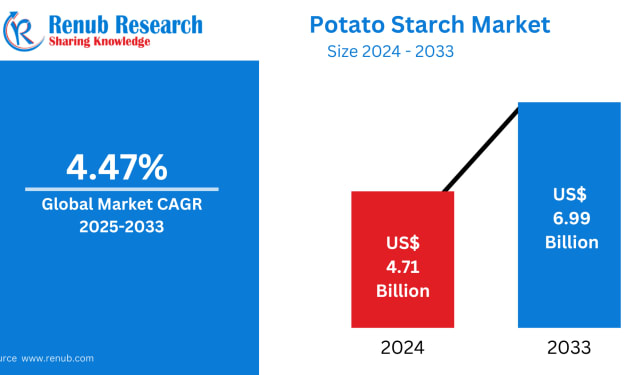
The global potato starch market is undergoing a major transformation and continues to gain traction as consumers worldwide shift toward clean-label, gluten-free, and plant-based products. According to Renub Research, the market is projected to grow from US$ 4.71 billion in 2024 to US$ 6.99 billion by 2033, reflecting a healthy CAGR of 4.47% during 2025–2033. This growth comes at a time when the food processing industry is expanding rapidly, industrial applications of starch are widening, and consumers are becoming increasingly attentive to the ingredients behind the products they consume.
By Aaina Oberoiabout a month ago in Feast
My Tous les Jours Trip
As someone who lives in a rural area, I don't get the chance to visit fancy restaurants or bakeries that often. So, when a friend told me about a French-Asian bakery that's less than an hour away, I knew I had to check it out and grab some pictures for social media. Tous les Jours ended up providing an immersive experience that went above and beyond my expectations--although I did leave with a few reservations.
By Kaitlin Shanks17 days ago in Feast
Germany Candy Market Size & Forecast 2025–2033
Germany Candy Market Overview The Germany Candy Market is poised for steady and sustained growth over the coming decade. According to Renub Research, the market is projected to expand from US$ 3.21 billion in 2024 to US$ 4.53 billion by 2033, registering a Compound Annual Growth Rate (CAGR) of 3.91% between 2025 and 2033.
By Marthan Sir4 days ago in Feast
The steps to losing a child
Step One: Lose a child. Not what anyone wants to happen and nothing you can do to change it, but you can go through steps to becoming happy again. You can go through steps to loving again. You can go through steps to become a new you because after losing a child you will never be the same person you once were.
By Tabitha Hinkley3 days ago in Fiction



Comments
There are no comments for this story
Be the first to respond and start the conversation.