
Zoologically speaking
Anthropomorphism and fiction

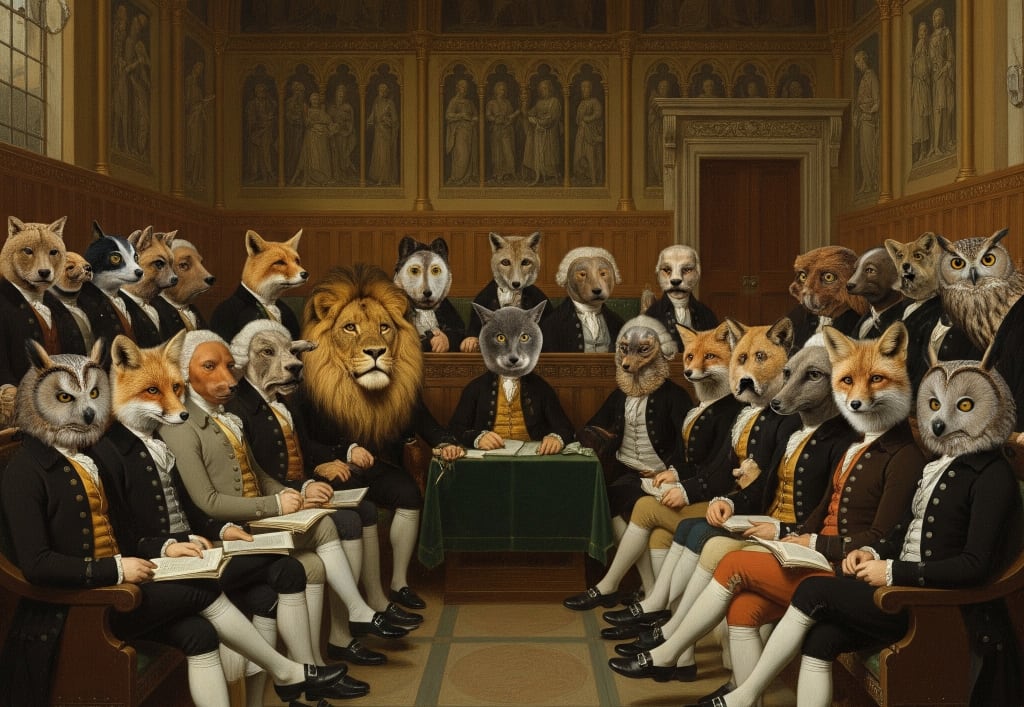
Have you ever read, or for that matter written, a story that sees the world through the eyes of animals? There are numerous authors who have written in a genre that has been described as anthropomorphism. Dodi Smith, Richard Adams, E.B. White, Roald Dhal, George Orwell, among others. Most are best known as authors of children's books.
Written for the ZSL Fellowship Conference, Saturday 7 June, 2025
This includes Richard Adams, Watership Down, although the book might equally be thought of as an adult read. Not least because of the complexity of the societal relationships of the main characters and the drama of intrigue and battles. Yet many people with an interest in zoology would be inclined to pour scorn on such stories as sentimental, and possibly risky to a proper understanding of the animal kingdom.

Despite any misgivings on this account I may have, I am fascinated by the concept of how animals understand and interact with the world. Though I have no background professionally or academically, I often wonder how a wolf, for instance, understands sound and scent patterns.
Which is one reason why I wrote my book Run with the Pack. An adventure that sets a pair of wolves in the unremitting environment of a people-less forest wilderness. I have no wish at this stage to launch into an academic study of animal behaviour. I merely speculate. Yet, is this any more or less than science is capable of when it comes to understanding how other species experience stimuli compared with homo sapiens?
Please judge for yourself. I have listed a number of my short stories here as well as my wolfy book. Is this anthropomorphism, and should we be dismissive of it? I think you need to read the book to decide. You can do this either by buying the book in paperback or Kindle, or by reading it online chapter by chapter.
Buy the book: Run with the Pack
Or read: Run with the Pack, starting from Chapter ONE
Is it misleading, in a work of fiction, to represent the complexities of social interaction between wolves as if it were human speech? You tell me. I don't however, see this story as anthropomorphic. Quite the opposite, since my intention is not to confer human characteristics on another species. It is rather an attempt to explore the social ecology wolves and, as such, is informed by research into the subject.
On which basis I have made an attempt at defining my own fictional genre, which I have referred to as:
Theriocentric Fiction
What about this Drabble (a story in 100 words), in which there is no dialogue, lupine or otherwise?
A lone wolf steals into a deserted encampment, drawn in by the scent and the sound of movement. There, by the smouldering embers, she spots a bundle of arms and kicking legs. Looking around for others of its kind, she wonders how it came to be alone. Ears pricked, scanning for any sign of danger, she pads silently across the bracken. As she reaches the infant she stops, to sniff at the discarded blanket. Gripping the woollen material in her teeth, she stretches it over the child, before curling around the bundle to provide warmth, ears raised, eyes open, alert.
Or, how about the classic myth of the conflict between Romulus and Remus founders of Rome? Here is my fictional and latter-day take on the subject. A shocking tale of orphaned brothers and organised crime.
In the following story, I have reinterpreted a classic fable of a young girl alone in the woods and the strange bond she forms with.... well, read on to find out.
Moving on to other species of canid, you might find amusing.
Perhaps you would like some tips and ideas about how to write your own animal characters and stories? This article attempts to set out some general principles.
I hope you have found something interested in this little talk and I would be delighted to hear from you, to learn whether you have found anything interesting or entertaining in any of my work.
Finally, a story in verse about a stag beetle with an eye for the ladies and a rather nasty habit, with its implicit conservation message
Thanks for reading. If you linked to this article from the postcard I brought to the conference, please email me to let me know what you think. Any Vocal media registered users are of course welcome to comment below.
The author: Ray Taylor, is a Fellow of the Zoological Society of London
Research reference for Run With the Pack: L. David Much and Luigi Boitani eds., Wolves: Behavior, Ecology, and Conservation.
About the Creator
Raymond G. Taylor
Author living in Kent, England. Writer of short stories and poems in a wide range of genres, forms and styles. A non-fiction writer for 40+ years. Subjects include art, history, science, business, law, and the human condition.
Keep reading
More stories from Raymond G. Taylor and writers in Earth and other communities.
Best Beckenham secret walk
Ask any of the good citizens of Beckenham what their favourite walk is, they may well tell you about the historic Beckenham Place Park, or Beck Rec with its famous (recently renovated) 'David Bowie' bandstand. For me, one of the best places to walk, or bicycle, is along the Pool River from Cator Park to Catford. My journey on this fine April day began at New Beckenham Station, where I enjoyed a coffee from a wagon parked outside, before walking to the toward the Harris Academy school. Before you reach the school, you can pick up the footpath on the right, immediately before the school's sports hall.
By Raymond G. Taylor2 years ago in Earth
The BAFTA Awards
By now, in a stunning departure from recent years, most of the world is aware of what happened at the BAFTA film awards. Social Media Headlines will tell you the bare bones: that John Davidson, a Tourette's Syndrome advocate, shouted a racial slur at two Actors of Colour, Michael B Jordan and Delroy Lindo.
By Natasja Rose3 days ago in Psyche


Comments (4)
Oh God, I've still not finished your Run With The Pack series, on Vocal. I gotta somehow find some time for it
To be honest, Ray really these types of stories and your 'Run with the Pack' series to me was always a good read. I enjoyed each installment and, your drabble in this article very good.
Well-wrought, Ray! I often wonder at what level of consciousness animals have compared to us, and from what I've researched, I suspect some are in a higher bracket, so to speak. A great read on neuroscience that I highly suggest is Anil Seth's "Being You". He is trying to understand the "hard problem of consciousness" and mostly references our perception, but there are some great stories about his encounters with animals in there too!
I find the idea of animals' perspectives really interesting. You raise a good point about anthropomorphism. I've always wondered the same about how animals perceive their world. Your wolf story sounds cool. Do you think it's possible to accurately capture an animal's understanding without crossing into anthropomorphic territory? Also, how did you research the wolf behavior for your book? Did you rely on real-life observations or other sources? It's a tricky balance, but I'm eager to see how you pulled it off.