
Why does uranium decay
Why is there uranium on Earth after 4.55 billion years


Uranium is an important raw material for the use of nuclear energy, but it is also a radioactive element that decays. Why does uranium decay? This begins with the microstructure of the atom.
As we all know, an atom is composed of a nucleus and electrons, while the nucleus is composed of a certain number of protons and neutrons. Inside the nucleus, which has multiple protons, there is a battle between two forces: the strong interaction force, which binds protons and neutrons together, and the electromagnetic force, which repels protons when there are multiple protons in the nucleus because they are positively charged.
The strong interaction force is the strongest of the four fundamental forces of the universe, but it is a short-range force, acting at a distance of only 10^(-15) meters, while the electromagnetic force is a long-range force, theoretically infinite, which means that the repulsive force between protons can be superimposed, while the strong interaction force can only " alone".
Because of this, when the number of protons inside the nucleus reaches a certain level, the repulsive force between the protons can reach a strength that can counteract the strong interaction force, and the nucleus becomes unstable.
This is the case of the uranium nucleus, which is the heaviest element we can find in nature, its atomic number is 92, that is, the number of protons in the nucleus of uranium is as high as 92, with so many protons, of course, the nucleus of uranium is unstable, and this is the reason why uranium will decay.
We know that everything in the universe spontaneously tends to a stable state, and the nucleus of uranium is certainly no exception. One of the most effective ways is to reduce the number of protons.
However, for a heavy nucleus like uranium, which has a large number of protons and neutrons, it is almost impossible to release protons alone, because there is a "clumping effect" inside the nucleus, which simply means that protons and neutrons are not evenly distributed inside the nucleus, but are combined into a clump. One of the easiest clusters to form is the "alpha cluster" consisting of two protons and two neutrons.
So the uranium nucleus always tends to release an "alpha cluster" to the outside, yes, this is the "alpha decay" that we often hear about. When the nucleus of uranium undergoes "alpha decay", it will lose two protons and two neutrons at once, and its atomic number will be reduced by 2, which will turn into thorium, the 90th element, for example, uranium-238 will turn into thorium-234 after "alpha decay".
As we know, the "age" of the Earth is about 4.55 billion years, so the question arises since uranium keeps decaying, then why is there still uranium on the Earth after 4.55 billion years? This is quite understandable.
The fact that a uranium nucleus always tends to decay does not mean that it will decay right away, it is probabilistic. For a single uranium nucleus, there is no certainty when it will decay, i.e., it can decay after 1 second or after 100 million years, but if enough uranium nuclei are observed, there is a clear pattern in their decay.
This is where the concept of "half-life" comes into play, which can be simply understood as the time it takes for half of the nuclei of a large number of radioactive elements to decay.
For example, suppose a radioactive element has a half-life of 1 second, then when we observe 200 million such nuclei, it takes only 1 second for 100 million nuclei to decay, and in the next second, 50 million of the remaining 100 million nuclei that did not decay before will decay, and as time goes on, these nuclei will continue to " halved" until their number is so small that they are no longer statistically significant.
Studies have shown that the only three naturally occurring isotopes of uranium on Earth are uranium-238, uranium-235, and uranium-234, all of which decay in "alpha decay", with uranium-238 having the longest half-life of about 4.468 billion years, which means that after 4.55 billion years, uranium-238 on Earth has only decayed by about half. -238 has decayed by only about half.
U-235 and U-234 have relatively shorter half-lives of about 704 million years and 245,500 years, respectively, but they have not been "halved" enough in 4.55 billion years to be lost to nature, except that their relative abundance is lower than that of U-238, and measurements Measurements show that the relative abundance of U-238, U-235, and U-234 on Earth is 99.2742%, 0.7204%, and 0.0054%, respectively.
A summary is that although uranium keeps decaying, we can still find traces of all three isotopes on Earth after 4.55 billion years because they have relatively long half-lives.
It is worth mentioning that all the uranium elements in the universe were produced during high-energy events like supernova explosions and neutron star collisions, and a very small fraction of them came to Earth after a long time, so the uranium on Earth is older than we think, and they have decayed for a long time before coming to Earth.
About the Creator
Robert Jack
One of the secrets of emotional stability for adults is to keep the expectations of others to a minimum.
Keep reading
More stories from Robert Jack and writers in Earth and other communities.
are lucky to have escaped
The universe is full of all kinds of dangers, even on Earth, which is known as the "paradise of life", we still face threats from outer space, such as those asteroids "wandering around" in the solar system, that will come close to Earth from time to time, and If they hit the Earth, it may bring a disaster to mankind.
By Robert Jack4 years ago in Earth
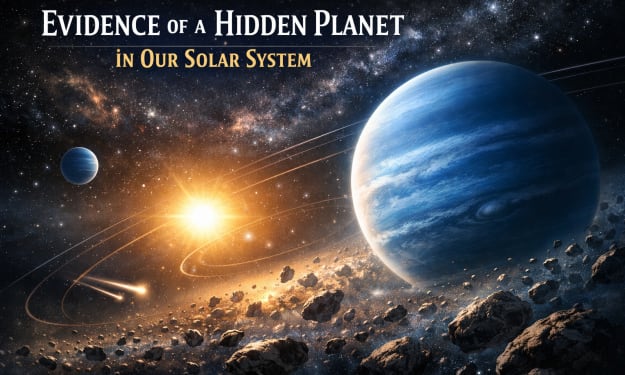
Evidence Suggests a Large Hidden Planet May Exist in Our Solar System
For centuries, scientists believed the major members of our Solar System were fully known. From the rocky inner planets to the gas giants and icy bodies beyond, astronomers thought they had mapped most of the significant objects orbiting the Sun. However, new research by American scientists suggests that a large, hidden planet may still be lurking in the distant reaches of our Solar System.
By Irshad Abbasi 3 days ago in Earth



Comments
There are no comments for this story
Be the first to respond and start the conversation.