
are lucky to have escaped
It missed the Earth's surface by only 10 kilometers


The universe is full of all kinds of dangers, even on Earth, which is known as the "paradise of life", we still face threats from outer space, such as those asteroids "wandering around" in the solar system, that will come close to Earth from time to time, and If they hit the Earth, it may bring a disaster to mankind.
According to scientists' research, in 1908, there was an asteroid that posed a great threat to mankind, it was only 10 kilometers away from hitting the surface of the Earth, and mankind was lucky to escape a disaster, let's see how this happened.
On June 30, 1908, in the area near the Tungus River in central Siberia, Russia, there was a powerful explosion, according to the description of the locals, they saw a huge fireball falling from the sky, its emitted light is brighter than the noon sun, even if you close your eyes you can feel its blinding light, a few minutes later, they felt the huge sound and impact.
The event is the famous "Tungus explosion", the relevant data show that the explosion destroyed more than 2100 square kilometers of about 80 million trees, although the center of the explosion is far away from human settlements, still led to a large number of human buildings with varying degrees of damage, the impact of the distance can reach 650 kilometers, and within 1,000 kilometers, people can hear the explosion generated by the roar.
At first, scientists generally believed that this was a large-scale asteroid impact event, and speculated that there should be a giant crater in the area where the "Tungus explosion" occurred, but the results of the field survey showed that there was no imaginary crater in the area, so the event became mysterious.
Various speculations have been made, such as the "comet impact hypothesis", "antimatter hypothesis", "white dwarf debris hypothesis", etc., and some even believe that the event is related to an alien civilization. However, these speculations are very difficult to explain the "Tungus explosion" reasonably.
In 2020, a scientific team from the Siberian Federal University of Russia published a paper saying that the "Tungus explosion" should be caused by an asteroid and that the reason for not finding the crater the asteroid did not hit the surface of the Earth.
We know that the Earth is round, so when a fast enough asteroid breaks into the Earth's atmosphere at a small angle (relative to the Earth's surface), it may pass close to the Earth's surface and then return to outer space, the process can be simply described as first it gets closer and closer to the Earth's surface, but when it reaches its lowest point, it gets farther and farther away from the Earth's surface, until it flies out of the atmosphere. until it flies out of the atmosphere.
It is worth noting that such a situation is not only theoretical because, on August 10, 1972, an asteroid flyby event was observed, in which an asteroid entered the Earth's atmosphere from above North America and then kept approaching the Earth's surface, but at a distance of about 50 km from the Earth's surface, it flew higher and higher and finally flew out of the Earth's s atmosphere.
So the question arises, if the asteroid did not hit the Earth's surface, then how did it cause the "Tungus explosion"? This is quite understandable.
In daily life, we often encounter such a phenomenon: if an object with a certain speed to us, we can feel the airflow it brings up, the faster the object, the closer we are, and the stronger we feel the airflow.
For the same reason, the asteroid through the atmosphere, will also drive its surrounding gas with it, and in this process, the air in front of the asteroid will be violently compressed and constantly warmed, if the speed of the asteroid is fast enough, the mass is large enough, then when it runs close enough to the Earth's surface on the location, it's driven by the high-temperature airflow will be violently bombarded the ground, and thus cause the effect of the explosion.
That caused the "Tungus explosion" of the asteroid in the end what type, how big, and how fast? To figure out this series of questions, the team's scientists conducted several simulations using computer models.
The simulations showed that the most likely scenario is that it is an iron asteroid with a diameter of at least 200 meters, an angle of incidence of about 11 degrees, a speed between 20 and 25 kilometers per second, and a closest distance of about 10 kilometers from the Earth's surface. In other words, the asteroid was only 10 kilometers short of hitting the Earth's surface, and mankind was lucky to escape this calamity.
According to scientists' calculations, the power of the "Tungus explosion" is equivalent to about 15 million tons of TNT equivalent, which is about 1000 times the power of the Hiroshima atomic bomb. Accordingly, it is not difficult to imagine that an asteroid driven by high-temperature air currents has such huge power, that if it directly hit the surface of the Earth, the consequences will be how terrible.
About the Creator
Robert Jack
One of the secrets of emotional stability for adults is to keep the expectations of others to a minimum.
Keep reading
More stories from Robert Jack and writers in Earth and other communities.
Since the universe was born at a singularity
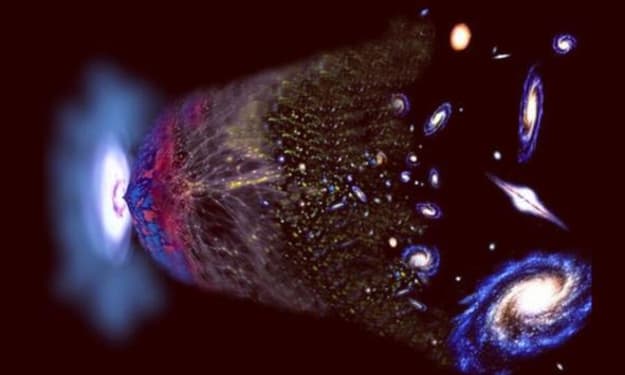
I believe we are all familiar with the "big bang theory of the universe", after all, this is the mainstream theory to explain the origin of the universe, we usually understand the theory that the universe was born in a very small, very dense, extremely high-temperature singularity, about 13.8 billion years ago, this singularity exploded, and then gradually evolved into what we now The universe as we see it now. But the question is, since the universe was born in a singularity, what is outside the singularity?
By Robert Jack4 years ago in Earth
Australia Horticulture Market 2026: Climate-Smart Farming, Export Demand & Agri-Tech Innovation
Australia Horticulture Market Overview Australia’s horticulture market plays a crucial role in the country’s agricultural economy, supplying fresh fruits, vegetables, nuts, flowers and nursery products to both domestic and international markets. The sector is widely recognized for high-quality produce, strong biosecurity standards and advanced farming practices. Growing consumer demand for nutritious foods, expanding export opportunities and continuous technological innovation in agriculture are driving sustained development across Australia’s horticulture industry.
By Amyra Singh6 days ago in Earth


Comments
There are no comments for this story
Be the first to respond and start the conversation.