
Evidence Suggests a Large Hidden Planet May Exist in Our Solar System
American researchers say unusual orbital patterns in distant space objects could point to a massive, undiscovered world beyond Neptune.

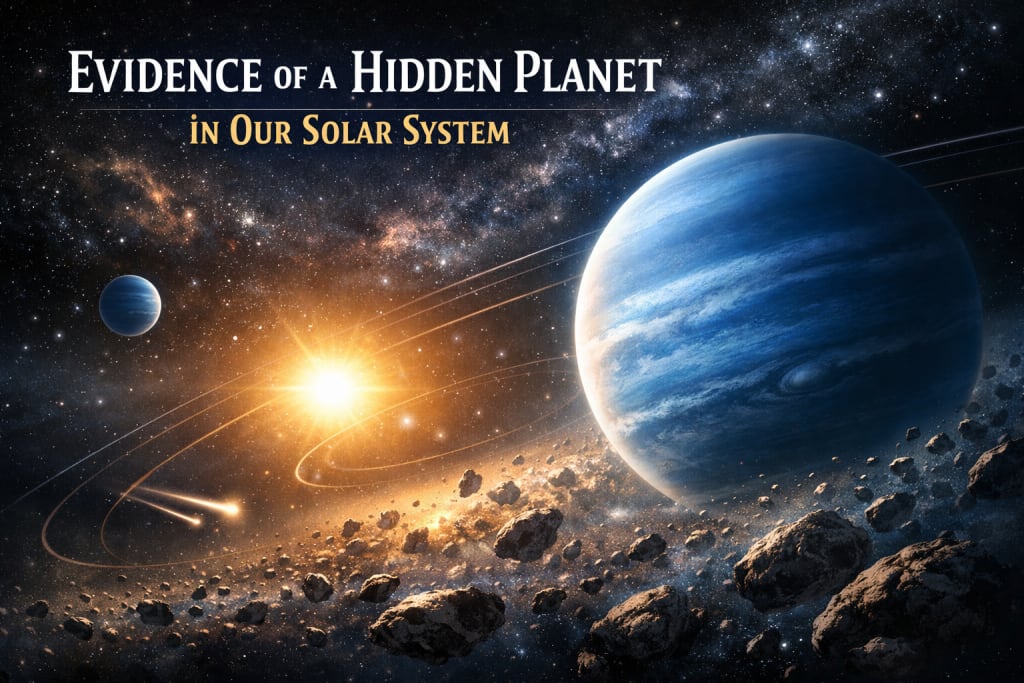
For centuries, scientists believed the major members of our Solar System were fully known. From the rocky inner planets to the gas giants and icy bodies beyond, astronomers thought they had mapped most of the significant objects orbiting the Sun. However, new research by American scientists suggests that a large, hidden planet may still be lurking in the distant reaches of our Solar System.
The mysterious object, often referred to as Planet Nine, has not yet been directly observed. Instead, its existence is inferred from unusual gravitational effects on small icy bodies located far beyond Neptune. These objects belong to a region known as the Kuiper Belt, a vast ring of frozen remnants left over from the early formation of the Solar System.
The idea that a large planet might exist in this distant region gained serious attention in 2016 when two astronomers at the California Institute of Technology proposed the theory after analyzing the orbits of several distant objects. The researchers, Konstantin Batygin and Michael E. Brown, noticed that a group of Kuiper Belt objects appeared to follow strangely aligned paths around the Sun.
According to their calculations, these orbits could be explained if a massive unseen planet were exerting gravitational influence from far away. Their models suggest the planet could be roughly five to ten times more massive than Earth, making it similar in size to a “mini-Neptune.”
Scientists estimate that Planet Nine, if it exists, could orbit the Sun at a distance 400 to 800 times greater than Earth’s distance from the Sun. At such an extreme distance, the planet would take between 10,000 and 20,000 years to complete a single orbit.
Because it would reflect very little sunlight and move extremely slowly across the sky, spotting the planet with current telescopes is incredibly challenging. Astronomers are searching for it by scanning large areas of the sky and analyzing the motion of distant objects that might reveal its gravitational presence.
Recent studies have strengthened the case for the planet’s existence. Researchers have continued to discover more distant objects whose orbits appear to cluster in a way that is difficult to explain without a large gravitational body shaping them. Computer simulations also show that the presence of such a planet could explain several other strange features of the outer Solar System.
For example, some objects appear to orbit the Sun in highly tilted paths relative to the plane in which most planets move. In some cases, the orbits are even reversed, moving in the opposite direction. These unusual trajectories could be the result of gravitational interactions with a large hidden planet over billions of years.
Despite the growing evidence, many astronomers remain cautious. Some researchers argue that the orbital patterns observed so far may simply be the result of observational bias. Because telescopes cannot survey the entire sky equally, it is possible that the clustering seen in the data reflects where scientists have looked most carefully.
Others suggest that the gravitational effects might instead be caused by a large population of smaller icy objects rather than a single massive planet.
Nevertheless, the search for Planet Nine continues to intensify. Powerful observatories around the world are scanning deeper into the outer Solar System, hoping to catch a glimpse of the mysterious object. One facility expected to play a major role in this search is the Vera C. Rubin Observatory, which will conduct one of the most detailed sky surveys ever performed.
If Planet Nine is eventually discovered, it would dramatically reshape scientists’ understanding of how the Solar System formed and evolved. It could also explain several long-standing puzzles about the distribution of objects in the outer Solar System.
The discovery would be comparable in significance to the discovery of Neptune, which was predicted mathematically before it was ever observed through a telescope.
For now, Planet Nine remains one of the most intriguing mysteries in modern astronomy. Whether it proves to be a hidden giant planet or simply a statistical illusion, the search itself is pushing the boundaries of how scientists explore the farthest edges of our cosmic neighborhood.
As telescopes grow more powerful and sky surveys become more comprehensive, astronomers are hopeful that the coming years may finally reveal whether our Solar System truly has a ninth major planet waiting to be found. 🌌🔭
About the Creator
Irshad Abbasi
Ali ibn Abi Talib (RA) said 📚
“Knowledge is better than wealth, because knowledge protects you, while you have to protect wealth.
Keep reading
More stories from Irshad Abbasi and writers in Earth and other communities.
Venus and Jupiter Shine Together: A Stunning Planetary Display in Earth’s Sky
For skywatchers across the world, there are few sights more captivating than seeing bright planets glowing in the night sky. Among these celestial wonders, the close appearance of Venus and Jupiter from Earth is one of the most spectacular. When these two brilliant planets appear close together in the sky, they create a stunning astronomical event that fascinates both professional astronomers and casual stargazers alike.
By Irshad Abbasi a day ago in Earth
The Edge of the Atlantic: Life, Weather, and the Meaning of Home
Along the edge of the Atlantic, life moves to the rhythm of wind and water. The sun rises over the ocean with a quiet certainty, casting its first light across the rooftops of South Florida’s coastal towns. Palm trees sway, seabirds glide above the shoreline, and the day begins beneath a sky that seems almost endlessly blue.
By Nikolay Barkalin4 days ago in Earth



Comments
There are no comments for this story
Be the first to respond and start the conversation.