
“The Day the Skies Broke: Cloudburst Disaster in Swat & Buner – August 15, 2025”
How a sudden storm changed hundreds of lives in Khyber Pakhtunkhwa — a firsthand account of survival, loss, and resilience.

“The Day the Skies Broke: Cloudburst Disaster in Swat & Buner – August 15, 2025”
How a sudden storm changed hundreds of lives in Khyber Pakhtunkhwa — a firsthand account of survival, loss, and resilience.
On the morning of August 15, 2025, life in the valleys of Swat and Buner began like any other summer day. The mountains stood tall and green, children were on their way to madrassas and schools, and farmers were already in their fields tending to maize crops. No one knew that by afternoon, the skies would crack open with a fury that would leave families shattered and villages drowned.
By 2 p.m., dark clouds gathered over the Elum mountain range, stretching into Swat’s upper valleys. The air grew heavy, and the sound of thunder echoed like a war drum. Villagers, accustomed to summer monsoon rains, thought it would pass. But this was no ordinary storm.
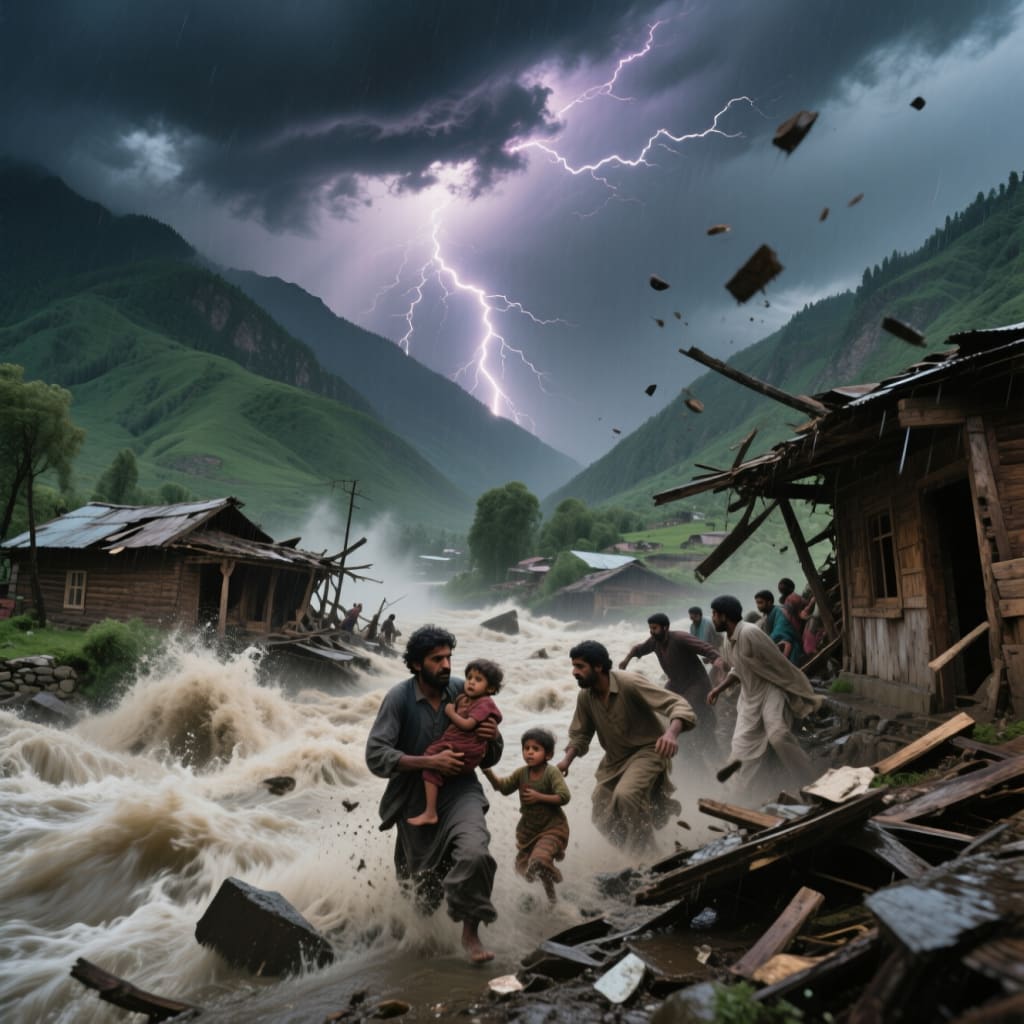
Within minutes, a cloudburst — a rare and deadly event — unleashed torrents of water. Walls of rain fell with unimaginable force, turning dry mountain streams into raging rivers. People describe it as if “the skies had broken apart.”
The Sudden Floods
The first waves of destruction hit Pir Baba in Buner. Small streams swelled into violent floods, sweeping away mud houses, livestock, and even people standing on rooftops.
In Shangla and upper Swat, flash floods tore down bridges that connected entire valleys. One eyewitness, an elderly man from Islampur Swat, said:
“We heard the roar before we saw the water. Within seconds, the flood swallowed fields, homes, and children playing near the stream.”
Roads collapsed, power lines fell, and communication with several villages was cut off.
Families Torn Apart
Dozens of families were displaced within hours. Parents clutched their children, running barefoot through muddy paths to reach higher ground. In Buner, entire households lost not only their homes but also their food storage for the coming winter. Women wept as their dowry trunks — collected over years — floated away in the flood.
Survivors describe the helplessness of watching everything vanish in minutes. A farmer, Rehmanullah, shared through tears:
“I worked for 20 years to build my house. Now it is mud again. My goats, my land, my wife’s jewelry — all gone in one day.”
Rescue and Helplessness
Local volunteers were the first to respond. Young men tied ropes across streams to help families cross. Tractor drivers risked their lives to pull people from stranded rooftops.
By nightfall, the Pakistani Army and Rescue 1122 teams reached the worst-hit areas. But heavy rainfall made rescue operations nearly impossible. Helicopters could not land due to poor visibility, and landslides blocked the main Swat–Buner road.
Dozens of people spent the night under the open sky, shivering and hungry. Children cried in fear as thunder continued to rumble.
The Loss
Initial reports confirmed:
At least 47 lives lost across Swat and Buner.
Hundreds of homes destroyed or partially damaged.
Agricultural land — the lifeline of poor farmers — washed away.
Schools and mosques submerged in floodwater.
For locals, this was not just a natural disaster — it was the collapse of their future. Without crops, without shelter, and without savings, many fear starvation and disease in the weeks to come.
A Glimpse of Hope
Yet, amid destruction, stories of humanity emerged. A schoolteacher in Buner opened his small school building as a shelter for 60 flood victims. Women cooked together in makeshift kitchens, sharing the little food left. Children, despite losing their homes, laughed as they floated empty plastic bottles like toy boats in floodwater.
Relief organizations from Peshawar and Islamabad began mobilizing aid, while social media carried viral images of destruction — demanding government support.
A Wake-Up Call
Experts warn that cloudbursts and flash floods will become more frequent in northern Pakistan due to climate change. The mountains, once seen as protectors, are now sources of unpredictable danger.
For the people of Swat and Buner, August 15, 2025, will forever remain in memory as the day when the skies broke. Yet their resilience, their will to rebuild, and their faith stand as proof that no disaster — however fierce — can drown the human spirit.
About the Creator
Wings of Time
I'm Wings of Time—a storyteller from Swat, Pakistan. I write immersive, researched tales of war, aviation, and history that bring the past roaring back to life
Keep reading
More stories from Wings of Time and writers in Earth and other communities.
When the Heavens Shattered
When the Heavens Shattered A day of fury in Buner and Swat: how today’s unimaginable cloudburst changed lives The sky over the soaring peaks of Khyber Pakhtunkhwa was already heavy with rumble and promise, as if foretelling what was to come. But on August 15, 2025, nature delivered a blow so sudden, so devastating, that it shattered the routine of countless villages in Buner and Swat.
By Wings of Time 5 months ago in Earth
Stock Market Today: Nasdaq Futures Rise; Oil Skids After Trump Dials Down Iran Tension
If you’ve been following the markets this week, you’ve probably noticed how sensitive traders are to geopolitical headlines. On Thursday, Nasdaq futures rose, while oil prices dropped after U.S. President Donald Trump made remarks that dialed down fears of immediate military escalation with Iran. It’s a classic example of how news can move multiple markets at once — tech stocks climbing while commodities react in the opposite direction. Nasdaq Futures Bounce Back Technology and growth-focused stocks led the recovery in futures trading. Nasdaq futures climbed, signaling that investors are regaining confidence after recent volatility. Many traders have been cautious, with some taking profits from high-flying tech names, but today’s rebound shows that market optimism is returning. Corporate earnings are a big factor here. Several tech giants, including semiconductor and software companies, have beaten analyst expectations in recent weeks. These results support longer-term growth narratives, giving investors confidence that the tech sector can continue to outperform even amid economic uncertainty. For anyone watching the markets, this is a reminder: futures are forward-looking indicators. When traders see signs of stabilization — like reduced geopolitical tension or strong earnings — markets often react positively before the official trading session even begins. Oil Prices Fall Amid Eased Tensions On the flip side, oil prices skidded. The energy market had been pricing in potential supply disruptions due to the tension with Iran, particularly in critical regions like the Strait of Hormuz. But after Trump’s comments, traders interpreted a lower risk of military conflict, and crude futures dropped sharply. West Texas Intermediate (WTI) and Brent crude both saw declines of around 4–5%, as investors adjusted their positions. This shows how geopolitical risk premiums can inflate commodity prices — and how quickly they can disappear once the perceived threat diminishes. Lower oil prices are a double-edged sword. On one hand, cheaper fuel eases costs for consumers and businesses. On the other, energy companies and oil-exporting nations may face pressure on revenue and profits if prices remain soft. Why Geopolitics Moves Markets The Middle East continues to be a major driver of global market sentiment. Even the possibility of conflict in oil-rich regions can make investors nervous, sending equities lower and commodities higher. Conversely, statements that calm these fears can produce quick rebounds in risk assets like stocks and a decline in commodities like oil. This week’s developments show just how reactive the markets have become. A single remark from a world leader — in this case, Trump — can shift risk perception and trigger immediate moves across multiple asset classes. Earnings and Economic Data Still Key While geopolitical headlines dominate daily moves, corporate earnings and economic data remain critical for long-term market trends. Financial giants like Morgan Stanley recently reported results that beat expectations, boosting their stock prices and reinforcing positive sentiment in the sector. Investors are paying close attention to these fundamentals. Earnings reports and macroeconomic indicators provide insight into underlying trends, helping traders separate short-term volatility from sustainable growth. What Investors Should Watch For stock investors: The rebound in Nasdaq futures suggests that growth and technology stocks are finding support, but volatility is still high. Active risk management and portfolio diversification remain essential. For energy markets: Today’s slump in oil prices highlights how commodities react to geopolitical sentiment. Traders should watch for developments in the Middle East, as any escalation could reverse the decline in prices almost immediately. For global markets overall: Investors must balance multiple narratives — geopolitical events, corporate earnings, economic data, and interest rate expectations. This interplay shapes risk appetite and influences how capital flows across sectors and regions. The Takeaway Today’s market action illustrates a broader theme: markets are highly sensitive to shifts in risk perception. When geopolitical tension eases, equities tend to rise, and risk-sensitive commodities like oil fall. But when threats reappear, sentiment can flip, reminding investors that global markets are dynamic and interconnected. This combination of Nasdaq gains and falling oil prices isn’t just about numbers — it’s about investor psychology, risk management, and the speed at which news travels in our global economy. The lesson is clear: staying informed and flexible is more important than ever for anyone participating in today’s markets.
By Muhammad Hassan4 days ago in Earth
Cement's Quiet Pivot
Why this is under-the-radar progress Cement and concrete account for a sizable slice of global CO₂, but the fastest cuts right now aren’t headline-grabbing moonshots — they’re practical shifts already filtering through specifications, standards, and procurement. Three forces are converging: (1) modern cement standards that enable big clinker reductions with reliable performance; (2) rapid market adoption of Portland-limestone cement (PLC) and new ternary blends such as limestone–calcined clay cements (LC3); and (3) public buyers setting embodied-carbon requirements that move the market. Together, these are driving real-world emission declines from the most-used construction material on earth — often without changing how structures are designed or built [8].
By Futoshi Tachino8 days ago in Earth


Comments
There are no comments for this story
Be the first to respond and start the conversation.