
The Abyss: A Journey to the Deepest Depths of the Ocean
Descending into the Unknown: Exploring the Scale and Secrets of the World's Oceans

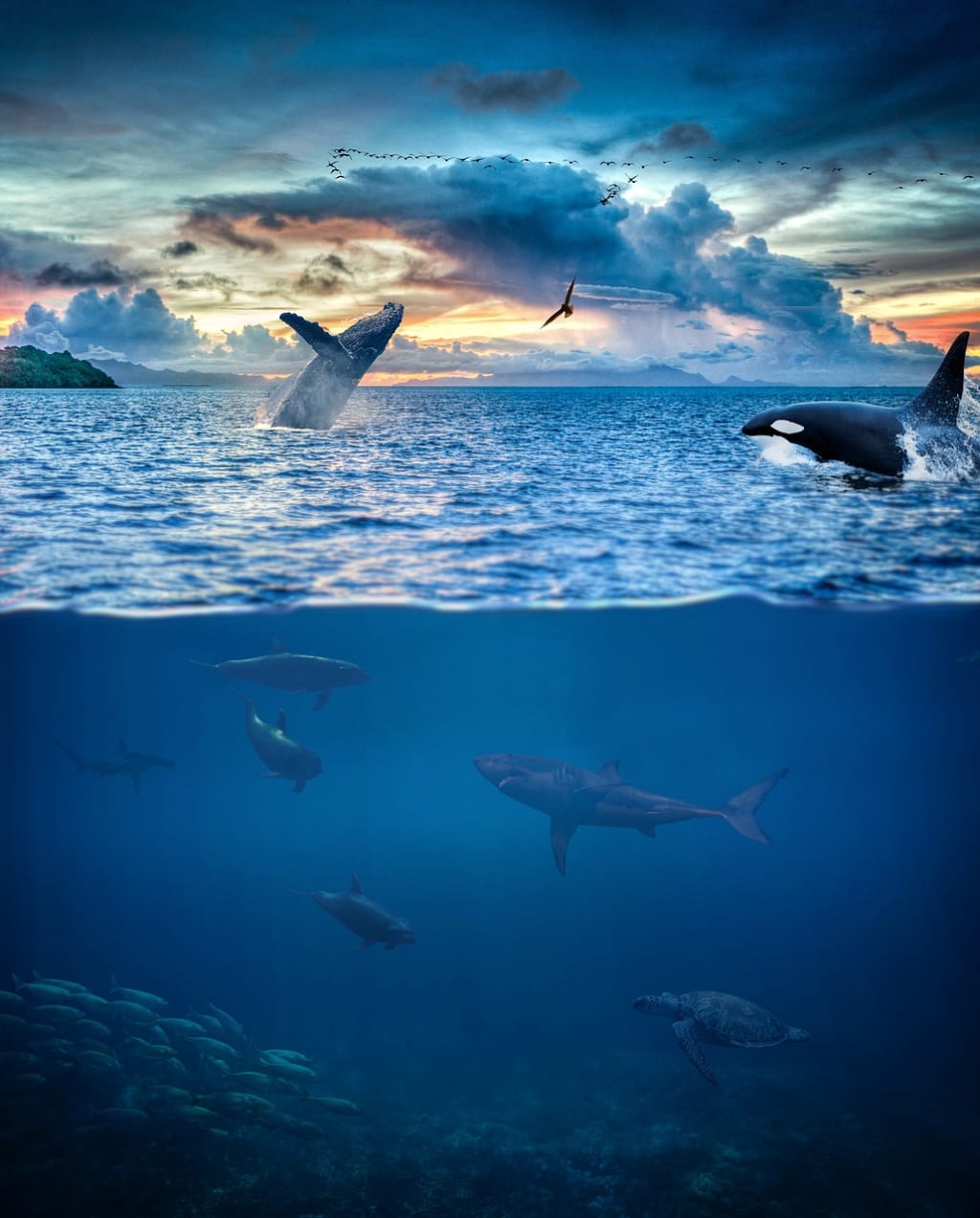
The ocean is unimaginably deep—far deeper than most people realize. If we were to shave off all the land from the tops of every continent and island and use it to fill the ocean’s deepest trenches, the entire planet would be covered by an ocean roughly 2 miles (3.2 kilometers) deep. Despite this theoretical evenness, three-fourths of Earth is already covered in water, and the oceans plunge far deeper than 2 miles in many places. To truly grasp the ocean's scale and depth, let’s start with some comparisons and descend step by step into its hidden, mysterious world.
The first milestone we encounter is 40 meters (131 feet) below the surface, the maximum depth allowed for recreational scuba diving. Going further, at 93 meters (305 feet), lies the wreck of the Lusitania, the famous ocean liner sunk during World War I. Remarkably, the Lusitania is 240 meters (787 feet) long, meaning it sank in waters shallower than the ship’s own length. If the wreck were positioned vertically, it would extend above the ocean’s surface. Just beyond this at 100 meters (328 feet) is where diving begins to become dangerous due to the risk of decompression sickness. Despite this danger, Herbert Nitsch set the world record for free diving by descending to an astonishing 214 meters (702 feet) on a single breath. Further still, Ahmed Gabr holds the scuba diving world record, plunging to a depth of 332 meters (1,089 feet)—almost the height of the Empire State Building.
At 500 meters (1,640 feet), we encounter the maximum dive depth of blue whales, the largest animals on the planet, as well as the operational limit of the U.S. Navy’s Seawolf-class nuclear submarine. Emperor penguins also reach their maximum diving depth here at 535 meters (1,755 feet). The pressure at this depth is extraordinary—comparable to a polar bear standing on a quarter. By 830 meters (2,723 feet), we would match the height of the Burj Khalifa, the tallest building in the world.
When we descend to 1,000 meters (3,280 feet), the ocean enters a realm of perpetual darkness, as sunlight cannot penetrate beyond this point. This zone, often referred to as the “midnight zone,” is where water pressure becomes as extreme as standing on the surface of Venus. It’s also where we encounter mysterious creatures such as the giant squid, whose existence was only confirmed in recent years. The leatherback sea turtle holds the record for deepest dive by a reptile, reaching 1,280 meters (4,200 feet). At 1,828 meters (6,000 feet), we reach the depth equivalent to the Grand Canyon’s height if it were submerged.
At 2,000 meters (6,561 feet), things start to get eerie. Here, we find creatures like the black dragonfish, a carnivorous predator with a stomach that doesn’t emit light, allowing it to remain invisible in this pitch-black environment. Descending further to 2,250 meters (7,382 feet), we meet sperm whales, known for battling colossal squids in the deep. These squids can grow up to 14 meters (46 feet) long, weigh 750 kilograms (1,650 pounds), and have razor-sharp hooks in their tentacles.
At 3,800 meters (12,467 feet), we find the wreck of the RMS Titanic. By 4,000 meters (13,123 feet), we enter the abyssal zone, where water pressure reaches an astounding 11,000 pounds per square inch. This extreme environment is home to alien-like creatures such as anglerfish, fangtooths, and viperfish. On average, the ocean floor lies at about 4,267 meters (14,000 feet), though some areas are significantly deeper.
The wreckage of the WWII battleship Bismarck lies at 4,791 meters (15,719 feet), while 6,000 meters (19,685 feet) marks the start of the hadal zone, named after the Greek underworld, Hades. Here, water pressure reaches unimaginable levels—equivalent to an elephant balancing on a postage stamp or the weight of 50 Boeing 747s on a single person. Only specialized submersibles can survive at this depth, such as the DSV Alvin, which helped explore the Titanic wreckage and can dive as deep as 6,500 meters (21,325 feet).
At 8,848 meters (29,029 feet), we reach the height of Mount Everest, were it submerged upside down in the ocean. Beyond that, at 10,898 meters (35,755 feet), filmmaker James Cameron descended in 2012 during the Deepsea Challenger mission. However, the deepest part of the ocean ever reached by humans was in 1960, when Don Walsh and Jacques Piccard descended to 10,916 meters (35,814 feet) in the Trieste submersible. Their descent took five hours, but they could only stay at the bottom for 20 minutes due to a cracked window.
At 10,994 meters (36,070 feet), we arrive at the Challenger Deep, the deepest known point in the ocean, located in the Mariana Trench near Guam. For perspective, this depth is roughly the cruising altitude of a commercial airplane. While Challenger Deep is the deepest confirmed point, it is likely that even deeper parts of the ocean exist. In fact, the Sirena Deep, discovered in 1997, reaches 10,732 meters (35,151 feet), making it the second-deepest point.
Astonishingly, we have only mapped about 5% of the ocean floor, leaving 95% unexplored. With advancements in technology, it may only be a matter of time before we uncover even greater depths in this vast, mysterious abyss.
About the Creator
Lisa Ann Bastiaan
Fueled by curiosity and a passion for truth, I delve into mysteries, science, and human psychology. Through storytelling, I uncover the unknown, spark discovery, and ignite meaningful conversations about the fascinating.
Keep reading
More stories from Lisa Ann Bastiaan and writers in Earth and other communities.
Exploring the Fascinating and Uncharted Creatures of the Ocean's Depths
Unveiling the Mysteries of the Deep: Exploring the Ocean’s Most Enigmatic Creatures The ocean, covering more than 70% of the Earth’s surface, is a realm of mystery and wonder. Its depths remain largely unexplored, with scientists estimating that up to 80% of the marine environment is uncharted. In this vast, unilluminated world, countless fascinating and enigmatic creatures thrive. While many of these species have been discovered and studied, some remain cloaked in mystery, sparking intrigue and awe across the globe. Here, we delve into the strange and unexplainable creatures that call the ocean home.
By Lisa Ann Bastiaanabout a year ago in Earth
Harnessing Pyrolysis for Forest Fire Mitigation
Forest ecosystems face increasing wildfire risks due to climate change, prolonged drought, and human activity. Traditional fire prevention methods, including controlled burns and mechanical thinning, have proven partially effective but carry limitations in scalability and environmental impact. Integrating pyrolysis-based strategies presents an innovative pathway to reduce combustible biomass while generating valuable by-products, aligning ecological stewardship with economic utility.
By Wayne Shen4 days ago in Earth
Landscape Beneath Antarctica's Icy Surface Revealed in Unprecedented Detail
For decades, Antarctica has been the Earth’s ultimate mystery — a vast expanse of ice covering almost 14 million square kilometers, hiding secrets beneath its frozen surface. Now, thanks to advanced radar technology and satellite mapping, scientists have produced the most detailed map yet of the continent’s hidden landscape, revealing mountains, valleys, subglacial lakes, and river systems that were previously invisible. This discovery is more than just a scientific curiosity. Understanding Antarctica’s topography beneath the ice is critical for predicting ice sheet stability, global sea-level rise, and climate change impacts. The new data could also shed light on Earth’s geological history and the ways in which life may survive in extreme environments. How Scientists Mapped the Hidden Terrain For years, researchers have relied on a combination of methods to peek beneath the ice: Ice-penetrating radar: Devices mounted on aircraft or satellites send radio waves through ice layers, which bounce back when they hit bedrock, revealing contours beneath kilometers of frozen water. Satellite gravimetry: Small variations in Earth’s gravitational field help infer the presence of mountains, valleys, and subglacial lakes. Seismic surveys: Explosions or controlled vibrations allow scientists to detect underground structures by measuring the way seismic waves travel through different materials. Using these techniques, a consortium of international researchers created a high-resolution map of Antarctica’s sub-ice topography, revealing features that rival the landscapes of continents that have been visible for millions of years. What’s Beneath the Ice? The map reveals a striking variety of features: Mountain ranges: Peaks rise more than 4,000 meters above the surrounding terrain, hidden beneath miles of ice. Some of these ranges may be older than the Rockies or the Alps. Deep valleys: Vast troughs and gorges, carved by ancient rivers or tectonic activity, provide clues about how the continent evolved over millions of years. Subglacial lakes: Scientists have identified hundreds of liquid water lakes trapped beneath the ice, including the famous Lake Vostok. These lakes remain liquid due to pressure and geothermal heat and may host microbial life isolated for millions of years. Subglacial river networks: Surprisingly, water flows beneath the ice in channels and rivers, slowly carving pathways that affect ice sheet movement. This intricate landscape challenges the perception of Antarctica as a flat, featureless ice sheet. Instead, it is a dynamic and complex environment, where hidden topography influences everything from ice flow to global sea levels. Why This Discovery Matters The importance of understanding what lies beneath Antarctica’s ice cannot be overstated: Predicting Ice Sheet Stability: Ice sheets move more quickly over smooth surfaces than over rugged terrain. Knowing where mountains and valleys lie helps scientists predict which areas of ice may collapse first, potentially raising sea levels faster than anticipated. Climate Change Models: Subglacial lakes and water channels lubricate the ice from below, influencing melting rates. Incorporating these features into models improves accuracy in forecasting future sea-level rise. Earth’s Geological History: The newly revealed landscape offers a window into Antarctica’s past — from tectonic shifts to ancient rivers and climates. This data helps reconstruct how continents drifted and climates evolved over millions of years. Search for Extreme Life: Subglacial lakes may harbor microbial life isolated for millions of years, providing insights into life in extreme environments, potentially even on other planets. Global Implications Antarctica may feel distant, but its ice sheets hold the key to global sea-level stability. Even small changes beneath the ice can have profound consequences for coastal cities around the world. With melting accelerated by climate change, understanding the terrain under the ice is crucial for planning and mitigation. Governments, scientists, and environmental organizations are now using this information to: Improve climate models for sea-level rise predictions Identify vulnerable regions of the ice sheet Guide future research missions to subglacial lakes and mountains The discovery also strengthens the case for continued international collaboration in Antarctica, where research and environmental protection are governed by treaties emphasizing peaceful scientific study. Challenges Ahead Mapping Antarctica is far from complete. Extreme weather, thick ice sheets, and logistical difficulties make the continent one of the hardest places to study. While radar and satellite technologies have advanced, field validation and deeper exploration remain difficult and expensive. Researchers also face ethical and environmental concerns. Drilling into subglacial lakes to sample microbial life, for instance, must be done carefully to avoid contamination. Antarctica’s fragile ecosystem demands that scientific progress balances discovery with protection. Looking to the Future The detailed map of Antarctica’s hidden landscape opens new possibilities for exploration and understanding: Ice Flow Predictions: With accurate topography, scientists can model how ice sheets will respond to warming climates more precisely. Resource Insights: While exploitation is restricted by international agreements, understanding subglacial mineral deposits can inform potential future uses. Extreme Environment Biology: Studying subglacial lakes could reveal new species adapted to cold, dark, and high-pressure environments, broadening our understanding of life on Earth. The data also strengthens international scientific cooperation, as multiple countries share findings and resources to better understand a continent that belongs to no single nation. Final Thoughts Antarctica’s ice may appear static and endless, but beneath it lies a vibrant and rugged landscape filled with mountains, valleys, lakes, and rivers. The new detailed mapping of this hidden world is a landmark achievement in Earth science, combining advanced technology, international collaboration, and the human drive to explore. By uncovering what lies beneath the ice, scientists are not just satisfying curiosity — they are equipping humanity with the knowledge to protect our planet, anticipate climate challenges, and understand the deep history of Earth itself. Antarctica’s secrets, once locked beneath kilometers of ice, are finally being revealed, and what we learn could reshape our understanding of the planet and our place within it.
By Muhammad Hassan7 days ago in Earth


Comments
There are no comments for this story
Be the first to respond and start the conversation.