Science
Naphtha as a High‑Value Output from Plastic Pyrolysis
Plastic pyrolysis converts mixed or contaminated polymer streams into liquid hydrocarbons, permanently diverting them from landfill or incineration. Among the liquid fractions, naphtha is the most commercially significant because it integrates directly into existing petrochemical value chains.
By Wayne Shen7 months ago in Earth
Dimensional Dynamics of Light, Gravity, and Space-Time: A Novel Theoretical Framework
Abstract This paper proposes a revolutionary theoretical model that interconnects light, gravity, and space-time through a dimensional framework beyond traditional four-dimensional physics. It posits that photons, far from being limited to classical interpretations, may inherently belong to a sixth-dimensional reality where time ceases to exist. The theory redefines black holes, neutron stars, and gravitational interaction, offering a model where light can generate gravity under high energy densities. It challenges the compartmentalized view of physical phenomena, suggesting a unified dimensional structure where energy, mass, and causality intertwine.
By Heavenly emperor Huang 8 months ago in Earth
🌍 Navigating the Climate Crossroads: Urgent Call for Global Solidarity
✍️ By: Umair Ali Shah Yousafzai --- 1. Double Threat: Escalation of Extreme Weather Climate change is no longer a distant thundercloud on the horizon—it is here, loud, relentless, and devastating. From scorching heatwaves in Pakistan and India to unprecedented floods in Brazil, the frequency and intensity of extreme weather events have doubled over the past two decades. According to NASA, the Earth has just endured its hottest consecutive five-year period in recorded history. Unseasonal rains, supercharged cyclones, and extended droughts have now become the "new normal." Cities that once thrived on moderate climates are now witnessing temperatures soar past 50°C. Entire towns are being submerged in flash floods that defy all historical patterns. The planet is clearly screaming for help, yet we move forward with the same indifference that got us here. The dangerous part? These events are interconnected. Prolonged droughts parch the soil, which then leads to quicker flooding when rains finally come. Forest fires ignite more easily in overheated, dry woodlands. Every action in one part of the ecosystem echoes elsewhere—disruption is now systemic. This double threat—of rising temperatures and increasing natural disasters—is not just a meteorological issue. It is an existential one. --- 2. Polar Crisis: The Melting Alarm The Arctic and Antarctic—our planet’s cryogenic guardians—are melting faster than ever. The ice caps, which regulate Earth's temperature by reflecting sunlight, are disappearing at alarming rates. Greenland lost over 250 billion tons of ice in 2023 alone, according to recent satellite data. This isn’t just about polar bears losing their homes (though that is heartbreaking enough). Melting ice raises global sea levels, threatening low-lying nations like Bangladesh, Maldives, and even parts of New York and London. The Intergovernmental Panel on Climate Change (IPCC) warns that if global warming surpasses 2°C, many coastal cities could become uninhabitable within our lifetime. Worse still, melting permafrost releases methane—a greenhouse gas many times more potent than carbon dioxide—further accelerating the warming process. This sets off a deadly feedback loop: more warming causes more melting, which causes more greenhouse gases, and so on. The poles are like the beating heart of Earth’s climate. If the heart fails, everything else collapses. --- 3. Human Toll: Health Under Siege We often speak of climate change in abstract terms—degrees, statistics, timelines. But behind every metric is a real human life. Climate change is already affecting public health globally, and the future looks bleak if we don’t act. Heatwaves are causing heatstroke-related deaths at unprecedented levels. In 2024, over 5,000 people died in South Asia due to unbearable heat. Hospitals are overwhelmed, infrastructure buckles, and power grids fail under pressure. Vector-borne diseases like malaria, dengue, and Zika are expanding into new regions as warmer temperatures enable mosquitoes to thrive in previously unaffected areas. Respiratory problems are on the rise due to increased air pollution and wildfire smoke. Mental health issues—climate anxiety, displacement trauma, and depression—are silently creeping in as people lose their homes, livelihoods, and sense of security. The World Health Organization estimates that between 2030 and 2050, climate change will cause an additional 250,000 deaths annually from malnutrition, disease, heat stress, and other related conditions. In short, climate change is no longer just about the planet—it’s about people. About you and me. --- 4. Food, Water & Fragility: Agriculture in Peril The soil beneath our feet is losing its resilience. Crops that once thrived in certain seasons are now withering under erratic weather conditions. In Pakistan, wheat production has seen a significant decline due to unexpected rainfalls and temperature shifts. Globally, climate change is shifting rainfall patterns, increasing evaporation rates, and exhausting underground water reservoirs. The result? Water scarcity is becoming the next big crisis. Cities like Cape Town, Chennai, and even Los Angeles have faced 'Day Zero' threats where running out of water becomes a real possibility. In Africa, maize and millet crops are failing. In the Middle East, irrigation is collapsing under relentless droughts. In Europe, olive groves are drying. The chain is long, and the cracks are everywhere. And let’s not forget the oceans. Rising temperatures and acidification are killing coral reefs—the nurseries of marine life. Fisheries are collapsing. Millions who rely on seafood for protein and employment are now facing famine and poverty. Climate change is eating away at our food and water security. And once these two fall, civilization itself is at risk. --- 5. Climate Inequality: A Social Crisis Here lies one of the most unjust realities of climate change: those who contribute the least to global warming suffer the most. Developed nations—the historic polluters—have the means to adapt, invest in infrastructure, and escape the worst effects. Meanwhile, poorer nations in the Global South are left to drown, burn, and starve. A farmer in rural Sindh loses his crop due to drought, a fisherman in Bangladesh sees his village swallowed by the sea, a mother in Sudan watches her child waste away from dehydration—all while nations responsible for this chaos continue with "business as usual." Women and children, indigenous communities, refugees, and low-income families are disproportionately impacted. Access to clean air, safe drinking water, healthcare, and even shade becomes a matter of privilege. This is not just a climate crisis—it is a justice crisis. And until we frame it as such, solutions will continue to serve the few, while ignoring the many. --- 6. Justice and Governance: The Path Forward So what now? Are we doomed to ride this burning chariot to oblivion? Not yet. The Paris Agreement, COP summits, climate strikes, green technologies, and youth activism all offer glimmers of hope. But pledges alone won’t save us. We need binding laws, carbon taxes, green incentives, and above all, political will. We must redefine progress. GDP cannot be the sole measure of success when it thrives at the expense of forests, rivers, and breathable air. We need a paradigm shift—from exploitation to regeneration, from profit to preservation. Governments must commit to 100% renewable energy, halt deforestation, and invest in resilient infrastructure. Industries must embrace circular economies, zero-waste policies, and sustainable practices. And individuals—you and I—must change our habits: consume less, plant more, waste nothing. Time is the most valuable currency we have left. Let’s not spend it sleeping. --- 🌿 Planting Hope: A Moral Wake-Up Call for Humanity --- There are moments in history when a single voice becomes a forest, when a single step becomes a road, and when a single act of kindness blooms into a generation of healing. This is one of those moments. Humanity is standing on the edge of a cliff. Beneath us lies an abyss of ecological collapse, above us floats a sky choked with smoke, and around us burn the fields that once fed our children. What now? We must return. Return not just to our lands, but to our soul. To the ancient covenant we once had with nature: You will protect us with your rain and shade, and we will guard you with our gratitude and restraint. But we broke that covenant. We cut down the trees that gave us oxygen. We poisoned the rivers that quenched our thirst. We hunted the animals that balanced the earth. And now, in our blind hunger, we are eating away at our own survival. So here is the call—not from a politician or a scientist—but from a fellow human who still believes in the power of repentance. --- 🌱 Plant a Tree: Plant a Prayer A tree is not just wood. It is a miracle in slow motion. It is a servant of the earth—absorbing carbon dioxide, releasing life-giving oxygen, providing shade, anchoring the soil, feeding insects, birds, and beasts. When you plant a tree, you’re not just sowing leaves—you are planting patience, protection, and prayer. Let every child plant a tree. Let every school celebrate “Green Day” not with balloons, but with soil under their nails. Let every village and city declare: “We owe the earth, not the other way around.” If every human on this planet plants just two trees a year, we will have 16 billion trees in a decade. That’s not just possible—it’s powerful. --- 🪵 Stop Cutting: The Chainsaw is the Axe of Doom Every time a healthy tree falls, a silent scream goes unheard. We must outlaw unnecessary deforestation—not just in paper, but in action. Governments must enforce bans on illegal logging. But even you and I have a responsibility: Don't buy furniture made of rare or rainforest woods. Reuse paper, go digital where possible. Support companies that protect forests, not destroy them. Think before you chop. Think long. Because when the last tree falls, so will the last breath of clean air. --- 🐦 Feed the Birds, Water the Earth In this hot, dry summer, a bowl of water outside your door could be the difference between life and death—for a sparrow, a squirrel, a bee. Let’s teach our children compassion through action. Let them see a bird drink water from a clay pot and understand: kindness creates ecosystems. The Prophet Muhammad ﷺ taught us that even giving water to a thirsty dog is a rewardable act in the eyes of Allah. Are we not capable of more? Place water pots on rooftops, outside shops, on your balcony. Place food near trees. Let the earth know that we still care. --- 💚 Green is the Colour of Life—and Faith Green is not just the color of plants—it is the color of paradise, peace, and promise. In Islam, planting a tree is sadaqah jariyah—a charity that keeps rewarding you even after you leave this world. Every shade it gives, every fruit it bears, every bird it shelters—your book of deeds grows heavier in your favor. In Christianity, too, the tree is a symbol of resurrection and eternal life. In Buddhism, enlightenment was found under a tree. In all faiths, the message is the same: "Protect nature, and you protect your soul." So whether you believe in heaven or science or both, planting a tree is your stairway to a better future. --- ✨ Let’s Be the Generation That Returned Not the one that invented weapons of mass destruction. Not the one that drowned cities and burned forests. But the generation that said: "Enough." "We will walk back. We will rebuild." Let’s teach in our schools that trees are older than kings, kinder than armies, and wiser than policies. Let’s revive village traditions where planting trees was a rite of passage. Let’s reward farmers who grow food sustainably. Let’s cherish poets who write about rivers and children who ask why the sky looks sad. We are not powerless. We are planted with purpose. And that purpose is to coexist. --- 🌍 Conclusion: A Message from the Soil to the Soul Dear reader, If your hands can hold a smartphone, they can also hold a sapling. If your voice can post on social media, it can also call your community to action. And if your heart can feel pain when your child falls sick, it should feel the same for a tree that withers. Let’s not wait for others. Let you and I be the change. From the mountains of Swat to the deserts of Thar, from the canals of Punjab to the forests of Sindh, let Pakistan bloom again—and the world with it. Water the earth with your mercy. Guard the trees with your presence. Speak to the skies with your deeds. And maybe—just maybe—the earth will smile again. --- ✍️ Written with hope and humility, By: Umair Ali Shah Yousafzai --- #weather #nature #sky #clouds #photography #rain #photooftheday #love #beautiful #instagood #sun #summer #sunset #naturephotography #storm #travel #winter #instagram #landscape #snow #sunrise #beauty #light #rainyday #green #beach #cloudporn #flowers #cold #cloud#climatechange #environment #sustainability #nature #climateaction #globalwarming #climatecrisis #savetheplanet #ecofriendly #climate #zerowaste #sustainable #gogreen #earth #climatechangeisreal #sustainableliving #plasticfree #green #climatejustice #climateemergency #recycle #pollution #renewableenergy #conservation #eco #vegan #cop #biodiversity #climatestrike #water
By Umair Ali Shah 8 months ago in Earth
Water on the Moon. AI-Generated.
1. The Silent World in the Sky For thousands of years, people have looked up at the sky and wondered about the Moon. It looks like a big round ball made of light. It changes shape every night—from a full circle to a small curve, and then back again. Long ago, many thought the Moon was just a light in the sky. But now we know it is a real place, a world with land, rocks, and secrets.
By Bilal Mohammadi8 months ago in Earth
The World Is In Danger and Us In It
The Climate Crisis and Global Warming Perhaps the most urgent threat is climate change, driven largely by human activities such as burning fossil fuels, cutting down forests, and polluting the air and oceans. These activities release massive amounts of greenhouse gases—especially carbon dioxide and methane—into the atmosphere. As a result, the planet is warming at an alarming rate.
By Atifa Iqbalzada8 months ago in Earth
Fixes to the ocean climate could make the oxygen crisis worse.
Scientists are looking to the ocean to slow down global warming. About 25% of CO2 emissions caused by humans are absorbed by the sea, which is the greatest carbon sink on Earth. Potential ways to lower atmospheric carbon and perhaps restore diminishing oxygen levels are provided by this enormous system.
By Francis Dami8 months ago in Earth
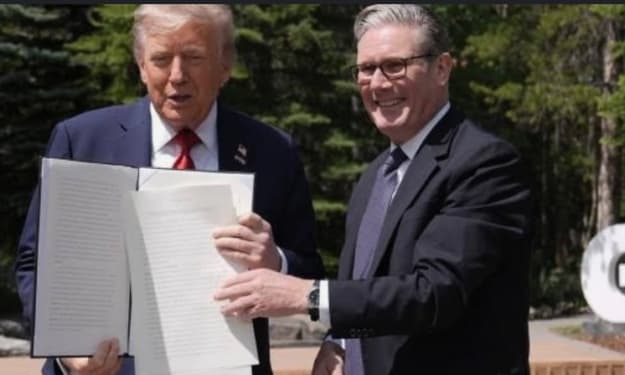
Donald Trump signs executive order to implement US-UK trade deal
Trump signs an executive order to implement the US-UK trade agreement. A significant shift in international trade relations saw the former U.S. A new trade agreement between the United States and the United Kingdom has been put into effect by an executive order signed by President Donald Trump. After the United Kingdom leaves the European Union, the agreement, which has been in the works for years, is expected to reshape bilateral trade ties. The move by Trump signifies a return to assertive executive action in trade policy and a significant turning point in the economic landscape following Brexit. The executive order, signed during a formal ceremony attended by former administration officials, business leaders, and British dignitaries, outlines the framework for immediate implementation of key provisions within the US-UK trade agreement. The order directs the relevant federal agencies in the United States to begin implementing regulatory changes that are in line with the terms of the agreement. These changes include lowering tariffs, expanding access for British and American businesses to each other's markets, and mutual recognition of standards. Trump describes the trade agreement as "a victory for American workers, farmers, and entrepreneurs" and "a historic moment for two great nations." Trump praised the UK as a close ally and "natural partner" in his remarks, highlighting their shared values and long-standing relationship. He claimed the deal would "create thousands of jobs and strengthen our economies on both sides of the Atlantic."
By GLOBAL NEWS8 months ago in Earth
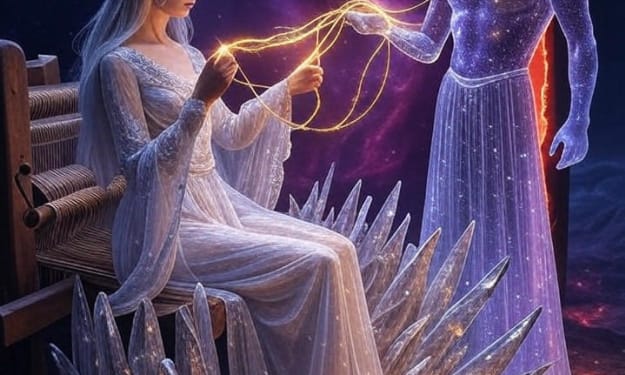
The Last Whisper of the Starweave
In the swirling heart of the Nebula Veil, where stars danced like fireflies weaving a tapestry of light, lived Sylvara, the last of the Starweavers. Her kind, once guardians of the cosmos, had faded with the Great Collapse, a cataclysm that tore the fabric of reality. Sylvara’s home was a crystalline cavern, its walls aglow with the soft hum of dying stars, and her loom—forged from comet shards—stood as a relic of a lost art. Each thread she spun was a dream harvested from the universe’s edge, each knot a prophecy woven into existence. But her hands, though skilled, trembled with the weight of solitude.One dusk, as the nebula pulsed with an eerie crimson glow, a shadow flickered at her threshold. It was a boy, no older than twelve, with eyes like twin galaxies swirling with secrets. He carried a broken thread, golden and alive, humming with a power that made the cavern tremble. “I am Kael,” he said, his voice a whisper carried on starwind. “Weave this, and save what remains.” His words held a command, yet his gaze was pleading, as if he bore a burden too vast for his small frame.Sylvara studied the thread. It burned her fingers, alive with whispers in a tongue older than the first stars. Reluctantly, she threaded it into her loom. As she worked, visions flooded her mind—worlds crumbling, skies bleeding, and a shadowed figure pulling at the universe’s seams. The thread fought her, rewriting patterns, demanding a price she feared to pay. Kael watched, silent but trembling, his presence a mystery she couldn’t unravel.Days bled into nights. The tapestry grew, a map of stars leading to a rift—a tear in the Starweave threatening to unravel all existence. Each knot Sylvara tied seared her skin; each row drained her life force. Her silver hair began to ash, her once-steady hands faltering. Kael urged her on, his voice a mix of desperation and resolve. “Finish it,” he whispered, “or everything ends.” But the thread’s whispers grew louder, revealing a truth that chilled her soul: Kael was no mere boy. He was the rift’s guardian, bound to it by a vow made eons ago, his soul torn into that golden thread to seal the tear—a sacrifice forgotten by time.Sylvara paused, her loom creaking under the strain. She faced a choice—complete the tapestry and bind Kael’s soul forever, saving the universe but dooming him, or cut the thread and let reality dissolve. Her heart ached. She had lost her people; must she lose this child too? Yet the nebula’s glow intensified, the rift widening with each hesitation. The whispers grew frantic, pleading for resolution.With a heavy sigh, she resumed weaving. The final knot was agony, a blaze of light that blinded her. The cavern shook as the tapestry flared, its golden threads stitching the rift shut. Kael’s form shimmered, his galaxy-eyes dimming as he dissolved into starlight, his last whisper a faint “Thank you.” The nebula stilled, the universe safe once more.Sylvara collapsed, her loom silent, her hands scarred but still. The tapestry glowed, a monument to Kael’s sacrifice, its patterns holding the memory of a boy who gave everything. She traced its edges, tears mixing with the ash in her hair. The Last Whisper of the Starweave was gone, but its echo lived in the stars, a silent promise kept.Outside, the nebula shimmered, its threads weaving anew, as if honoring the boy and the weaver who saved them all. Sylvara smiled faintly, knowing her final work was more than a prophecy—it was a legacy, woven into the cosmos forever.
By Muhammad Saeed8 months ago in Earth