Umair Ali Shah
Bio
Writer exploring life, truth, and human nature through words. I craft stories, essays, and reflections that aim to inspire, challenge, and connect. Every piece is a step on a shared journey of thought and emotion.
Stories (21)
Filter by community
A Light That Shone from the Soil
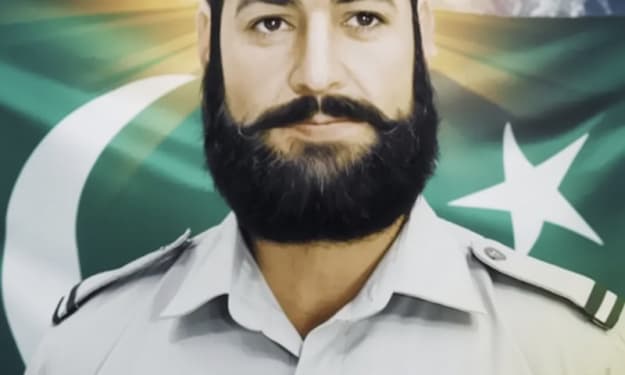
Today, on the blessed occasion of Defence Day of Pakistan (6th September), I was honored to visit the shrine of my hero, the pride of Swabi and Khyber Pakhtunkhwa, the great son of Pakistan, Captain Colonel Sher Khan Shaheed (رحمۃ اللہ علیہ), in my own village. For me, this was a matter of immense pride. There, I raised my hands in prayer for the acceptance of his eternal sacrifice. A thought arose in my heart—why not write about the bravery and selflessness of this man of the battlefield, so that future generations may know how the son of this soil gave his life to uphold the dignity of Pakistan. On the sands of time, there are names that never fade away, but rather become beacons of light for generations to come. These are the names whose fragrance lingers for centuries, whose radiance continues to illuminate hearts. Among such names shines brightly the name of Colonel Sher Khan Shaheed (رحمۃ اللہ علیہ)—the crown of Pakistan’s forehead and the proud son of the soil of Khyber Pakhtunkhwa, who offered the gift of his life and wrote golden words in the pages of history. Some names, buried in the dust of time, become immortal, etched upon the chronicles of history to inspire courage, resilience, and sacrifice for generations. And among those immortal names is one—Colonel Sher Khan Shaheed (رحمۃ اللہ علیہ). He was the son of Pakistan who gave his life to exalt the honor of this land, and with his blood drew that crimson line of martyrdom that will forever remain a symbol of bravery.
By Umair Ali Shah 5 months ago in History
Condemned by a Lie: The Ricky Jackson Story and the 43 Years That Justice Forgot
> By Umair Ali Shah Yousafzai Introduction: When Truth Becomes the First Victim What does it mean to lose not just a year or a decade, but an entire lifetime — to a lie? What happens to the human soul when it is buried alive behind concrete and steel, screaming innocence into deaf ears for 43 unrelenting years? The story of Ricky Jackson isn’t a tale told to teach children moral lessons. It is the embodiment of a real-world tragedy, where justice failed so catastrophically that even an apology decades later sounds hollow. It is not only the longest wrongful imprisonment in American history; it is the chilling dissection of a justice system that sentenced an innocent teenager to death based on the coerced testimony of a frightened 12-year-old boy. --- An Ordinary Boy in Cleveland Ricky Jackson was just 18 years old in 1975 — a quiet, thoughtful African-American youth living in Cleveland, Ohio. He had never been arrested, never carried a weapon, never even held a criminal record. He lived in a modest neighborhood, with dreams no different from other boys his age: education, work, and family. But everything changed on a day that should have passed like any other. A local businessman named Harold Franks was shot and killed in broad daylight during an apparent robbery. The incident shocked the community. In the police department’s desperation to find someone to blame, a name was offered by a 12-year-old boy who hadn’t even witnessed the murder. That name was Ricky Jackson. --- A Murder, A Lie, and A Child’s Testimony Eddie Vernon was barely out of childhood when he was approached by police and persuaded — some would say coerced — into identifying Ricky Jackson as the shooter. No physical evidence connected Ricky to the crime. No fingerprints. No murder weapon. No surveillance. Nothing but the fragile words of a frightened boy. Years later, Vernon admitted: > “I didn’t see anything. The police threatened my family, told me they’d put my parents in jail if I didn’t talk.” But in 1975, his word was gold. It was all the prosecution needed. It didn’t matter that other witnesses contradicted him. It didn’t matter that Ricky had an alibi. Vernon’s coerced statement became the scaffold on which Ricky’s fate was hung. --- The Trial: Theater of Injustice The trial was swift. No physical evidence was presented. No cross-examination of Vernon’s statement truly tested its validity. Ricky, along with two friends — Wiley and Ronnie Bridgeman — were sentenced. Ricky Jackson received the death penalty. He was 18. He had not yet attended college. He had never fallen in love. He had no children. And now, the state was going to kill him. But before the execution could be carried out, Ohio overturned the death sentence to life imprisonment. The reprieve wasn’t mercy. It was a new kind of suffering — the long, slow death of a man behind bars. --- From Death Row to Life Sentence: A Prisoner of Time For the next four decades, Ricky Jackson became a ghost within America’s prison system. He was moved from facility to facility. He missed the funerals of his parents. He never saw a computer, never used the internet, never walked into a supermarket again. He watched the world evolve through metal bars and razor wire — watched new presidents rise and fall, watched the Cold War end and 9/11 reshape history, all from within a concrete cage. But while his body was confined, his mind clung to hope. “I knew I was innocent,” he would later say in an interview with The Washington Post. “I couldn’t let go of that, or I’d go crazy.” Yet hope is not armor. It doesn’t keep out the dark. The nights were long. The guiltless solitude maddening. --- The Psychology of a Stolen Life What does 43 years in prison do to a human being? Psychologists describe wrongful imprisonment as a form of chronic trauma, similar to post-war PTSD but complicated by betrayal trauma — the deep psychic injury caused when the very institutions meant to protect you, turn against you. For Ricky Jackson, this betrayal was total. The court system. The police. The media. Even his own neighbors who believed the headlines more than his voice. Everyone walked away from him, except time — and even that, it seems, walked slower in his cell. He spent birthdays alone. Holidays watching TV news flashes from a flickering screen bolted to a prison wall. He wasn’t merely doing time — time was doing him. As he later told CBS News, > "The hardest part wasn’t the food, or the cold, or even the violence. It was waking up every day knowing that no one believed me… and wondering if they ever would.” --- 2011 – The First Crack in the Wall It took 36 years before the first sign of redemption appeared. Eddie Vernon, now in his late 40s, broke down. Years of guilt had gnawed at his conscience. Encouraged by a local pastor, Vernon came forward and admitted his testimony had been a lie — a lie told under police pressure, not malice. “I was just a scared little boy,” he said under oath. This single act of courage — the reversal of a lie — shook the very foundations of Ohio’s justice system. The case was re-opened. And finally, for the first time in 37 years, someone listened to Ricky Jackson. --- 2014 – The Day the Sky Opened On November 21, 2014, Ricky Jackson walked out of prison a free man. There were no parades. No orchestras. Just a quiet Cleveland morning, the wind soft and cold, and the silence of a man tasting sunlight after four decades. He was 61. His hair was gray. His face had aged. He was no longer the young man wronged by the system — he was a living monument to how long justice can take to arrive. When asked if he felt hatred, he simply said: > “No. If I held onto hate, I’d still be in prison. Just a different one.” --- Forgiveness Over Fury Ricky’s refusal to embrace bitterness wasn’t naïve. It was radical. His strength wasn’t forged in fury, but in faith — not religious dogma, but a deeper, spiritual belief that forgiveness is freedom. Many exonerees become bitter, angry, even broken. But Ricky stood tall. He smiled in interviews. He talked about healing. He spent time with his siblings. He walked in parks and marveled at things people take for granted — the softness of carpet, the click of a smartphone, the taste of fresh fruit. He didn’t just get released. He re-learned how to live. --- The Legal Aftermath: Can Justice Be Priced? In 2016, the state of Ohio awarded Ricky Jackson a $1 million settlement under its wrongful imprisonment compensation program. But even the government admitted — no money could truly compensate for what had been stolen. As The New York Times wrote, > “This was not just the loss of years. It was the theft of a life.” That $1 million covered lost wages, emotional trauma, and punitive damages. But how do you put a price tag on never being a husband, never raising children, never hearing your mother’s voice again? For Ricky, the money was a symbolic apology. But no amount could erase the decades of injustice. --- America’s Shame: A Broken Justice System Ricky Jackson’s case is not an isolated tragedy. According to the National Registry of Exonerations, more than 3,400 people in the United States have been exonerated since 1989 — many of them Black men, many convicted based on flawed eyewitness testimony, police misconduct, or prosecutorial overreach. A study by the Innocence Project shows that false eyewitness identification accounts for nearly 70% of wrongful convictions later overturned by DNA evidence. Ricky's case adds a horrifying statistic: He spent more time behind bars than any other wrongfully convicted person in U.S. history. His story has become a textbook case in law schools, a subject of documentaries (The Guardian, BBC, PBS), and a haunting reminder that the legal system is only as just as those who operate it. --- 🕊 The Role of the Media: Silenced Then, Shouted Now In 1975, when Ricky Jackson was first arrested, the media reported it as an open-and-shut case. Local Cleveland headlines ran with phrases like “Teen Accused in Fatal Robbery” and “Quick Arrest After Shooting”. There was no in-depth investigation. No challenge to the lack of physical evidence. No empathy for a young man with no prior record. He was Black, poor, and accused — and that was enough. It took decades for the media to revisit his story. When the truth finally emerged, national outlets like The New York Times, BBC, The Guardian, CNN, and NPR covered the injustice. Documentaries followed. Podcasts interviewed Ricky. Legal journals dissected the case. But the media was late. Too late. For 43 years, it had ignored him — and that silence was complicity. In an interview with NPR, Ricky put it plainly: > “If someone had just listened back then… really listened… maybe all of this could’ve been avoided.” The media's redemption, much like the justice system’s, came long after the damage was done. --- The Innocence Projects: Saving Lives in the Shadows Ricky Jackson owes his freedom not just to Eddie Vernon’s confession, but to the relentless efforts of organizations like the Ohio Innocence Project. These nonprofits, often underfunded and overworked, have dedicated themselves to correcting wrongful convictions through new evidence, DNA testing, and legal appeals. Without their advocacy, Ricky’s case might have remained buried — like hundreds of others still lost in legal purgatory. Their work reminds us of one chilling truth: For every Ricky Jackson who gets justice, there may be ten more who never will. --- Psychological Fallout: Life After a Life Lost (Your chosen core theme — expanded further here) The release from prison did not end Ricky’s sentence. For many exonerees, life outside is a different kind of prison. The world they return to has changed beyond recognition. Technology is baffling. Old friends are gone. Social trust is shattered. The smallest tasks — using a microwave, unlocking a smartphone — feel foreign. Ricky spoke about this in a 2017 The Atlantic feature: > “I didn’t know what a debit card was. I didn’t know how to cross the street without looking over my shoulder. Even in freedom, I felt like a prisoner.” He struggled with anxiety, depression, insomnia. Prison had reprogrammed his instincts. Freedom, once longed for, felt overwhelming. Therapists describe this as institutional PTSD — the brain’s adaptation to long-term survival in a hostile environment. Years of hyper-vigilance, suppressed emotions, and rigid routines leave permanent marks on the psyche. Yet, Ricky did not let it break him. He faced his trauma like a veteran returning from a battlefield — scarred, but not surrendered. --- Faith and the Human Spirit: A Quiet Revolution Ricky never publicly aligned with a religious denomination, but his language revealed something deeper — a spiritual resilience forged in solitude. He once said: > “When you’re in a cell alone, you start talking to yourself. But if you talk long enough, you start hearing answers. Maybe they’re your own voice. Maybe they’re God’s. But they keep you sane.” Faith — whether in God, justice, or one’s own soul — was Ricky’s companion when the world forgot him. He did not turn to hatred or revenge. He turned inward, and what he found was strength. --- When a Nation Apologizes Too Late The government of Ohio issued a formal apology to Ricky Jackson. It came with a settlement check and some public acknowledgment of its mistake. But justice delayed is justice denied. No amount of money, no legal brief, no governor’s signature can return the 15,000 days that Ricky spent confined — days when he could have been a father, a friend, a free man. As The Guardian wrote in its editorial on the case: > “The apology is polite. The injustice was barbaric.” --- Lessons for the World: Truth, Justice, and the Power of a Single Lie This story is not just American. It is universal. It speaks to every nation where power overrides truth. Where the poor are expendable. Where the law serves convenience, not conscience. Ricky Jackson’s tragedy is a mirror — held up to us all. The most terrifying thing about this case is how easy it was to ruin a life: One false witness. One negligent investigation. One rushed trial. And four decades gone. It is a warning to courts, police, media, and society at large — that truth must never be hurried, that justice must never be assumed, and that no lie is ever small when it costs a man his future. --- Final Reflections: Let No Other Ricky Jackson Be Forgotten Ricky Jackson is free now. He smiles in photographs. He speaks at schools. He mentors at-risk youth. He is trying to build a life from ashes. But behind that smile is the echo of stolen time. He is not just a man. He is a symbol. Of injustice survived. Of forgiveness chosen. Of a system that must do better. We owe him more than headlines. We owe him change. Because somewhere, right now, another 18-year-old boy sits in a cell — innocent, unheard, and condemned by a lie. May we find him before it's too late. --- 📚 References & Sources: The New York Times: “Freed After 39 Years, Ricky Jackson Reflects on Injustice” (2014) BBC News: “Wrongfully Jailed Man Free After 39 Years” (2014) The Guardian: “The Longest Wrongful Imprisonment in US History” (2015) NPR: “Ricky Jackson Speaks After 43 Years in Prison” (2016) The Atlantic: “Psychological Toll of Wrongful Convictions” (2017) Ohio Innocence Project: Legal documentation and case archive National Registry of Exonerations: Official record of U.S. wrongful convictions ---
By Umair Ali Shah 8 months ago in History
🌍 Navigating the Climate Crossroads: Urgent Call for Global Solidarity
✍️ By: Umair Ali Shah Yousafzai --- 1. Double Threat: Escalation of Extreme Weather Climate change is no longer a distant thundercloud on the horizon—it is here, loud, relentless, and devastating. From scorching heatwaves in Pakistan and India to unprecedented floods in Brazil, the frequency and intensity of extreme weather events have doubled over the past two decades. According to NASA, the Earth has just endured its hottest consecutive five-year period in recorded history. Unseasonal rains, supercharged cyclones, and extended droughts have now become the "new normal." Cities that once thrived on moderate climates are now witnessing temperatures soar past 50°C. Entire towns are being submerged in flash floods that defy all historical patterns. The planet is clearly screaming for help, yet we move forward with the same indifference that got us here. The dangerous part? These events are interconnected. Prolonged droughts parch the soil, which then leads to quicker flooding when rains finally come. Forest fires ignite more easily in overheated, dry woodlands. Every action in one part of the ecosystem echoes elsewhere—disruption is now systemic. This double threat—of rising temperatures and increasing natural disasters—is not just a meteorological issue. It is an existential one. --- 2. Polar Crisis: The Melting Alarm The Arctic and Antarctic—our planet’s cryogenic guardians—are melting faster than ever. The ice caps, which regulate Earth's temperature by reflecting sunlight, are disappearing at alarming rates. Greenland lost over 250 billion tons of ice in 2023 alone, according to recent satellite data. This isn’t just about polar bears losing their homes (though that is heartbreaking enough). Melting ice raises global sea levels, threatening low-lying nations like Bangladesh, Maldives, and even parts of New York and London. The Intergovernmental Panel on Climate Change (IPCC) warns that if global warming surpasses 2°C, many coastal cities could become uninhabitable within our lifetime. Worse still, melting permafrost releases methane—a greenhouse gas many times more potent than carbon dioxide—further accelerating the warming process. This sets off a deadly feedback loop: more warming causes more melting, which causes more greenhouse gases, and so on. The poles are like the beating heart of Earth’s climate. If the heart fails, everything else collapses. --- 3. Human Toll: Health Under Siege We often speak of climate change in abstract terms—degrees, statistics, timelines. But behind every metric is a real human life. Climate change is already affecting public health globally, and the future looks bleak if we don’t act. Heatwaves are causing heatstroke-related deaths at unprecedented levels. In 2024, over 5,000 people died in South Asia due to unbearable heat. Hospitals are overwhelmed, infrastructure buckles, and power grids fail under pressure. Vector-borne diseases like malaria, dengue, and Zika are expanding into new regions as warmer temperatures enable mosquitoes to thrive in previously unaffected areas. Respiratory problems are on the rise due to increased air pollution and wildfire smoke. Mental health issues—climate anxiety, displacement trauma, and depression—are silently creeping in as people lose their homes, livelihoods, and sense of security. The World Health Organization estimates that between 2030 and 2050, climate change will cause an additional 250,000 deaths annually from malnutrition, disease, heat stress, and other related conditions. In short, climate change is no longer just about the planet—it’s about people. About you and me. --- 4. Food, Water & Fragility: Agriculture in Peril The soil beneath our feet is losing its resilience. Crops that once thrived in certain seasons are now withering under erratic weather conditions. In Pakistan, wheat production has seen a significant decline due to unexpected rainfalls and temperature shifts. Globally, climate change is shifting rainfall patterns, increasing evaporation rates, and exhausting underground water reservoirs. The result? Water scarcity is becoming the next big crisis. Cities like Cape Town, Chennai, and even Los Angeles have faced 'Day Zero' threats where running out of water becomes a real possibility. In Africa, maize and millet crops are failing. In the Middle East, irrigation is collapsing under relentless droughts. In Europe, olive groves are drying. The chain is long, and the cracks are everywhere. And let’s not forget the oceans. Rising temperatures and acidification are killing coral reefs—the nurseries of marine life. Fisheries are collapsing. Millions who rely on seafood for protein and employment are now facing famine and poverty. Climate change is eating away at our food and water security. And once these two fall, civilization itself is at risk. --- 5. Climate Inequality: A Social Crisis Here lies one of the most unjust realities of climate change: those who contribute the least to global warming suffer the most. Developed nations—the historic polluters—have the means to adapt, invest in infrastructure, and escape the worst effects. Meanwhile, poorer nations in the Global South are left to drown, burn, and starve. A farmer in rural Sindh loses his crop due to drought, a fisherman in Bangladesh sees his village swallowed by the sea, a mother in Sudan watches her child waste away from dehydration—all while nations responsible for this chaos continue with "business as usual." Women and children, indigenous communities, refugees, and low-income families are disproportionately impacted. Access to clean air, safe drinking water, healthcare, and even shade becomes a matter of privilege. This is not just a climate crisis—it is a justice crisis. And until we frame it as such, solutions will continue to serve the few, while ignoring the many. --- 6. Justice and Governance: The Path Forward So what now? Are we doomed to ride this burning chariot to oblivion? Not yet. The Paris Agreement, COP summits, climate strikes, green technologies, and youth activism all offer glimmers of hope. But pledges alone won’t save us. We need binding laws, carbon taxes, green incentives, and above all, political will. We must redefine progress. GDP cannot be the sole measure of success when it thrives at the expense of forests, rivers, and breathable air. We need a paradigm shift—from exploitation to regeneration, from profit to preservation. Governments must commit to 100% renewable energy, halt deforestation, and invest in resilient infrastructure. Industries must embrace circular economies, zero-waste policies, and sustainable practices. And individuals—you and I—must change our habits: consume less, plant more, waste nothing. Time is the most valuable currency we have left. Let’s not spend it sleeping. --- 🌿 Planting Hope: A Moral Wake-Up Call for Humanity --- There are moments in history when a single voice becomes a forest, when a single step becomes a road, and when a single act of kindness blooms into a generation of healing. This is one of those moments. Humanity is standing on the edge of a cliff. Beneath us lies an abyss of ecological collapse, above us floats a sky choked with smoke, and around us burn the fields that once fed our children. What now? We must return. Return not just to our lands, but to our soul. To the ancient covenant we once had with nature: You will protect us with your rain and shade, and we will guard you with our gratitude and restraint. But we broke that covenant. We cut down the trees that gave us oxygen. We poisoned the rivers that quenched our thirst. We hunted the animals that balanced the earth. And now, in our blind hunger, we are eating away at our own survival. So here is the call—not from a politician or a scientist—but from a fellow human who still believes in the power of repentance. --- 🌱 Plant a Tree: Plant a Prayer A tree is not just wood. It is a miracle in slow motion. It is a servant of the earth—absorbing carbon dioxide, releasing life-giving oxygen, providing shade, anchoring the soil, feeding insects, birds, and beasts. When you plant a tree, you’re not just sowing leaves—you are planting patience, protection, and prayer. Let every child plant a tree. Let every school celebrate “Green Day” not with balloons, but with soil under their nails. Let every village and city declare: “We owe the earth, not the other way around.” If every human on this planet plants just two trees a year, we will have 16 billion trees in a decade. That’s not just possible—it’s powerful. --- 🪵 Stop Cutting: The Chainsaw is the Axe of Doom Every time a healthy tree falls, a silent scream goes unheard. We must outlaw unnecessary deforestation—not just in paper, but in action. Governments must enforce bans on illegal logging. But even you and I have a responsibility: Don't buy furniture made of rare or rainforest woods. Reuse paper, go digital where possible. Support companies that protect forests, not destroy them. Think before you chop. Think long. Because when the last tree falls, so will the last breath of clean air. --- 🐦 Feed the Birds, Water the Earth In this hot, dry summer, a bowl of water outside your door could be the difference between life and death—for a sparrow, a squirrel, a bee. Let’s teach our children compassion through action. Let them see a bird drink water from a clay pot and understand: kindness creates ecosystems. The Prophet Muhammad ﷺ taught us that even giving water to a thirsty dog is a rewardable act in the eyes of Allah. Are we not capable of more? Place water pots on rooftops, outside shops, on your balcony. Place food near trees. Let the earth know that we still care. --- 💚 Green is the Colour of Life—and Faith Green is not just the color of plants—it is the color of paradise, peace, and promise. In Islam, planting a tree is sadaqah jariyah—a charity that keeps rewarding you even after you leave this world. Every shade it gives, every fruit it bears, every bird it shelters—your book of deeds grows heavier in your favor. In Christianity, too, the tree is a symbol of resurrection and eternal life. In Buddhism, enlightenment was found under a tree. In all faiths, the message is the same: "Protect nature, and you protect your soul." So whether you believe in heaven or science or both, planting a tree is your stairway to a better future. --- ✨ Let’s Be the Generation That Returned Not the one that invented weapons of mass destruction. Not the one that drowned cities and burned forests. But the generation that said: "Enough." "We will walk back. We will rebuild." Let’s teach in our schools that trees are older than kings, kinder than armies, and wiser than policies. Let’s revive village traditions where planting trees was a rite of passage. Let’s reward farmers who grow food sustainably. Let’s cherish poets who write about rivers and children who ask why the sky looks sad. We are not powerless. We are planted with purpose. And that purpose is to coexist. --- 🌍 Conclusion: A Message from the Soil to the Soul Dear reader, If your hands can hold a smartphone, they can also hold a sapling. If your voice can post on social media, it can also call your community to action. And if your heart can feel pain when your child falls sick, it should feel the same for a tree that withers. Let’s not wait for others. Let you and I be the change. From the mountains of Swat to the deserts of Thar, from the canals of Punjab to the forests of Sindh, let Pakistan bloom again—and the world with it. Water the earth with your mercy. Guard the trees with your presence. Speak to the skies with your deeds. And maybe—just maybe—the earth will smile again. --- ✍️ Written with hope and humility, By: Umair Ali Shah Yousafzai --- #weather #nature #sky #clouds #photography #rain #photooftheday #love #beautiful #instagood #sun #summer #sunset #naturephotography #storm #travel #winter #instagram #landscape #snow #sunrise #beauty #light #rainyday #green #beach #cloudporn #flowers #cold #cloud#climatechange #environment #sustainability #nature #climateaction #globalwarming #climatecrisis #savetheplanet #ecofriendly #climate #zerowaste #sustainable #gogreen #earth #climatechangeisreal #sustainableliving #plasticfree #green #climatejustice #climateemergency #recycle #pollution #renewableenergy #conservation #eco #vegan #cop #biodiversity #climatestrike #water
By Umair Ali Shah 9 months ago in Earth
Every Day Is Theirs: A Heart’s Tribute to Our Parents Beyond One Day
✍️ By: Umair Ali Shah Yousafzai --- 🌸 Introduction: The Problem with “One Day” In an age where love has been reduced to emojis and celebrations are confined to trending hashtags, it’s become common to see people dedicate just one day a year to their parents — usually in the form of a well-edited photo, a generic social media caption, or a short video clip. "Happy Parents’ Day!" they declare, and with that, consider their duty fulfilled. But can one day capture the essence of lifelong sacrifice? Can a Facebook status outweigh a mother’s sleepless nights? Can an Instagram reel compensate for a father’s decades of toil? The answer — spoken by the heart — is a resounding no. Parents are not a seasonal celebration. They are the soul of our lives. They do not deserve a day; they deserve our every day, our every breath, our every success, our every prayer. --- 🕊️ A Love Beyond Comprehension Parental love is not poetic — it is prophetic. The mother’s womb becomes a sanctuary before we even open our eyes. Her body breaks to give us life. Her nights shatter so our dreams can form. Her meals go cold so ours stay warm. She becomes our shadow, our comfort, our shield. And the father? He becomes the silent mountain who absorbs the storm before it reaches us. He ages behind the curtain so we can grow on stage. His shoes wear thin so ours stay new. His pockets empty so our dreams can fill. His hands become rough while ours remain soft. Such love cannot be compared. It cannot be counted, priced, or postponed. It is as eternal as the sky — silent but all-encompassing. --- 🏠 From Cradle to Grave: They Gave Us Everything The truth is simple and painful: the very people who gave us everything, we give them the least. They carried us when we were weak. They taught us to walk, to speak, to eat. They encouraged our smallest achievements and bore our greatest failures. They forgave our rebellion, our rudeness, our rejection. They kept loving even when we didn’t love back. And what did they ask for in return? Nothing — except a little time. A little respect. A little remembrance. And yet, many of us fail even in that. --- 📅 One Day is Not Enough — It’s Almost Insulting Designating one day for parents is, in many ways, an insult wrapped in sentimentality. It suggests that gratitude can be scheduled, that love can be timed, that sacrifice can be acknowledged only when it's convenient. Do parents love only once a year? Do they support us only on Sundays? Do they pray for us only during exam season? No. Their love is relentless, their loyalty unconditional, their prayers eternal. Then how dare we give them just a day? --- 🕯️ Real-Life Reflections: Forgotten Candles of Our Lives Visit an old age home and you will see forgotten candles flickering dimly, waiting for someone to relight their flames. Mothers who once carried their children now carry loneliness. Fathers who once stood tall now sit silently by windows, hoping someone might knock on the door. "I gave him everything," says one mother, staring into her fading memories. "And now he sends money, but not himself." What do we owe them? Not riches. Not luxury. We owe them presence. We owe them honor. We owe them time. And if we fail to pay that debt in life, we will spend the rest of our lives repaying it in guilt. --- 🌙 The Islamic Perspective: A Duty, Not a Favor In Islam, honoring one's parents is not optional. It is second only to worshipping Allah. The Qur’an places “being good to parents” immediately after “worship none but Allah” (Surah Al-Isra, 17:23). > “And lower to them the wing of humility out of mercy and say: ‘My Lord, have mercy upon them as they brought me up [when I was] small.’” — (Qur’an 17:24)
By Umair Ali Shah 9 months ago in Chapters
2025 India-Pakistan War: Nuclear Tensions, Drone Strikes & Global Concerns
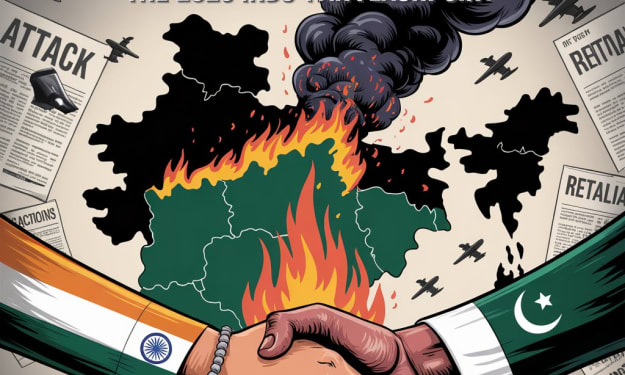
The 2025 India-Pakistan War: A Chronicle of Escalation, Misrepresentation, and Human Suffering Introduction: A Spark Ignited into a BlazeThe long-standing tensions between India and Pakistan flared into open conflict once again in early 2025, marking one of the most dangerous military confrontations in South Asia since the Kargil War of 1999. Though diplomatic channels existed, the failure of backdoor negotiations, escalations on the Line of Control, and cross-border skirmishes rapidly spiraled into a full-blown war. Both nations, armed with powerful conventional and nuclear forces, have now plunged into a dangerously volatile phase with high civilian casualties and a complete breakdown of bilateral trust. A Timeline of Escalations: From Border Skirmishes to Full-Scale Airstrikes The conflict began with intense artillery exchanges across the Line of Control (LoC) in January 2025. Indian forces accused Pakistan of harboring militants involved in attacks on Indian military installations in Jammu and Kashmir. In response, Pakistan denied the allegations and accused India of fabricating justifications for cross-border aggression. By February 2025, India launched multiple airstrikes, claiming to target terror camps in Pakistan-administered Kashmir and deeper into Pakistan’s Punjab and Khyber Pakhtunkhwa provinces. However, independent sources and on-ground reports revealed that the targets were not militant hideouts but civilian areas. The most alarming attack took place in the city of Bhakkar, where missiles struck a crowded mosque during Friday prayers, killing at least 58 civilians and injuring over 100. India's official statement referred to the site as a "radical training compound," but satellite imagery and third-party assessments confirmed that the location had no military significance. In retaliation, Pakistan launched a series of precision strikes on Indian army bunkers along the LoC and deep into Indian territory in Rajasthan and Punjab. The Pakistani government maintained that all its operations were strictly military in nature, targeting ammunition depots, radar installations, and logistic hubs. The False Narrative of 'Counter-Terrorism': India’s Claim vs. Ground Reality One of the most disturbing aspects of this conflict has been the dissemination of misleading narratives. India has consistently claimed that its airstrikes and missile attacks are aimed at "neutralizing terrorist threats." However, detailed independent investigations by international observers, including UN satellite surveillance teams and journalists from neutral countries, contradict this claim. The village of Kot Azam in South Punjab was obliterated by an Indian missile on March 3rd. Indian media stated it was a hub of Lashkar-e-Taiba operatives, yet the only buildings destroyed were a government school, a maternity clinic, and residential homes. Of the 39 casualties, 21 were women and children. This pattern repeats across multiple strike zones: Charsadda, Faisalabad outskirts, and even a refugee camp in Tharparkar, where hundreds of displaced Kashmiris were temporarily housed. India has refused to allow foreign journalists into the targeted areas under its control, raising further questions about the credibility of its public statements. Conversely, Pakistan has facilitated limited access to global media and aid organizations, albeit under military escort, showing scenes of widespread devastation in civilian zones. A Section Without Headings: The Faces Behind the Statistics The impact of this war cannot be measured solely in numbers or strategic gains. Beyond the military movements and political declarations lies a human catastrophe that both governments have failed to adequately address. In the narrow lanes of Chakwal, where a missile hit a religious seminary, the remains of children’s books, blood-stained prayer rugs, and shattered windows tell a tale that no press release can capture. Twelve children under the age of ten were killed, along with their teacher. Their parents now sit beside the rubble in silent mourning, the sound of jet engines overhead reminding them that peace is nowhere in sight. In Umerkot, where a convoy of Indian missiles hit a rural farming community, farmers who had never seen a gun in their lives now bury their dead in fields once ripe with wheat. "They said there were terrorists among us," says an elderly man who lost three grandsons. "But the only thing we were growing was grain, not hatred." Meanwhile, in Amritsar, an Indian army base was targeted by Pakistani drones. A young Indian soldier, who had just returned from leave, was among the dead. His brother, speaking to media in a hushed voice, said, “He never wanted war. He was just doing his duty.” These are not stories of enemy combatants; they are stories of sons and daughters, mothers and fathers, who are casualties in a war waged over narratives and power, not justice or survival. The Role of International Community: Silent Spectators or Strategic Players? The United Nations, despite urgent calls from both governments, has largely limited its involvement to issuing appeals for restraint. China and Russia have taken neutral stances publicly but are reportedly engaged in secret diplomacy with both sides. The United States has shown vocal support for India in its public statements, referring to India’s “right to self-defense,” but has privately expressed concern over the credibility of the intelligence guiding India’s strikes. Iran and Turkey have condemned Indian aggression, particularly highlighting the attacks on mosques and civilian homes. On the other hand, the European Union has proposed the formation of a South Asian Peace Commission to monitor the conflict and negotiate a ceasefire, though the proposal remains unapproved by both New Delhi and Islamabad. Pakistan’s Strategic and Moral Positioning in the Conflict Pakistan has tried to maintain a defensive posture, emphasizing sovereignty and protection of its population rather than seeking territorial gain. Prime Minister Shehbaz Sharif, in his address to the nation, declared, “We do not seek war, but we will not let injustice befall our people without consequence.” He further stressed the importance of unity, media integrity, and national resilience. Pakistan’s military strategy has so far avoided densely populated Indian cities, instead focusing on military logistics and air bases. Analysts suggest that Pakistan’s deliberate avoidance of civilian targets may serve to bolster its international legitimacy and moral standing. The Propaganda War: Misinformation, Digital Chaos, and Media Blackouts Another dimension of this war is being fought online. Social media platforms have become battlegrounds for misinformation, doctored videos, and psychological warfare. Indian state media has repeatedly aired footage of alleged terror compounds that upon scrutiny were either outdated, misrepresented, or entirely fictional. On the Pakistani side, national channels have focused on humanitarian tragedies, but sometimes exaggerated figures have raised concerns about factual accuracy. Internet blackouts in Kashmir, Punjab, and parts of Sindh have further clouded the ability of citizens to communicate or report events firsthand. The manipulation of information, suppression of voices, and the use of media to fuel public anger pose a long-term threat even greater than military casualties—eroding trust, fueling nationalism, and obstructing future peace.
By Umair Ali Shah 10 months ago in Chapters
A Heartfelt Plea: Nurturing Voiceless Creatures in the Summer Heat
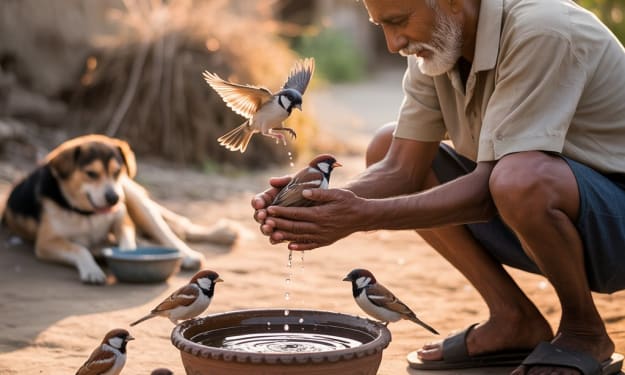
**A Compassionate Call to Care for Voiceless Creatures: Supporting Birds and Animals in the Scorching Heat** The image before us paints a heartwarming scene that speaks volumes about compassion, empathy, and humanity. An elderly man, dressed in traditional attire, kneels beside a water tap, gently holding a small metal container as water flows into it. Around him, small sparrows gather—some perched on his shoulder, others drinking from the container, and a few splashing in the tiny puddle formed on the ground. The setting is simple, rustic, with a mud wall and a bucket nearby, yet the message it conveys is profound and universal. In the sweltering heat of summer, when the sun blazes mercilessly, this image serves as a reminder of our duty to care for the voiceless creatures around us—birds and animals who suffer silently and depend on us for their survival.
By Umair Ali Shah 10 months ago in Earth
Beneath the Façade: Emotional Deception and the Illusion of Love in University Corridors
Introduction – A Beautiful Lie In the blossoming years of university life, where minds are expanding and dreams are taking shape, a parallel story is often unfolding quietly, tragically. It is the story of emotional deception—where the illusion of love is sold not as a promise of companionship, but as a weapon to exploit innocence. With sharpened acting skills and calculated emotions, many young men lure their female peers into relationships that begin with charm and end in desolation. Behind every rose lies a thorn, and in the corridors of many universities, these thorns pierce deeper than most wounds.
By Umair Ali Shah 10 months ago in Humans
India-Pakistan Crisis 2025: A Comprehensive Political, Economic, and Global Analysis
The April 2025 terrorist attack in Pahalgam, Kashmir, which killed 26 people—mostly Indian tourists—has triggered the most significant escalation in India-Pakistan tensions in recent years. Both nations, equipped with nuclear capabilities and a long history of conflict, have responded strongly, leading to an increasingly volatile situation. This column analyzes the crisis in political, economic, and international contexts, with an emphasis on fresh developments, stakeholder positions, and global perspectives.
By Umair Ali Shah 10 months ago in Chapters
The Age of War Must End — The Age of Humanity Must Begin
In a world boasting technological marvels, soaring skyscrapers, and instant communication, it remains a cruel irony that humanity continues to drown in the blood of senseless wars. Across continents and cultures, the cries of the innocent — children, women, and the elderly — echo louder than ever, shattering the very illusion of progress. The Ukraine-Russia war, the burning hostility between Pakistan and India, and the relentless agony of the Palestinians under Israeli occupation stand as damning evidence of international failure to protect human dignity.
By Umair Ali Shah 10 months ago in Chapters
The India-Pakistan War of 2025: A Dangerous Escalation and its Global Implications
Introduction The conflict between India and Pakistan has been one of the most persistent and perilous geopolitical struggles of the modern era. Despite multiple ceasefires and attempts at diplomacy, the relationship between these two nuclear-armed neighbors has been fraught with tension and conflict. The year 2025 marks a significant chapter in this long history, as both nations find themselves on the brink of war once again. The catalyst for this dramatic escalation was a deadly terrorist attack on April 22, 2025, in the Indian-administered region of Jammu and Kashmir, which has sparked a series of retaliatory military and diplomatic measures.
By Umair Ali Shah 10 months ago in Chapters
Indus Waters Treaty (IWT): Pakistan vs India – What it is, how it worked, and why it has just broken down
TABLE OF CONTENTS 1. Introduction: A Lifeline Turns into a Fault‑Line 2. Genesis of the Treaty (1947‑1960) 3. The East–West Allocation: Engineering Diplomacy into a River 4. How the Machinery Ran for Six Decades 5. Dam Wars and Legal Battlefields (1990‑2024) 6. The April 24 2025 Shock: India Presses the “Suspend” Button 7. Technical Fallout: Gauges, Gates, and Growing Uncertainty 8. Food Security, Energy Dreams, and Climate Stress 9. International Law, the World Bank, and Precedent Risk 10. Scenarios for 2030: From Renegotiation to Runaway Rivalry 11. Conclusion: Can a Hydrological Truce Survive Geopolitics?
By Umair Ali Shah 10 months ago in Writers
The Security Dilemma: Challenges in Khyber Pakhtunkhwa
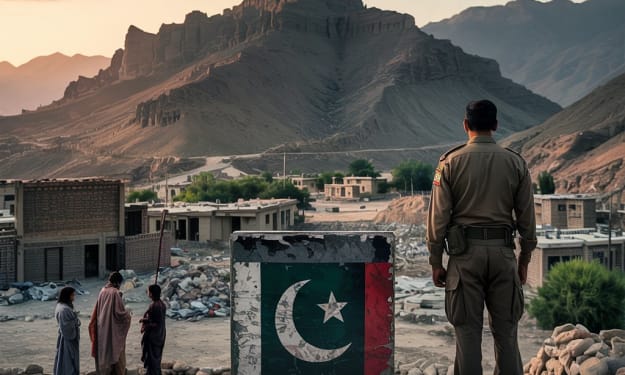
Khyber Pakhtunkhwa (KP), once known as the frontier province, has been at the epicenter of Pakistan's battle with militancy, extremism, and insurgency. The region’s security challenges are not just a matter of political discourse but have profound implications for the future of Pakistan itself. With its proximity to Afghanistan, the porous border, and a long history of regional and ethnic complexities, Khyber Pakhtunkhwa’s security dilemma is a microcosm of the larger global struggle against terrorism and extremism.
By Umair Ali Shah 11 months ago in Chapters