
Deep Beneath The Waves Lies A Whale That Should Be Gone, But It’s Still There, Preserved Like A Time Capsule
And it's not just one, researchers have found several over the years

Some discoveries don’t just challenge science, they haunt it.
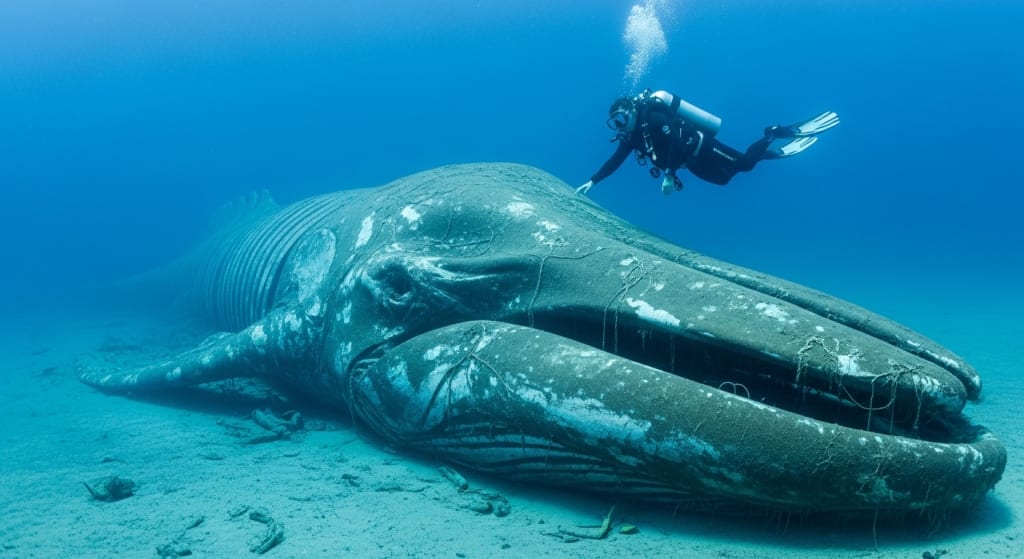
Thousands of feet below the ocean’s surface, far beyond the reach of sunlight and sound, a massive whale lies still. Not as bones. Not as a fossil. But skin wrapped over muscle, intact. Frozen in time. It’s been there for years, untouched. And here’s where it gets even stranger — there are more like it.
We’re not talking about legends or theories. These preserved giants are real, and marine biologists have documented their existence. They call them mummified whale falls, and they're changing the way scientists understand death, decomposition, and deep-sea life.
🌊 The Ocean Doesn’t Always Let Go
When most whales die, their bodies become a full-on buffet. Sharks, hagfish, sleeper sharks, crabs, bone-eating worms — all of them tear through the remains, stripping the bones clean in just weeks. But once in a while, something else happens.
The whale sinks, and nothing touches it.
In parts of the Pacific Ocean, especially near Monterey Canyon and the Southern California Bight, researchers using deep-sea robots have found massive whales lying motionless at depths of over 3,000 meters. They aren’t rotting. They aren’t eaten. They’re just… resting there. Their thick skin leathery but intact, their shape still clearly whale. Some are blue whales. Some are fin whales. All of them are preserved far longer than anyone ever thought possible.

❄️ Nature Presses Pause
What makes these bodies stay preserved?
It’s not a miracle. It’s extreme science.
At such crushing depths, the water is nearly freezing. Oxygen levels are so low that bacteria can barely function. And without those bacteria or scavengers, the whale’s body stays sealed in silence. Researchers believe the outer layers dry up fast enough to act like armor, keeping the rest of the body untouched. It’s almost like nature created a vacuum, halting everything inside.
One of the most shocking discoveries came from a whale that had been tracked for over seven years by the Monterey Bay Aquarium Research Institute. Every single visit showed the same thing. Skin still on. Body still there. Year after year.
This isn’t just about one body. Several mummified whale falls have been found in oceans around the world. Some rest untouched for nearly a decade. It’s not rare anymore. It’s a pattern.
🐋 Death Doesn’t Always Mean Decay
Whales that decay quickly often leave behind only bones. But in this case, the ocean turns them into time capsules. Entire bodies preserved for years — no predators, no erosion, just cold, pressure, and stillness.
It’s hard not to be moved by the thought. These were giants in life. And even in death, the ocean treats them with a kind of strange respect. They sink slowly to the seafloor and stay there, preserved like forgotten kings in underwater tombs.
But this preservation doesn’t last forever. Eventually, the armor breaks. And when it does, all the creatures that have waited in the shadows rush in. It becomes a feeding ground again. Life resumes. But only after years of complete silence.
📊 Why It Actually Matters
This goes far beyond being a strange ocean discovery, it holds serious weight in the world of science.
Preserved whale falls slow down the release of nutrients into the deep sea. That changes how marine ecosystems behave. It affects how species grow, migrate, and feed. It even impacts our understanding of oceanic carbon cycling, which ties directly to climate studies.
By studying these whale mummies, scientists are getting rare insights into deep-sea environments that barely anyone has touched. It also helps in finding new species, especially those that survive only around whale carcasses. Osedax worms, for example, were first discovered living on whale bones in the deep — they digest bones using acid and bacteria inside their bodies.
These discoveries reshape how we map marine life, how we track the health of the ocean, and how we respond to environmental change.
🔍 The Deep Sea Still Keeps Its Secrets
Every preserved whale body discovered raises more questions. Why do some rot while others don’t? Is it about the whale species? The ocean currents? The exact depth or position?
NOAA estimates that more than 80 percent of the ocean remains unmapped, unexplored, and unseen by humans. That means countless whale mummies could be out there right now, resting silently on the seafloor — undiscovered, untouched, and waiting.
These aren’t ancient fossils. They’re modern-day mysteries. And they’re proof that the deepest parts of our planet still hold stories we haven’t even begun to understand.
Whale falls are more than just marine biology topics. They reveal how little we truly know about our own world. When something as massive and obvious as a 100-foot whale can die and remain hidden for years without a trace — until a robot stumbles across it — that should make us pause. Because what else is down there, breathing in silence?
About the Creator
Ojo
🔍 I explore anything that matters—because the best discoveries don’t fit into a box...
Milo Manheim
Milo Manheim has steadily built a reputation as one of Disney’s most recognizable young stars, thanks to his charm, musical talent, and approachable screen presence. Known widely for his breakout role in Disney Channel’s Zombies franchise, Manheim has now found himself at the center of online discussions surrounding Disney’s ambitious slate of live-action adaptations. Among these, the idea of a Tangled live action film has sparked intense fan curiosity, with Milo Manheim frequently mentioned in speculative casting conversations. While Disney has not officially confirmed every detail, the growing buzz around a Disney Tangled live action project reflects the enduring popularity of the animated classic and the excitement surrounding its potential cast. Milo Manheim’s Rise in Disney Entertainment Milo Manheim entered the spotlight with a natural ease that made him instantly relatable to younger audiences. As the son of actress Camryn Manheim, he inherited a strong foundation in performance, but his success has been distinctly his own. His work blends humor, sincerity, and musical confidence—qualities that align closely with Disney’s storytelling style. Beyond Disney Channel films, Manheim has expanded his range through stage performances and competitive television, proving he is more than a one-note actor. This versatility is one reason his name continues to appear in conversations about major Disney roles, including speculation around Tangled. Why Tangled Remains a Perfect Live-Action Candidate Released in 2010, Tangled reimagined the story of Rapunzel with humor, heart, and stunning animation. Over a decade later, it remains one of Disney’s most beloved modern fairy tales. The blend of adventure, romance, and self-discovery makes it especially suited for a live-action retelling. A live action Tangled film would follow Disney’s recent trend of revisiting animated favorites, offering a more grounded visual style while preserving the emotional core of the original. Fans are particularly interested in how the tangled live action cast would bring iconic characters to life, especially Rapunzel and Flynn Rider. Milo Manheim and the Flynn Rider Conversation One of the most common fan-driven theories places Milo Manheim in the role of Flynn Rider. The character’s mix of roguish confidence and underlying vulnerability aligns well with Manheim’s on-screen persona. Flynn Rider is not a traditional prince—he’s witty, flawed, and ultimately sincere, traits that Manheim has demonstrated across his performances. While Disney has not confirmed casting details, the speculation alone highlights how strongly audiences associate Manheim with roles that require both charisma and emotional depth. If chosen, he would join the broader tangled cast legacy that fans already adore. Rapunzel Live Action Casting Speculation Just as much attention surrounds the potential rapunzel live action cast. Rapunzel is a character defined by curiosity, resilience, and warmth, making her one of Disney’s most relatable heroines. Recently, online discussions have connected actress Teagan Croft to the role, leading to widespread interest in teagan croft tangled fan concepts. Croft, known for her compelling performances, brings a balance of strength and sensitivity that could translate well to a rapunzel live action portrayal. Interest in teagan croft movies and tv shows has grown alongside these casting rumors, as audiences imagine how she might embody the iconic princess. Building the Disney Tangled Live Action Cast A successful disney tangled cast live action would rely on chemistry as much as individual talent. Rapunzel and Flynn Rider’s relationship is central to the story, evolving from mistrust to mutual respect and love. Casting actors who can convincingly portray that journey will be key. Beyond the leads, characters like Mother Gothel and the supporting ensemble would also shape the film’s tone. Disney’s challenge lies in honoring the animated original while allowing actors to bring fresh interpretations. This balance has defined the success—or failure—of past live-action adaptations. The Importance of Staying True to the Story One reason Tangled has endured is its emotional honesty. At its heart, the film is about freedom, identity, and the courage to step into the unknown. A disney tangled live action adaptation must preserve these themes while adapting them for a new visual medium. Fans aren’t simply looking for a scene-by-scene remake; they want a story that feels familiar yet alive. With the right creative team and casting choices, the transition from animation to live action could deepen the emotional impact rather than dilute it. Milo Manheim’s Future Beyond Speculation Whether or not Milo Manheim becomes officially linked to tangled live action, the speculation itself reflects his growing influence in the industry. He represents a generation of actors shaped by Disney but not limited by it. His career choices suggest a desire to explore diverse roles while staying connected to the audience that supported his rise. As Disney continues to develop its live-action portfolio, actors like Manheim remain central to the conversation—not because of confirmed roles, but because audiences can already imagine them stepping into iconic characters. A Story Fans Are Ready to Revisit The excitement surrounding tangled live action cast discussions shows just how deeply the story still resonates. Rapunzel’s journey, Flynn Rider’s transformation, and the vibrant world of Tangled continue to inspire new generations of viewers. If and when Disney officially unveils its plans, the anticipation will only grow. Until then, the combination of Milo Manheim’s rising star power and the enduring magic of Tangled keeps fans engaged, hopeful, and eager to see how this beloved fairy tale might shine in live action.
By Saboor Brohi 3 days ago in Earth
Day Will Turn to Night: Astronomers Officially Confirm the Date of the Longest Solar Eclipse of the Century
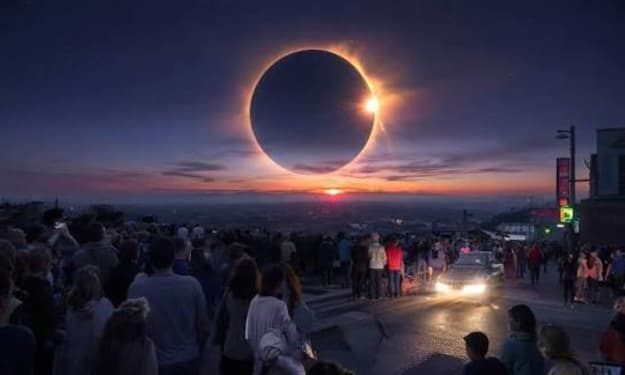
For stargazers, astronomers, and casual skywatchers alike, 2026 promises an astronomical event that will be remembered for a lifetime. Scientists have officially confirmed the date of the longest solar eclipse of the 21st century, a celestial phenomenon that will turn day into night for several minutes across parts of the globe. The announcement has sent excitement rippling through the scientific community and among enthusiasts who have long awaited a solar spectacle of this magnitude. The Science Behind the Eclipse A solar eclipse occurs when the Moon passes between the Earth and the Sun, casting a shadow on our planet and temporarily blocking the Sun’s light. While solar eclipses happen somewhere on Earth approximately every 18 months, total eclipses—where the Sun is completely obscured by the Moon—are far less common. What sets the 2026 eclipse apart is its duration. Astronomers predict that the eclipse will last for over six minutes in its longest phase, making it the longest total solar eclipse of the century. The phenomenon is a result of the precise alignment of the Sun, Moon, and Earth, as well as the Moon’s elliptical orbit, which causes slight variations in apparent size. Dr. Elena Morales, an astrophysicist at the European Southern Observatory, explains: "This eclipse is remarkable not just for its length but for its visibility. For several regions, the Sun will disappear completely, creating a surreal twilight in the middle of the day. It's an excellent opportunity to study the Sun’s corona, which is usually obscured by its brightness." Where and When to Watch The path of totality—the narrow band where the eclipse will be fully visible—stretches across several countries, including parts of the Arctic, Greenland, Iceland, and Spain. Millions of people living along this corridor will experience the full majesty of the eclipse, while a partial eclipse will be visible across much of Europe, northern Africa, and North America. Astronomers recommend planning travel in advance, as areas within the path of totality are expected to see a significant influx of visitors. Hotels, camping grounds, and viewing points are already reporting high demand, as enthusiasts from around the world seek to witness the once-in-a-lifetime event. Safety First: Protecting Your Eyes Viewing a solar eclipse can be dangerous if proper precautions are not taken. Staring directly at the Sun without specialized glasses can cause permanent eye damage. Experts emphasize the use of ISO-certified eclipse glasses or solar viewers for safe observation. Pinhole projectors, telescopes equipped with solar filters, and projection methods can also provide safe and magnified views of the eclipse. Many educational institutions and astronomical societies are planning public viewing events, combining safety with expert commentary to enhance the experience for attendees. Cultural and Scientific Significance Throughout history, solar eclipses have held deep cultural significance. Ancient civilizations often interpreted eclipses as omens or messages from the gods. Today, eclipses continue to captivate human imagination, blending scientific intrigue with awe-inspiring natural beauty. From a scientific perspective, total solar eclipses offer rare opportunities to study the Sun’s outer atmosphere, the corona, which is invisible during regular daylight. Researchers can observe solar flares, prominences, and other phenomena, gaining insights that contribute to our understanding of solar physics, space weather, and even the impact of solar activity on Earth’s climate and satellite communications. Preparing for the Experience For those planning to witness the eclipse, preparation is key. Many enthusiasts are setting up travel plans, packing eclipse glasses, cameras, and telescopes, and coordinating with local astronomy clubs for guided viewing. Timing is crucial—the totality phase, though extended in 2026, still lasts just a few minutes, making precise observation essential for both enjoyment and scientific study. Communities along the path of totality are also preparing for the influx of visitors. Local authorities are coordinating traffic management, accommodation, and public safety measures to ensure that the event remains enjoyable and safe for everyone involved. A Rare and Awe-Inspiring Event The 2026 solar eclipse is more than just a scientific event; it is a once-in-a-generation experience that reminds humanity of the vastness and beauty of the cosmos. For a brief moment, day will turn to night, and millions of people across the globe will share in the wonder of the universe’s intricate dance. Whether you are a professional astronomer or a curious skywatcher, this eclipse offers an unforgettable spectacle. It’s a moment to pause, look up, and marvel at the universe—a reminder that even in our modern, digital age, the natural world continues to inspire awe and wonder. Prepare your glasses, mark your calendars, and get ready for the longest solar eclipse of the century. For those lucky enough to witness it, it will be a memory etched in time, a celestial marvel that will be talked about for decades to come.
By Fiazahmedbrohi about 10 hours ago in Earth



Comments (1)
Disclaimer: The images used in this content are for illustrative and conceptual purposes only...